The 86th edition of Passing of the Pioneers includes obituaries from February. Among them are a missionary, two men who lost sons during WW1, a teacher, and the operator of refreshment rooms in the Otways.
ARNOTT, Alfred Edward-Died 28 February 1905 at Hamilton. Alfred Arnott was born in Manchester, England around 1864 but as a child, his parents moved to Scotland. As a young person, he didn’t keep good health, and a doctor suggested he might be better suited to the Australian climate. Alfred arrived in Victoria and started work for the National Bank. He was the ledger keeper at the Hamilton branch for four years before moving to Casterton for another two years. While in Hamilton, Alfred built a strong connection with the local Presbyterian church.

He was the secretary of the church fellowship association, sang with the choir, and taught bible classes. He also had a desire for missionary work and in 1899 an opportunity came to travel to China for that reason. On 28 August 1899, Alfred left Hamilton by train with his fiancé Mary McCormack of Scarsdale. They made their way to Sydney before travelling to Shanghai to complete two years of training in preparation for missionary work.
Alfred and Mary no doubt left with the knowledge that there was growing danger for missionaries in China. In the north of the country, there was increasing dissent towards foreigners and Christianity, which culminated in what is known as the Boxer Rebellion. There were missionaries killed and by 1900, Western countries including Australia were moving troops into the area.
Mary wrote to her Hamilton church friends, telling them about the dangers they faced. One letter was sent to Elizabeth Brown, only to arrive in Hamilton the day after Elizabeth’s death at the age of 32. Catherine Anketell received a letter from Mary in October. Mary wrote she had heard from Australian friends that there were reports all of their missionary group of 1899 had been murdered, and their photos were in the newspapers.
Mary’s sources were correct. The Critic from Adelaide published a photo of the group, including Alfred and Mary, in July 1900 suggesting their demise.

Mary also wrote that Alfred was working in an accountant’s office in Shanghai. In 1901, Alfred and Mary married in China, and in 1903, a son John was born there.
In February 1904, Reverand Morton spoke at Penshurst about his missionary work in China. He used projected lantern slides to illustrate his talk. A slide of Alfred Arnott’s image was among them.
The Arnotts returned to Australia later that year. It is difficult to trace their movements although it appears Mary arrived ahead of Alfred. A report on 23 July from The Brisbane Courier mentioned Alfred was on board the SS Australian which stopped at Pinkenba, Brisbane en route to Sydney. It was said he was returning for a holiday. Meanwhile, Mary was in Hamilton on 25 August 1904, when she gave a speech at a public meeting hosted by the Hamilton branch of the Women’s Christian Temperance Union (WCTU) at the Hamilton Temperance Hall. She mentioned Alfred had returned from China to the Percy Islands off Queensland where he received instructions to go to Brisbane.
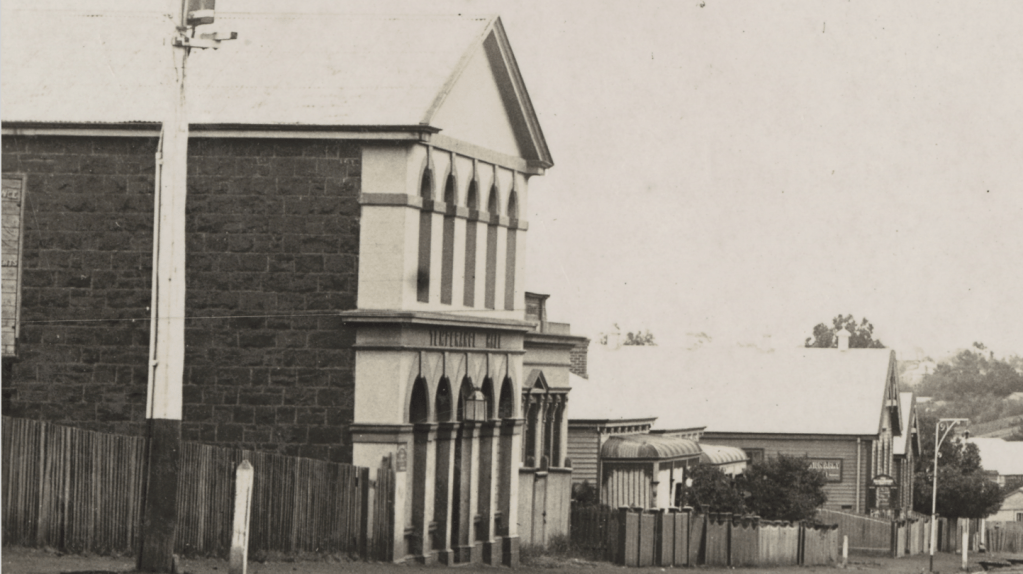
Alfred was in Sydney in early 1905 when he fell ill. His illness lingered but despite that, he wanted to fulfill his wish to return to Hamilton, the place he called home. He arrived on Saturday 25 February but on arrival at the Hamilton Railway Station, he was very weak. He was transported to the home of Martha Thomson in Gray Street where he died three days later.
In October 1905, The Express and Telegraph in Adelaide reported Mary was returning to China.
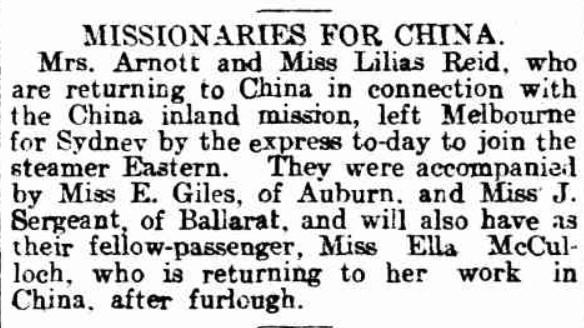
She married again to David Urquhart and they spent time living in Hawthorn. She also attended a school reunion at Scarsdale in 1918. In 1921, she suffered another loss when her and Alfred’s son John died at Hawthorn on 31 December.

John was buried with his father at the Hamilton General Cemetery.

GELLERT, Wilhelmine-Died 4 February 1909 at Croxton East. Wilhelmine Gellert was born in Prosen, Prussia (now in Poland). around 1838. She arrived in Adelaide with her family on the Hermann von Beckerath in 1847.
After a few years in South Australia, the Gellert family made their way to Victoria. In 1866, Wilhelmine married Christian Matuschka. They settled at Croxton East, near Penshurst, and went on to raise six children. Wilhelmine was buried at the nearby Tabor Cemetery.

COOKE, Sarah-Died 21 February 1915 at Mortlake. Sarah Cooke was born in Belfast, Ireland around 1822. She arrived in Victoria in the 1840s and found herself in Port Fairy where she married George Hyde in 1858. They settled in Mortlake and George worked as a bootmaker. They went on to have five children. George died in 1881. In 1914, Sarah fell and broke her thigh and was hospitalised at Warrnambool. She died the following year and was buried at the Mortlake Cemetery.
COWELL, James-Died 25 February 1917 at Mortlake. James Cowell was born in Cambridgeshire, England around 1838. He arrived in Victoria in the 1850s and from the 1860s was living in Mortlake, and working as a butcher. He then became a road contractor, taking jobs with the Mortlake Shire, remaining in that line of work until his early 1870s. When WWI broke, three of his sons enlisted, and one, Harry was killed at Gallipoli in May 1915. After the death of James, a second son Charles died from disease in England in October 1917. James Cowell was buried at the Mortlake Cemetery.
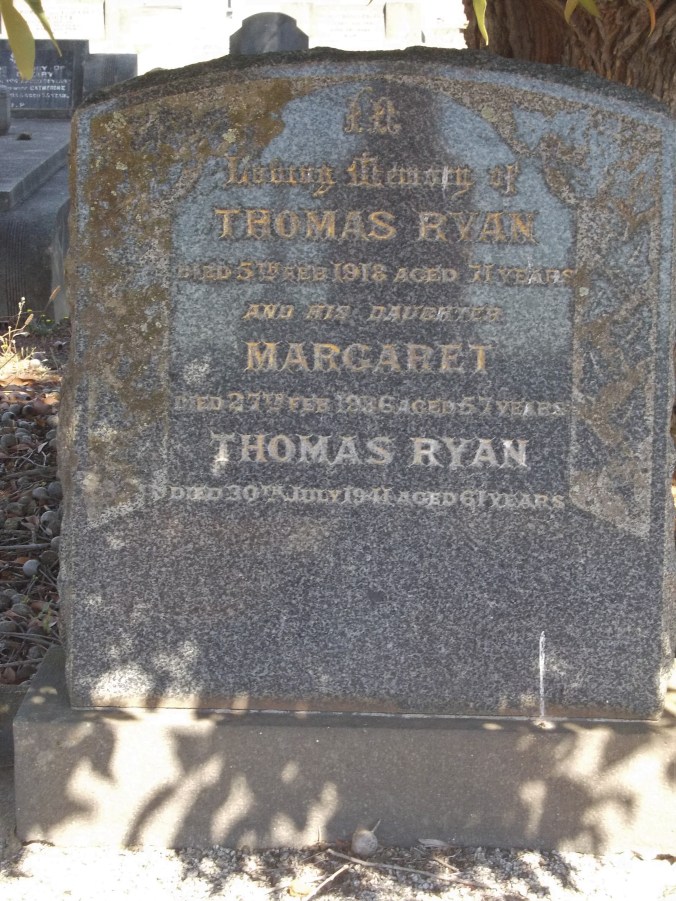
RYAN, Thomas-Died 5 February 1918 at Hamilton. Thomas Ryan was born in Tipperary, Ireland around 1837. He arrived in Victoria in the 1860s and proceeded to the Ballarat diggings. In the 1870s, he arrived in the Hamilton district and worked with Victorian Railways until retirement. In 1893, while working as a porter at the Hamilton Railway Station, he badly injured his elbow while coupling railway trucks.

Thomas was a long-time member of the Hamilton branch of the Hibernian Australasian Catholic Benefit Society (HACBS) and served in the role of president. He died in 1918, leaving two sons and two daughters. He was buried at the Hamilton General Cemetery.
CURTIS, Mary Ann-Died February 1928 at Geelong. Mary Ann Curtis was born around 1860 and spent much of her life in the Otways. She married James Granger Henderson in 1883 and they settled in the Lorne district and raised a family. Around the early 1900s, James had his leg amputated as a result of a sawmill accident.
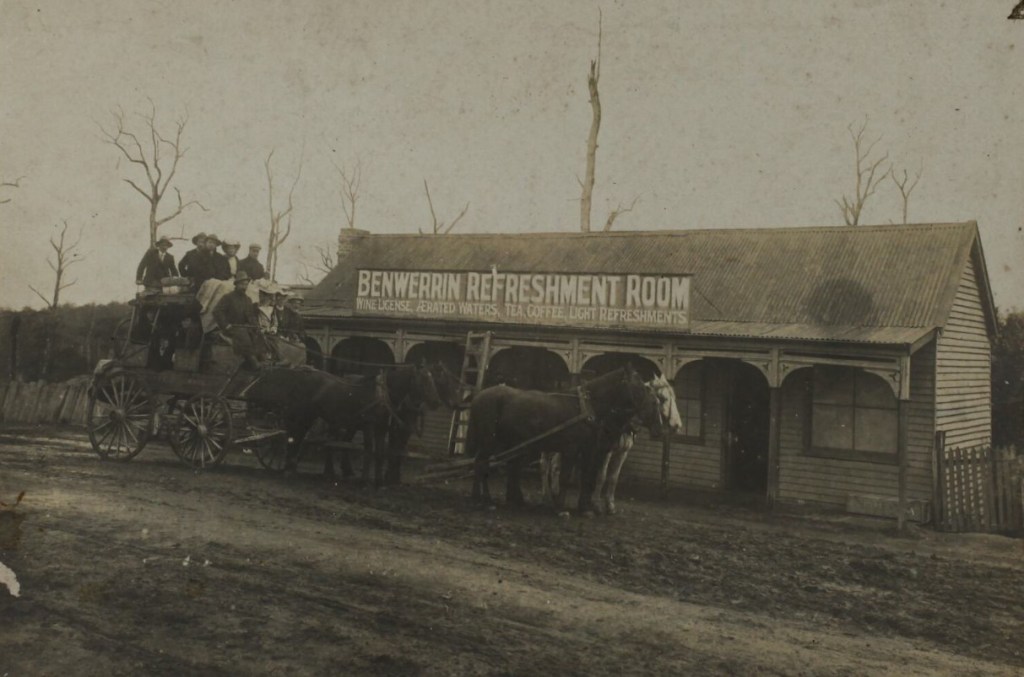
It was also in the early 1900s, the Benwerrin Post Office and Refreshment Rooms were for sale. At some point, James and Mary purchased the business.
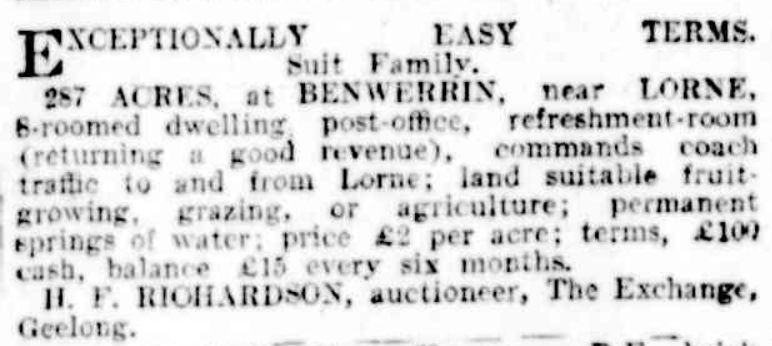
The Benwerrin Post Office, inland from Lorne, opened in 1886 and William Mountjoy was awarded the contract to run a mail coach between Birregurra and Lorne via Dean’s Marsh and Benwerrin. In 1889, the Deans Marsh Railway Station opened but a coach was still required from the station to Lorne, passing through Benwerrin. It was uphill from Deans Marsh to Benwerrin then downhill to Lorne, a trip taking about four hours. The coach stopped at the Benwerrin post office and soon refreshment rooms opened to cater to the passing tourists and proved popular to break their coach trip to Lorne.
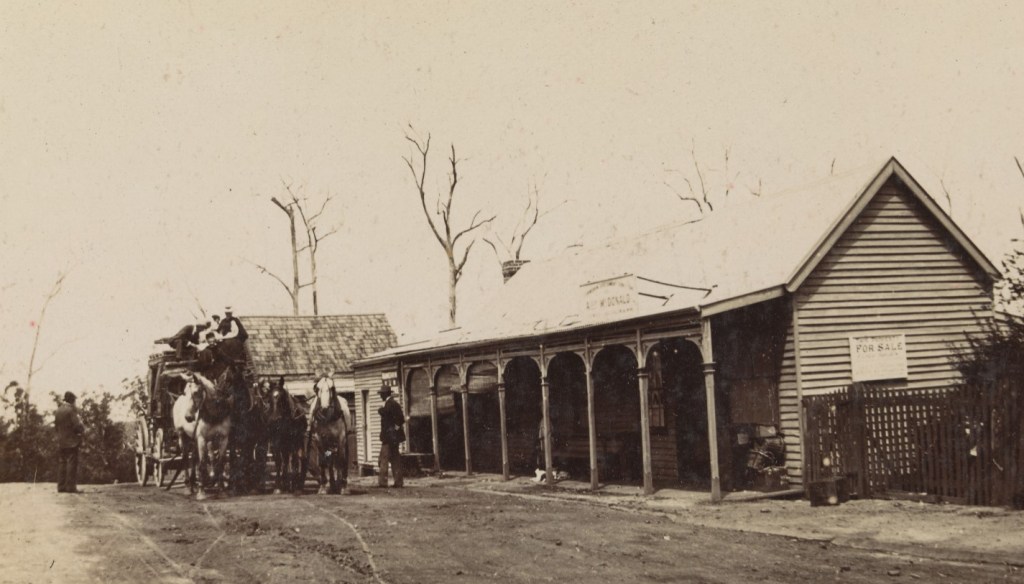
In 1906, fire swept through the district and the refreshment rooms were lucky to survive after catching fire twice. The stables and barn were destroyed.
In 1925, James died and in 1927, Mary closed the refreshment rooms due to falling clientele brought about by the increasing number of motor cars and the opening of the Great Ocean Road to the east of Lorne in 1922. Mary moved to Geelong but died only months later.
After the closure, a journalist from the Geelong Advertiser remembered stopping at the refreshment rooms…”Tables laden with all sorts of delicious homemade edibles that would tempt anyone to eat. And above all, succulent strawberries of super size, fresh from the garden, and an abundance of cream produced on the place. To have them once was to create a longing for the return journey when another issue would certainly be demanded.”
CASS, Michael-Died 4 February 1933 at Hamilton. Michael Cass was born in Kilkenny, Ireland around 1852. When he first arrived in Australia he went to Queensland where he eventually worked for Cobb & Co. He found the weather too hot and made his way south to Victoria, taking up residence in Harrow.
Michael eventually moved on to Chetwynd where he spent 50 years farming. He married Rose Bermingham in 1881 and they raised a family. In 1916, Michael and Rose saw two sons go off to war. One of them, John died from his wounds the following year, while the other, Peter received severe wounds and returned to Australia in early 1918.
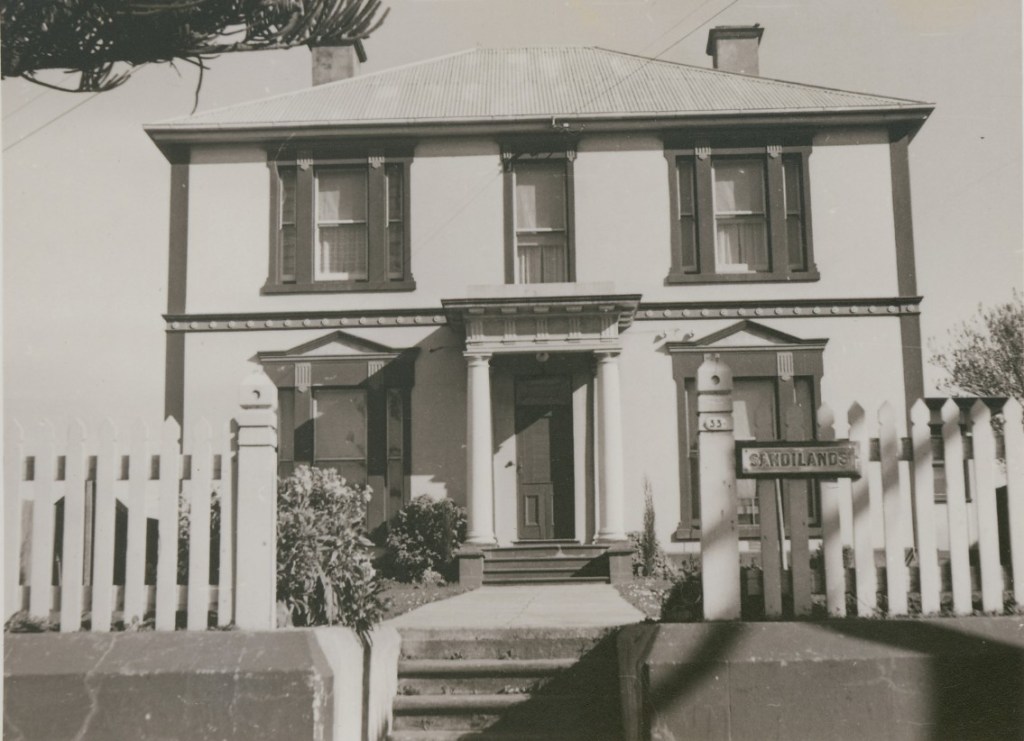
Michael retired but suffered another loss in 1922 when Rose died at Coleraine. He later moved to Portland and took up residence at Sandilands in Percy Street, a boarding house at the time.
With his health failing, Michael went to live with his son in Hamilton and it’s where he died in January 1933. Michael’s burial took place at Coleraine with Rose, and friends came from all around to farewell a quiet man known for his sense of humour.
SCHMIDT, Augustus Henrietta-Died 23 February 1953 at Camperdown. Augusta Smith was born in 1866 near Maryborough. She became a teacher and her first school was Dunach, south of Maryborough in 1884. Over the next four years, she taught in the Central Highlands area before an appointment at Tanjil in West Gippsland where she remained for two years. In 1890, Augusta was posted to Newfield School near Port Campbell. She remained teaching until 1895 and married the following year to William McKenzie. They settled at Port Campbell and went on to have three sons and one daughter.

Augustus died in 1953 and was buried at the Port Campbell Cemetery. You can view the teaching record of Augustus at the Public Record Office of Victoria (PROV) on the link-Teacher’s record

 Western District Families
You must be logged in to post a comment.