Finally, a new post and it’s Passing of the Pioneers. In this edition, you can read the stories of four women and five men, including a father and son, from the Western District’s past. December Passing of the Pioneers posts are always sadder with deaths occurring in the lead up to Christmas Day and sometimes on the day itself. One woman featured this edition was preparing her home for Christmas visitors when she died, and another died on Christmas Eve.
The fourth edition of Passing of the Pioneers in October 2011 had an entry for a man whose fascinating story has stayed with me. In October 2019, when invited to speak at the Hamilton History Centre on interesting early settlers, I knew I had to include that man…Thomas Denton Clarke of Merino. Now his father, Thomas Clarke senior, becomes a Passing Pioneer. His story is the feature this month, but it really only touches the surface of his interesting life, one that has given me some understanding of how his son became the man he did.
It’s been awhile so don’t forget if you click on any of the underlined text, you will go to the original source, most times a newspaper article at Trove with more information about a subject,
CLARKE, Thomas Henry – Died 2 December 1865 at Merino. Thomas Clarke was born in Great Yarmouth, Norfolk, England, and baptised in July 1815. From a family of sailors, he soon took to the sea, gaining certification as a Master Mariner. In 1844, he married Mary Ellen Denton in Liverpool, and four children were born.
Life at sea
Thomas went off sailing the world, leaving his family for long periods of time. For several years, he made an annual voyage to Portland at the helm of his brig Cornelius, taking the course via the Cape of Good Hope en route to Portland and via Cape Horn on the way home.
In 1850, he travelled via Hobart.

PORT OF PORTLAND. (1850, December 27). The Argus, p. 2. http://nla.gov.au/nla.news-article255611135
The cargo on the trip back to London in 1851 may have been on the nose at the end of the voyage.
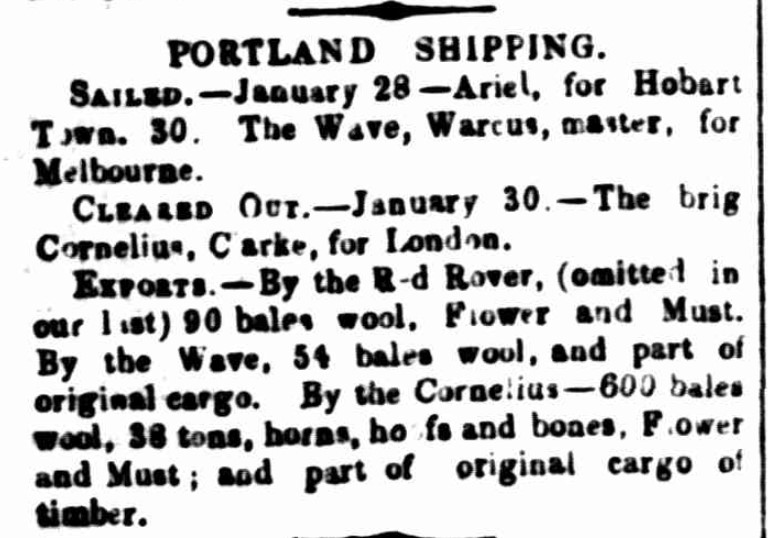
SHIPPING INTELLIGENCE (1851, February 5). The Melbourne Daily News, p. 2. http://nla.gov.au/nla.news-article226518279
The Cornelius sailed into Portland Bay, just in time for Christmas 1851.
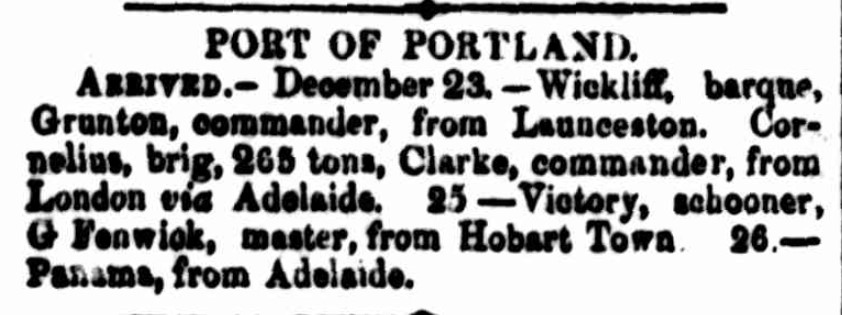
PORT OF PORTLAND. (1851, December 31). The Argus, p. 2. http://nla.gov.au/nla.news-article4782518

PORTLAND BAY c1851. Image courtesy of the State Library of Victoria http://handle.slv.vic.gov.au/10381/85333
On 11 February 1852, the Cornelius was running late departing Portland but would sail for London the following day.

PORT OF PORTLAND. (1852, February 11). The Argus, p. 2. http://nla.gov.au/nla.news-article4783182
The problem was, Thomas was having trouble mustering a crew for the voyage back to London, as were many ships because of the rush to the diggings. Thomas eventually set off with a skeleton crew, including a young local boy, Joseph Pearson. High winds upon his already delayed departure saw Thomas take a risk rather than wait in port any longer. He sailed the Cornelius between St Lawrence Rocks and Portland Bay, an action not advised by others, including well-known local master mariner Captain James Fawthrop.
Thomas got through successfully, but it wasn’t until he arrived in England he realised the ship’s false keel was missing, left behind on a reef in the St Lawrence passage.

LAWRENCE ROCKS, PORTLAND BAY, 1865. Image courtesy of the State Library of Victoria http://handle.slv.vic.gov.au/10381/95486
Thomas was barely back in London when he set sail again for Portland, arriving on 18 January 1853.
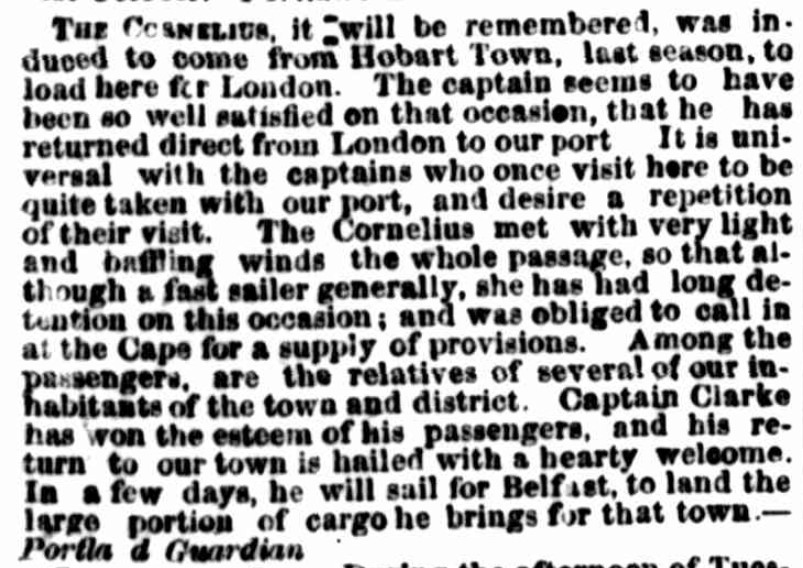
PORT OF GEELONG. (1853, January 12). The Argus, p. 4. http://nla.gov.au/nla.news-article4788871
After a couple of months in port, he returned to London on 1 April 1853 carrying wool and a box of gold dust.

PORT OF PORTLAND. (1853, April 18). The Argus p. 4. http://nla.gov.au/nla.news-article4791722
He reached Dover in 108 days. While there, he put in a good word for the port of Portland, a place he had developed a fondness for.
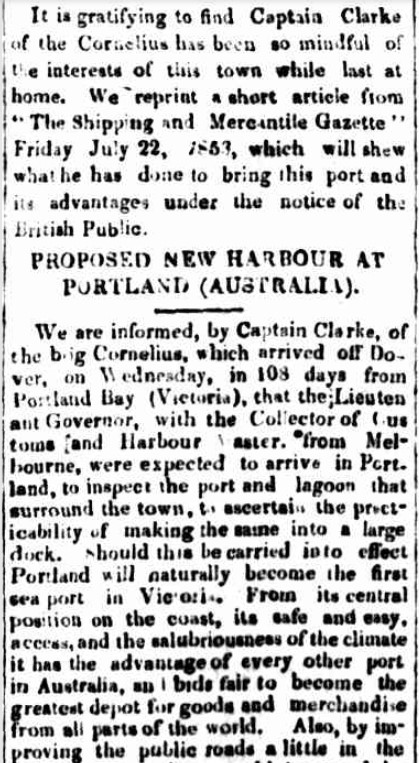
THE PORTLAND GUARDIAN AND NORMANBY GENERAL ADVERTISER (1854, February 9). Portland Guardian and Normanby General Advertiser, p. 2. http://nla.gov.au/nla.news-article71569648
The following year, 1854, started in the same way, when Thomas arrived at Portland Bay on 4 February.

PORT OF PORTLAND. (1854, February 17). The Banner, p. 8. http://nla.gov.au/nla.news-article179811844
This time, however, Thomas had his wife and children on board.

PORTLAND BAY c1857. Image courtesy of the State Library of Victoria http://handle.slv.vic.gov.au/10381/266998
Once in port, Thomas fell ill and required an operation. Soon after, he advertised the Cornelius for sale.
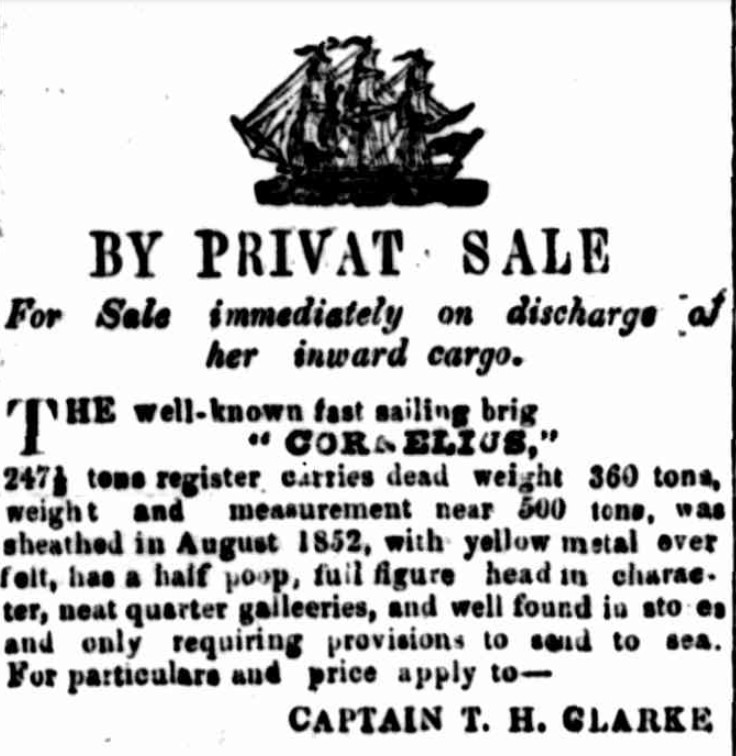
Advertising (1854, February 20). Portland Guardian and Normanby General Advertiser, p. 3 http://nla.gov.au/nla.news-article71569711
Thomas finds his land legs
Thomas stayed on dry land and went into business as an auctioneer in Gawler Street, Portland, thus beginning the next chapter in his life.
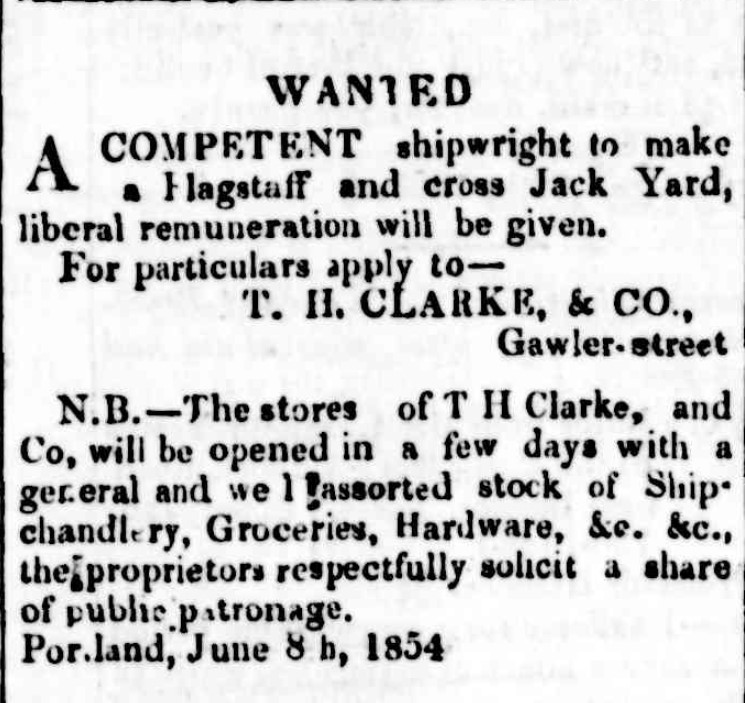
Advertising (1854, June 15). Portland Guardian and Normanby General Advertiser, p. 3 http://nla.gov.au/nla.news-article71570371
But he couldn’t part with the Cornelius, instead putting a master in charge of her. On 3 September 1854, the Cornelius set off to Singapore via Sydney when it wrecked on the Great Barrier Reef near Raine Island in the Torres Strait.
Life in Merino
On 28 May 1855, Mary Ellen died at Portland aged just thirty. In the months after, Thomas and the children went to live at Merino Waterholes, now Merino, where he set up an auctioneering business known as the Merino Auction Mart.
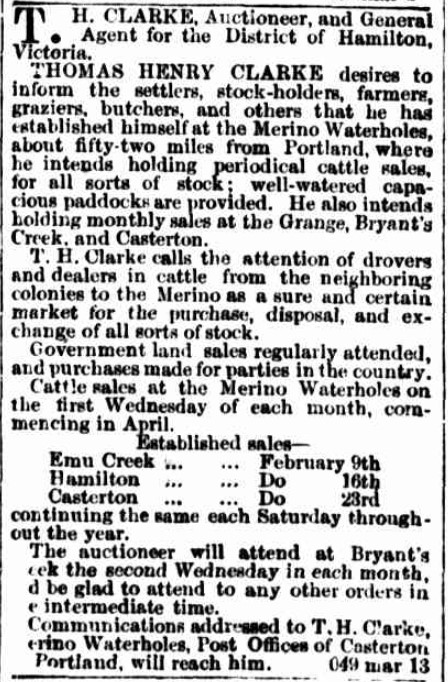
Advertising (1856, February 29). The Argus, p. 7. http://nla.gov.au/nla.news-article4831997
In 1857, Thomas built the Farmers Arms Inn, later known as the Railway Hotel.

Advertising (1857, February 4). Portland Guardian and Normanby General Advertiser, p. 3 http://nla.gov.au/nla.news-article64567702
Aside from getting his own businesses off the ground, Thomas was very active in the community. In June 1857, he formed the Merino Flour Mill Company, calling for 200 shares at £10 each. A wind-powered mill was earlier proposed and shareholders had already invested in that option. Thomas put forward the option of a steam mill and many of the investors of the wind-powered mill were prepared to transfer to the steam option.
On 1 February 1859, a boiler and other related machinery made in Kirkcaldy, Scotland, arrived in Merino from Melbourne. It created a lot of excitement among residents with “five drays…drawn by 24 pure Clydesdale horses, …declared by competent judges to be the finest heavy draught horses seen in this part of the district”. You can read more about the mill’s construction on the link- Merino Flour Mill.
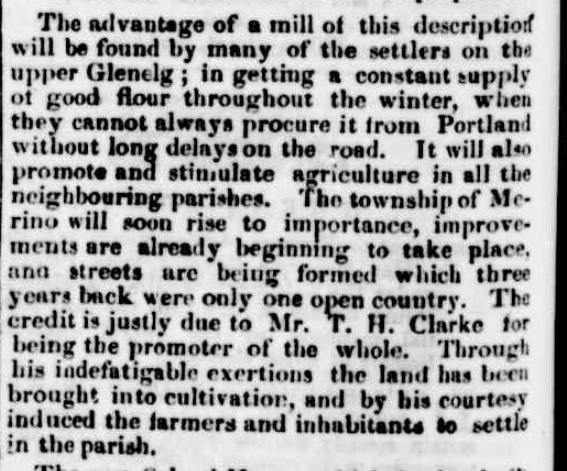
TOWNSHIP OF MERINO. (1859, February 9). Portland Guardian and Normanby General Advertiser, p. 2 http://nla.gov.au/nla.news-article64510216
The two-story mill is in the photo below from 1859, the year if its contruction. Over 160 years later, the mill building still stands.
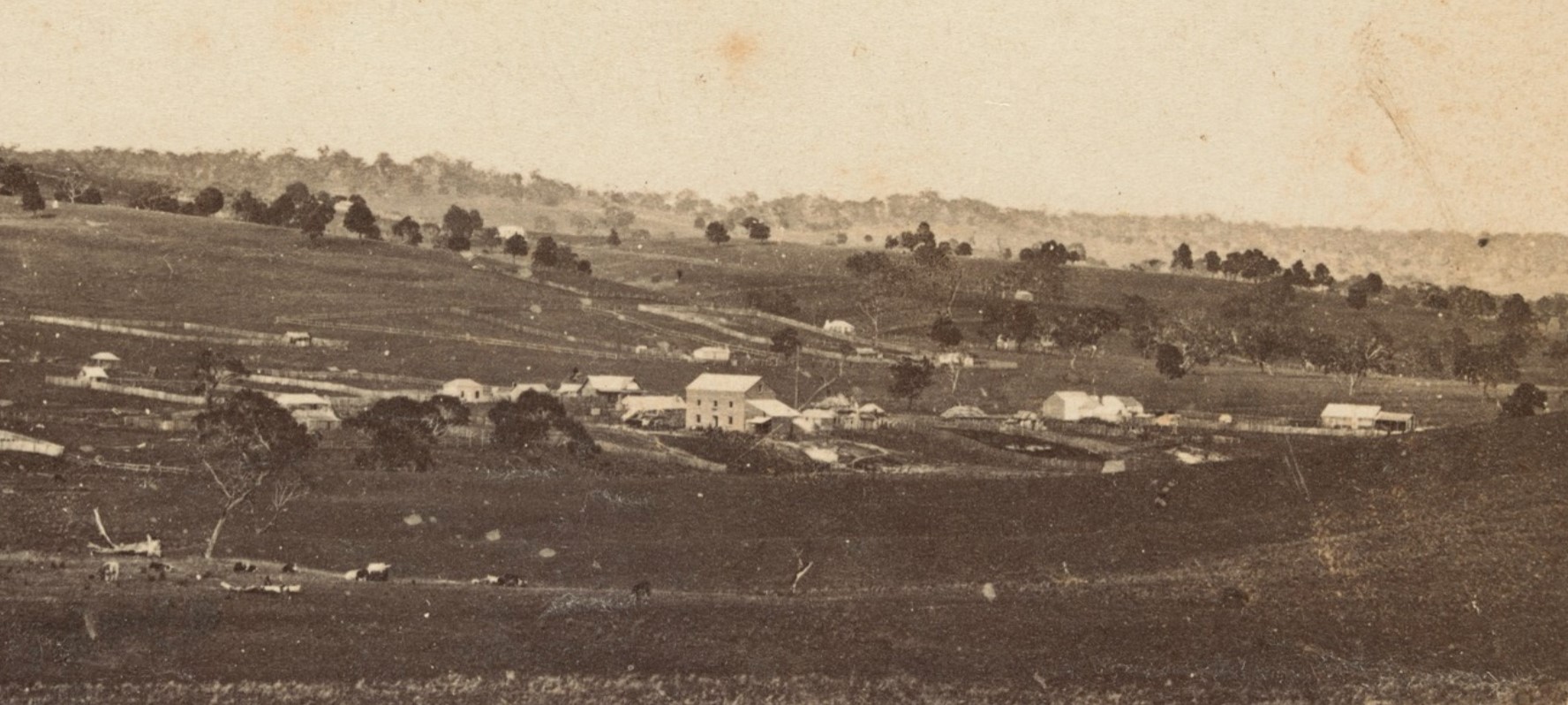
Photographer: Thomas Hannay. Image courtesy of the State Library of Victoria
As the mill equipment was arriving in town, a school was under construction at Merino.

TOWNSHIP OF MERINO. (1859, February 9). Portland Guardian and Normanby General Advertiser, p. 2 http://nla.gov.au/nla.news-article64510216
As stated in the article, the school would open owing money. Thomas Clarke was on the first Merino School committee in 1858 and appointed secretary and treasurer. He also had the task of organising a suitable school building. After locating one, there were insufficient funds leaving Thomas and committee chairman Reverend Russell to make up the shortfall of £88. They hoped for reimbursement once the school was operational and receiving subscriptions or government support. Money was tight, and Thomas tried various methods to keep the school going and pay its debts.
In August 1860, Thomas wrote a letter to the Hamilton Spectator and Grange District Advertiser calling for subscribers to the school. There were men in the district, he said, who had bought the finest land in the country for a “trifling” price, and surely they could help keep the school going and put the books in the black. “Nothing will teach the young colonists and the rising generation to more patriotism than promoting their moral character and education-an example I have never lost sight of since I first landed on Australia’s shores.”
During what was a busy period of his life, Thomas remarried in 1857 to Ann Clarke. In 1860, he suffered the misfortune of losing his crops to a bushfire in the district. In 1861, he was appointed a trustee of the land set aside for a Church of England building at Merino. St Peter’s Church, Merino, did open, but not until December 1867, two years after Thomas’ death.

ST PETER’S ANGLICAN CHURCH, MERINO. Image courtesy of the Museums Victoria Collections https://collections.museumsvictoria.com.au/items/766451
Thomas was deputy registrar for Births, Deaths, and Marriages at Merino from 1862, and the pound keeper. He was also a handy fill in if a doctor or a clergyman wasn’t available. He had a good knowledge of medicine, most likely picked up during his time at sea, and he helped many in the district. Assisting the school and some failed speculating proved detrimental to Thomas as he fell into insolvency in 1863. In October 1864, he was appointed as a valuer for the Glenelg Shire Council, receiving an annual salary of £58.
Thomas wrote many letters to the editor of the various district papers. In July 1857, he penned a detailed letter to the Portland Guardian and Normanby General Advertiser supporting the idea of the construction of a lighthouse on Lady Julia Percy Island around 35 kilometres south-east of Portland Bay, even offering advice on the construction. The lighthouse never eventuated. In another written in August 1863, after a visit to Portland, Thomas told of walking the beach and finding debris from a ship. He identified it as a piece of American pine, matching the description of debris found at Swan Island near the entrance to Port Phillip Bay, He explained how debris washed up on the beach at Portland could in fact be debris from a ship wrecked anywhere between Cape Bridgewater and Wilsons Promontory.
Thomas was just fifty at the time of his death in 1865, but what a life he led. He left his widow, Ann, and eight children, including four young children born over the previous eight years. On the day of his funeral, the cortege left Merino for Portland at 10 am with many people making the journey. It was raining in Portland, keeping people away. Thomas was buried at the Portland North Cemetery overlooking Portland Bay which meant so much to him. Ann died in 1898.
Thomas Clarke’s legacy
In 1867, the Merino correspondent for the Portland Guardian and Normanby General Advertiser reported on the growth in Merino and promoted the district as a good place to settle with a bright future. He said, “Much of the early history of Merino is connected with the late Captain Clarke whose enterprise and energy gave an impulse to the early progress of the town.”
Thomas’ contribution to the maritime history of Portland was remembered in 1904, when the Portland Guardian recounted the 1854 voyage of the Cornelius from England. That was the same voyage Thomas brought his family to Victoria.

The Portland Guardian, (1904, February 3). Portland Guardian, p. 2 http://nla.gov.au/nla.news-article63687181
An article in 1919 about Thomas’ life said he was a failure on the land, with many of his speculations not successful and suggesting his “ill fortune” followed him to the end, but it was full of praise for his life on the sea:
Captain Clarke’s early life was devoted to the sea, as were those of his ancestors for generations back. His experiences in the tea, sugar, timber and metal trades when in command, at different periods, of the ships Earl Grey, George Canning. Countess West-Moreland, Cornelius and Ruby, trading from India, Turkey, China, West Indies, Australia, and many other parts, would fill a good sized volume. From the end of the forties to the middle of the fifties, he traded regularly between London and Portland, the passage and back being made usually once a year, chiefly in the Cornelius…
The article also told of an c1851 painting of the Cornelius sold at a clearing sale after the death of Donald Cameron of Oakbank near Heywood in 1879. The auctioneers forwarded it to Thomas Clarke Jr at Merino and John Smith of Grassdale had a print made of the original.
DISNEY, Robert – Died 21 December 1875 at Hamilton. Robert Disney was born in County Cork, Ireland around 1831 and arrived in Victoria in 1852, and was a police cadet by the end of that year. A year on and Robert was a Sub-Inspector and then Sub-Lieutenant. He spent time as a gold escort at Beechworth, Castlemaine, and Ballarat, among other places. In 1858, he was the officer in charge of the escort at Dunolly.

DUNOLLY. (1858, August 10). Maryborough and Dunolly Advertiser, p. 1 (SUPPLEMENT TO THE M.&D. ADVERTISER).http://nla.gov.au/nla.news-article253588476
Robert spent time in Ararat around 1864 before moving on to Swan Hill. In 1865, he received a promotion to Inspector 2nd Class, and the following year, 1866, he went back to Beechworth. In March 1869, Robert led a troop of mounted police to escort the Duke of Edinburgh Prince Alfred to Sandridge pier after a visit to the colony. A few months later, Robert received a transfer to Benalla before Kyneton for four years. By that time, Robert had reached the rank of Senior Inspector.
In 1871, another transfer took Robert to Hamilton, where he was the District Inspector of Police, and took up residence in French Street. In November 1875, illness forced his retirement, and he was soon bedridden. Robert succumbed to his condition on 21 December 1875, aged forty-four. Robert was very popular in Hamilton and a lengthy funeral cortege, including many police members, left his home on 23 December for the Hamilton (Old) Cemetery.
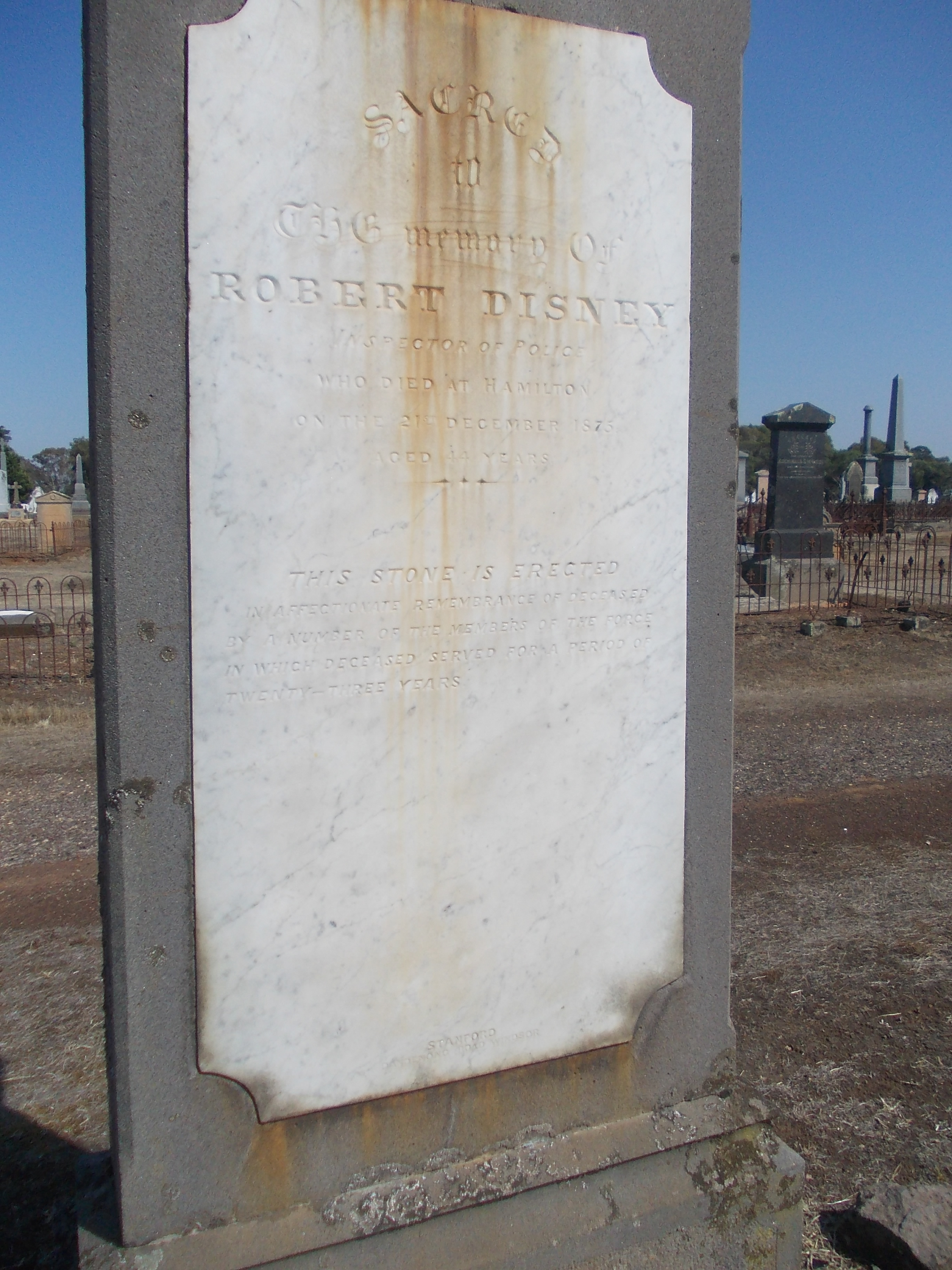
HEADSTONE OF ROBERT DISNEY AT HAMILTON (OLD) CEMETERY
TWOMEY, John Joseph– Died 1 December 1879 at Carlton. John Twomey was born around 1790 in County Cork, Ireland. He married Margaret O’Connor, and they raised a large family. Around 1842, the Twomey family arrived in Victoria and about 1851, John took up the Kolor run near Mt Rouse, south-east of Hamilton. He and his sons took up surrounding land, and each had their own portion. Edward had Langulac, Daniel and John Jr shared Kolor, and Timothy was at Banemore.
In August 1865, John’s wife Margeret died. It came only months after a tragic loss for the family. On 5 April 1865, their son John and his wife were on the SS Western travelling overnight between Melbourne and Port Fairy. On arrival at their destination, John was nowhere to be found. Investigations found he didn’t disembark at Warrnambool, so he most likely fell overboard some time after he was last seen on deck, about seven miles off Warrnambool. A £100 reward was offered for the return of his body and John Sr continued on in partnership of Kolor with Daniel.
In August 1868, Daniel Twomey held a ceremony at Kolor for the laying of the foundation stone for a new homestead he was building. John Twomey had the honours and on taking the trowel he declared, “the stone well and truly laid”
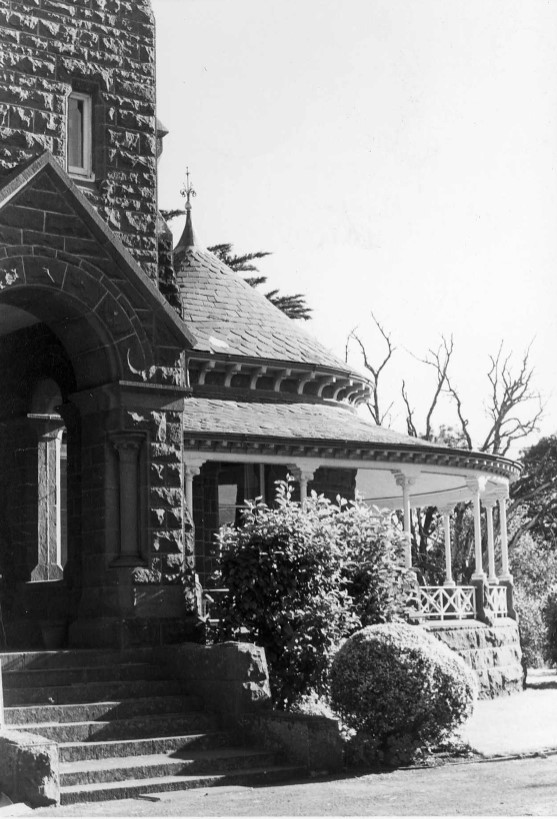
“KOLOR. Image courtesy of the J.T. Collins Collection, State Library of Victoria http://handle.slv.vic.gov.au/10381/233438
John went to live at Langulac the property of his son Edward, around 1875. The older man in the photo below, taken at Langulac, could be John.

LANGULAC HOMESTEAD, c1875. Image courtesy of the Museums Victoria Collections https://collections.museumsvictoria.com.au/items/770166
Somehow, John came to be living in a boarding house at 11 Drummond Street, Carlton and he died there on 1 December 1879, aged eighty-nine. His body returned to Hamilton and buried in the Roman Catholic section of the Hamilton (Old) Cemetery. His impressive monument also included a memorial for his missing son John Jr. A charitable man until the end, John bequeathed £100 to the Hamilton Hospital.
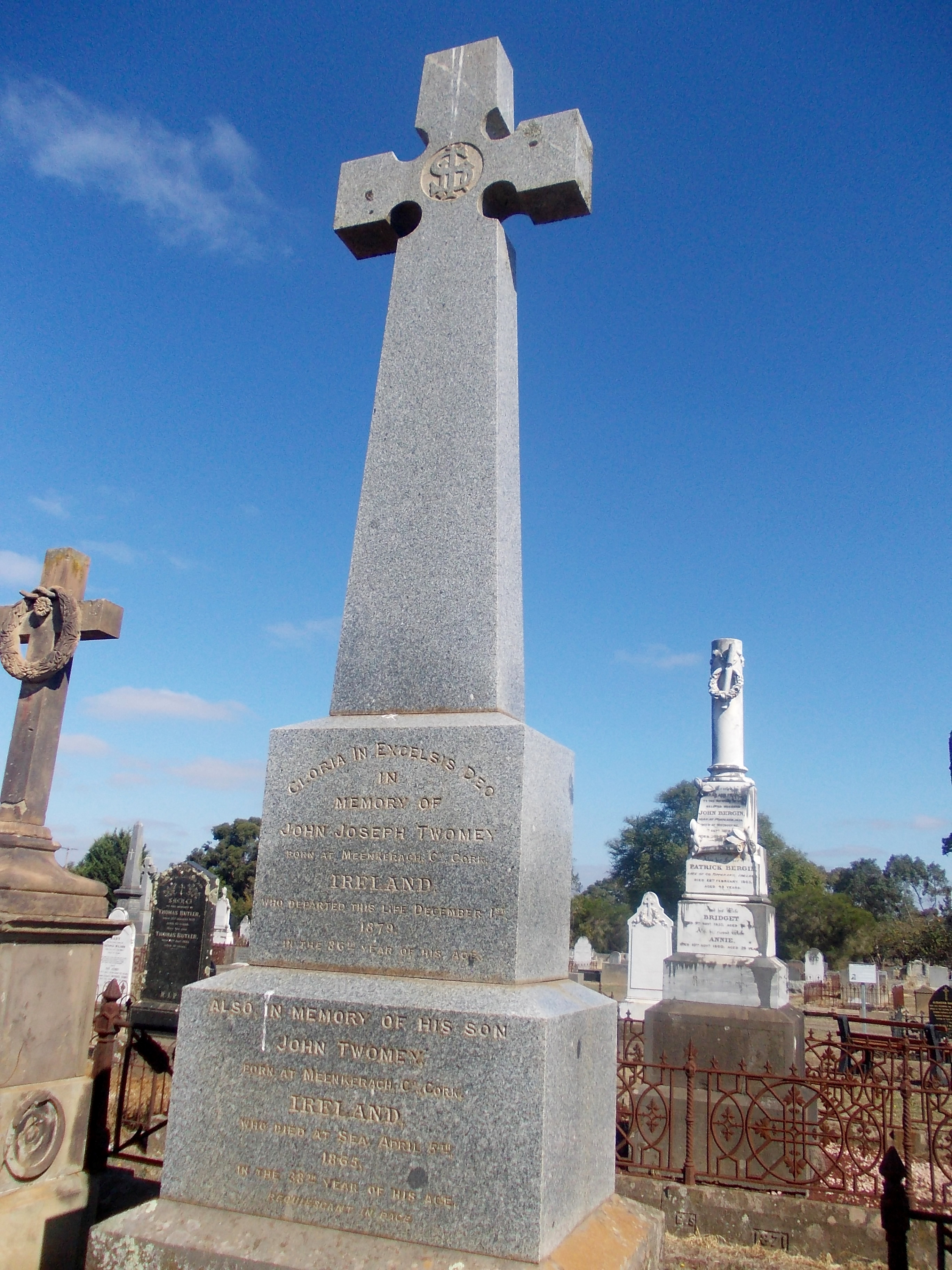
GRAVE OF JOHN JOSEPH TWOMEY, HAMILTON (OLD) CEMETERY.
TAIT, James – Died 28 December 1880 at Camperdown. James Tait was born in County Caithness, Scotland in 1809. He lived in Glasgow for around twenty years before travelling to Australia about 1854 with his wife, Jane Wares. Three years later, the Taits arrived at Camperdown and James opened the first store in the town. It was on the corner of Adeney and Campbell Streets, but in time, he constructed a store in Scott Street, later known as Penzance House (below)

James Tait’s Camperdown Store c1859 Photographer: Thomas Hannay, Image courtesy of the State Library of Victoria http://handle.slv.vic.gov.au/10381/320656
James was a founding member of the Hampden and Heytesbury Roads Board. He was also an elder of the Presbyterian Church from 1863 and involved with the Sabbath school. He promoted temperance and religion and managed several of the local temperance societies.
James died at this home in Scott Street, Camperdown in 1880. His burial took place at the Camperdown Cemetery, with around forty vehicles and twenty men on horseback making up the cortege. His widow Jane died in 1898.
TWOMEY, Daniel– Died 30 December 1891 at Penshurst. Daniel Twomey was born in County Cork, Ireland around 1832, the fourth son of John Joseph Twomey (see above) and Margaret O’Connor. The Twomey family arrived in Victoria around 1845, and Daniel’s father took up the Kolor run at Mount Rouse. Daniel and his brother joined their father in acquiring land and later, Daniel took up the running of the Kolor run with his brother John.
On 5 April 1865, John disappeared from the SS Western. He died intestate and since he left a widow and a part share of Kolor, a “friendly” court case found it necessary to sell Kolor to dissolve John and Daniel’s partnership, Daniel then purchased the property outright and set about building a new homestead. He employed Melbourne architects Reed and Barnes with partner Joseph Reed appearing to have the design credit for Kolor homestead. Reed and Barnes came with good credentials. They had recently finished designing Rippon Lea at Elsternwick, the Melbourne Town Hall, and the former Menzies Hotel on the corner of Bourke and William Streets, Melbourne. Joseph visited Kolor in 1868 to inspect the site and the building started soon after.
In August 1868, Daniel held a ceremony at Kolor for the laying of the foundation stone for the homestead. Around 200 people, including workers, were there to see John Twomey Snr. take a trowel and lay the stone.

JT Collins Collection, La Trobe Picture Collection, State Library of Victoria http://handle.slv.vic.gov.au/10381/4121911
On 6 September 1871, Daniel married Helen Cameron, and they had four children. Helen died in 1890 while away in Europe. Daniel felt the loss immensely and his health suffered. During late November 1891, he had a minor stroke but by Christmas Day, he was getting into the festive sprit. However, between Christmas and New Year, he suffered another stroke, and died on the morning of New Year’s Eve. They left two boys and two girls under the age of twenty, all away at school in England. Described as a lover of sport and a friend to the poor, Daniel had a gentle nature . The funeral cortege left Kolor for the Hamilton (Old) Cemetery.

GRAVE OF DANIEL TWOMEY, HAMILTON (OLD) CEMETERY
CLARKE, Anne – Died 13 December 1892 at Portland. Anne Clarke was born in Devon, England, around 1813 and arrived in Portland on the ship Francis Henty in 1854.
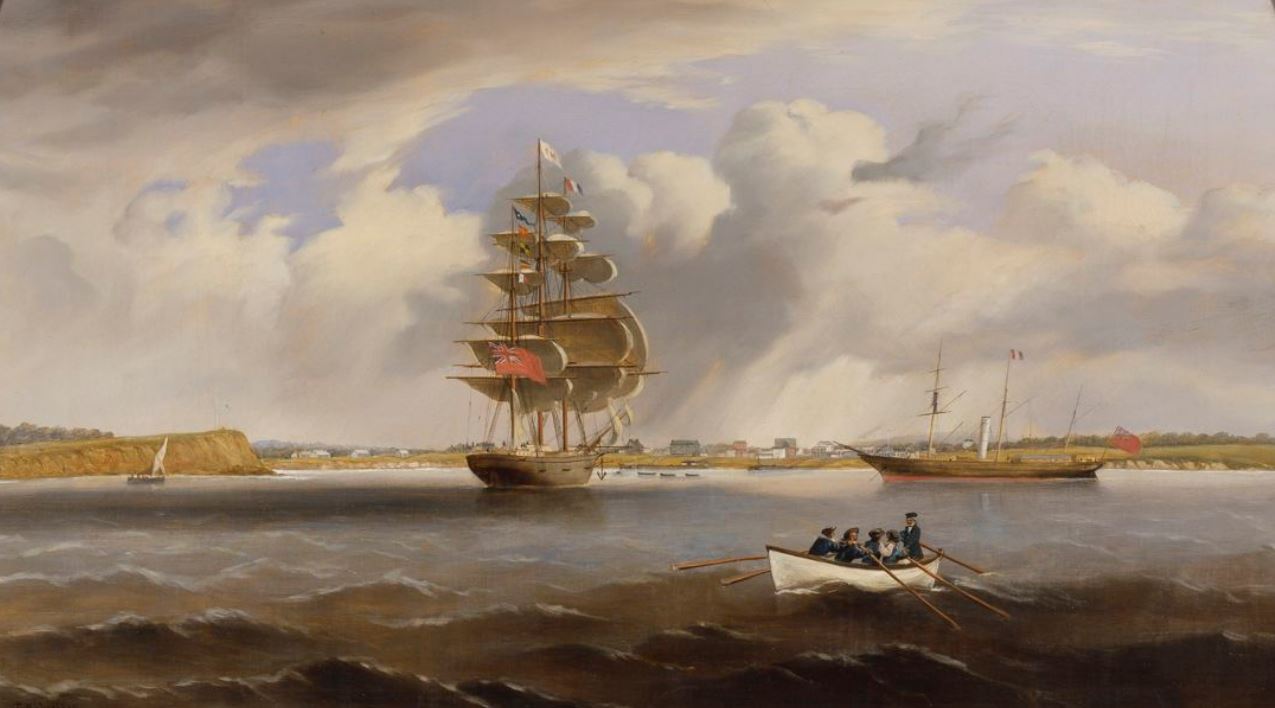
THE FRANCIS HENTY, c1858. Image courtesy of the State Library of Victoria http://handle.slv.vic.gov.au/10381/91541
She opened a school for young ladies in Gawler Street, Portland, in 1857.

ANNE CLARKE’S SCHOOL FOR YOUNG LADIES c1859 Photographer: Thomas Hannay. Image courtesy of the State Library of Victoria http://handle.slv.vic.gov.au/10381/318603
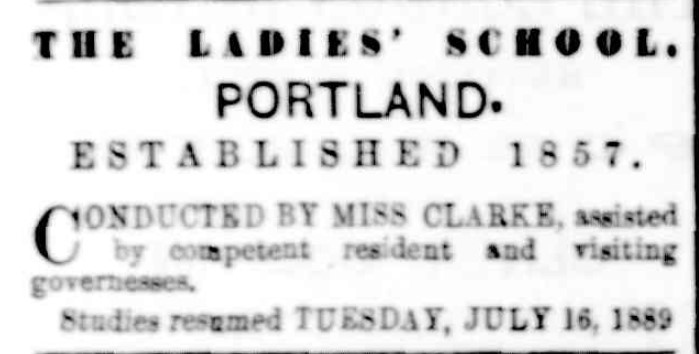
Advertising (1889, July 17). Portland Guardian, p. 2 http://nla.gov.au/nla.news-article63623908
Her obituary mentioned many of the girls she taught married in the Western District and Anne also educated their girls. In January 1891, Anne announced she was retiring and Miss Hayden would take over the school.
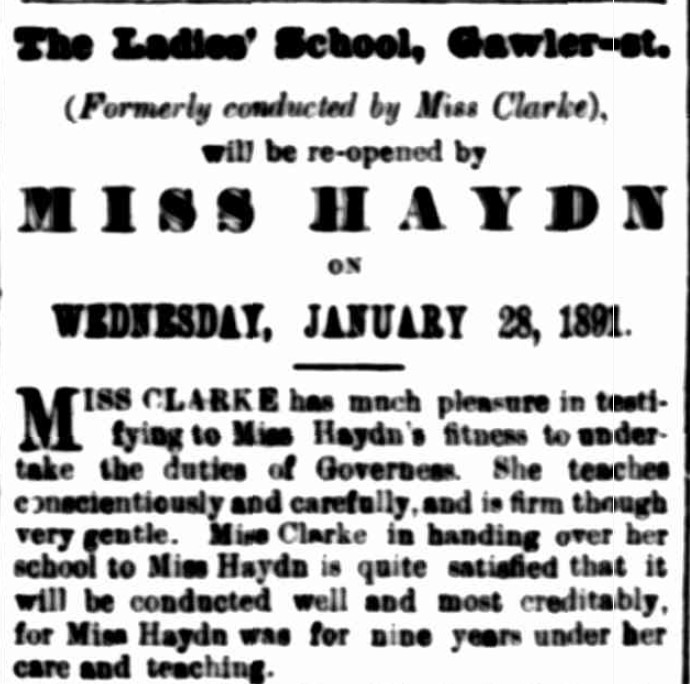
Advertising (1891, February 25). Portland Guardian p. 3 http://nla.gov.au/nla.news-article63631900
Anne fell ill in late 1892 and the news reached Casterton, with the Casterton News reporting Anne had taught many girls from that district. She died on 13 December 1892.
Anne was among the women named in the Book of remembrance of the pioneer women of the Portland Bay district (1934). It mentioned before her arrival in Victoria, Anne taught at the school for the daughters of clergymen mentioned in Jane Eyre. That was the Cowan Bridge school in Lancashire, attended by the Bronte sisters in the 1820s.
DELANEY, Mary Ann – Died 2 December 1911 at Hamilton. Mary Ann Delaney was born around 183. She married John Cain in 1850. By 1861, they were living in Harrow and remained there for thirteen years before moving to Hamilton. Six sons and five daughters were born to Mary Ann and John, who lived in Milton Street, Hamilton. On the day before her death, neighbours saw Mary Ann hanging curtains on her front windows preparing for Christmas visitors. Her burial took place at the Hamilton (Old) Cemetery (below).
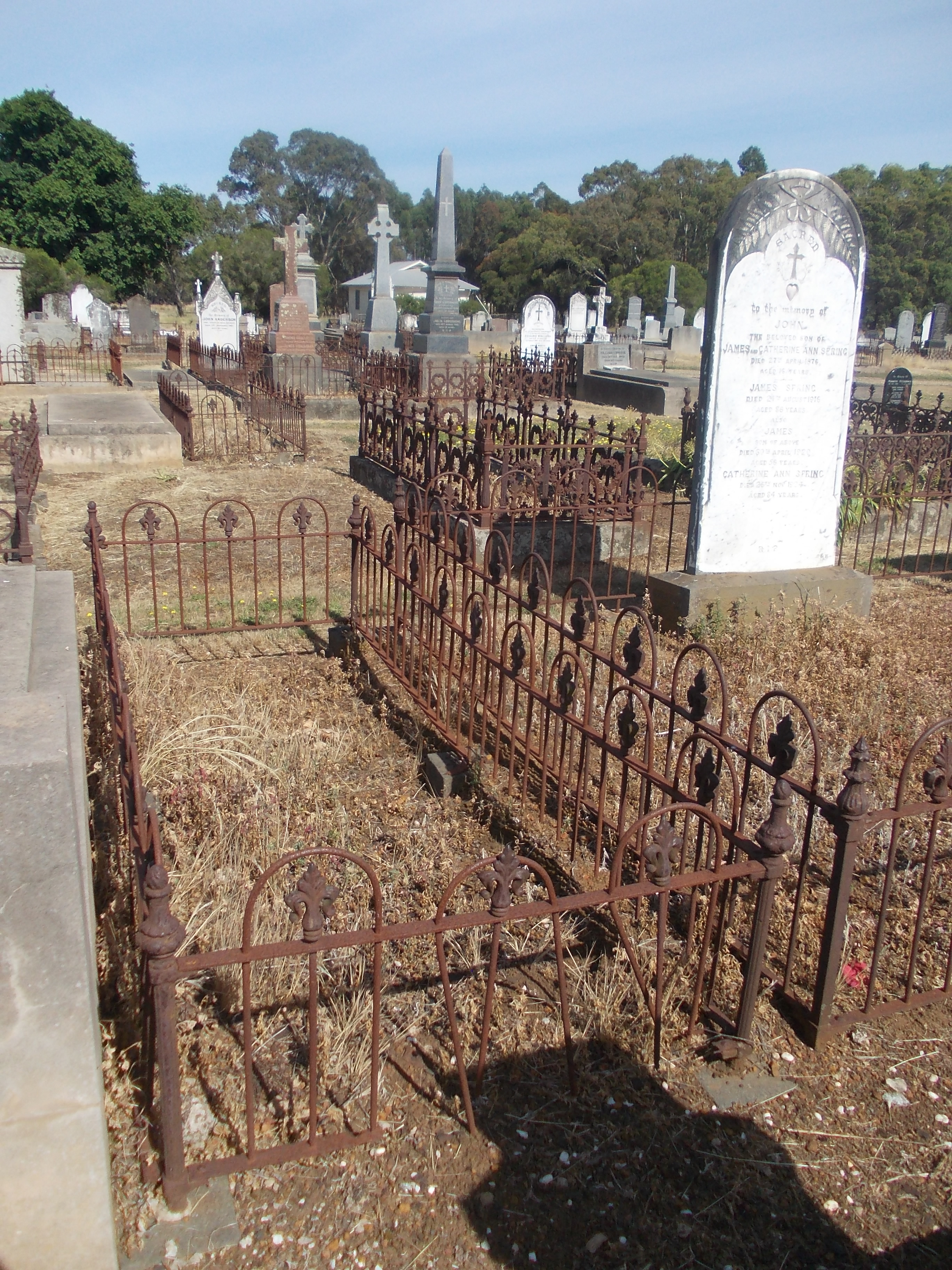
GRAVE OF MARY ANN DELANEY, HAMILTON (OLD) CEMETERY
BYRNE, Elizabeth– Died 12 December 1918 at Telangatuk. Elizabeth Byrne was born in Liverpool, England, and married there in 1858 to Thomas Jasper. They had two daughters in Liverpool, Sarah and Maria, before leaving for Australia. There arrived at Hobsons Bay in April 1864 aboard the Albion. They went first to Penshurst (then known as Mt Rouse), then Dunkeld before finally settling at Telangatuk, north east of Balmoral. They had a further nine children over that time. Thomas died in 1900. At the time of Elizabeth’s death in 1918, she had ten children still living, 26 grandchildren, and four great-grandchildren. The photo below shows descendants of Thomas Jasper and Elizabeth Byrne, picnicking near Balmoral c1905. Among them, is their son William, the only person named in the photo.

MEMBERS OF THE JASPER FAMILY, BALMORAL, c1905. Image courtesy of Museums Victoria Collections https://collections.museumsvictoria.com.au/items/773761
LORD, Eliza – Died 24 December 1934 at Port Campbell. Eliza Lord was born in 1853 at Geelong. Her family went to the Ballarat diggings and her miner father Samuel Lord was at the Eureka stockade in 1854. In 1865, Samuel selected land at Pomborneit. Known as Lissie and proficient in several languages, she started teaching in 1871 at Pomborneit. Her appointment was as a “teacher without salary” and she remained until 30 September 1873, when she retired. Her report stated she… “requires only a little more experience and training to make a very fair teacher”.¹ Eliza had other plans and on 11 February 1874, she married John Bowker at Christ Church, Geelong.
The Bowkers settled at Camperdown, where John operated a butcher shop and they started a family.
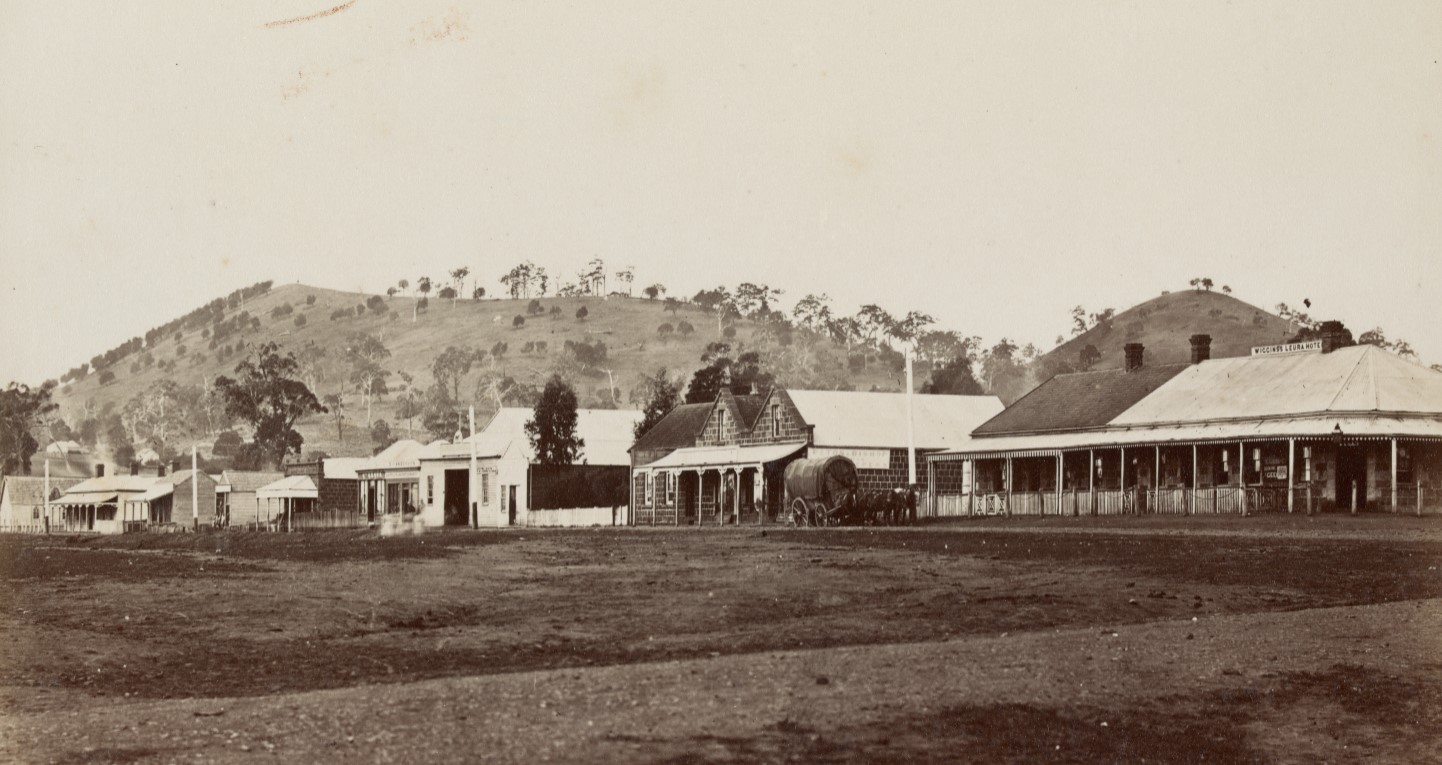
MANIFOLD STREET, CAMPERDOWN c1882. Image courtesy of the State Library of Victoria.
http://handle.slv.vic.gov.au/10381/172495
In the early 1880s, they moved south to Princetown on the coast. There wasn’t a school, and the townspeople were keen to have one built, with Eliza suggested as a teacher.

CURRENT TOPICS. (1884, March 22). Camperdown Chronicle (Vic. : 1877 – 1954), p. 2. Retrieved December 27, 2021, from http://nla.gov.au/nla.news-article23580257
Eliza was a member of the Princetown Church of England congregation. During WW1, Eliza and John’s son Alwynne (below) was killed at The Nek, Gallipoli on 7 August 1915 while serving with the 8th Light Horse Regiment.

In 1928, John died and Eliza continued to live out her days at the family property Kangaroobie, Princetown. She died on Christmas Eve 1934, aged eighty-two, leaving three sons and one daughter. Eliza’s burial took place at the Port Campbell cemetery.
- Public Records Office of Victoria, Teacher Record Books, VPRS 13579/P0001, Teacher Record No. 5201-5500, Eliza Bowker, Record No. 5278









 Western District Families
You must be logged in to post a comment.