BYADUK PLOUGHING MATCH
The Byaduk Farmers Club held their annual ploughing match on June 14, 1881. The venue was the farm of the Christie brothers and 13 competitors displayed their finest ploughing techniques.
James Harman was a keen competitor of ploughing competitions and on the day won the Champion class. His plough of choice was the Lennon made in North Melbourne by Hugh Lennon. Only the year prior the Lennon plough had made news with the capture of the Kelly Gang. The armour forged for the gang had been made out of Lennon plough boards.
Reuben Harman, James’ younger brother won the B class. Reuben was 41 at the time and died only two years later. He was also a fan of the Lennon. Another Harman, Arthur came second in the C class with a Hornsby plough and along with his uncle Reuben won a prize for best crowns.

“BYADUK PLOUGHING MATCH.” The Australasian (Melbourne, Vic. : 1864 – 1946) 18 June 1881: <http://nla.gov.au/nla.news-article137816092>.
Other notable Byaduk residents to win prizes were William and Alexander Christie and Peter Fraser. Thanks to Peter Fraser, then an 18-year-old, we now have the book Early Byaduk Settlers, a recollection of his life in Byaduk. Following the match, the participants enjoyed the annual dinner at Hardy’s Temperance Hotel. As the Harmans were staunch Methodists, the venue would have been seen as most appropriate.
Ploughing matches were a popular activity for farmers in the late 19th century. They were an opportunity to display skill, show off the latest farming implements and to gather socially with other farmers. The first ploughing match was held in the Portland area in the 1850s and they appear to have peaked in the 1880s when Inter-Colonial Ploughing Matches were held at Werribee Park and Ballarat. The sketches below depict the 1882 event at Werribee Park where 3000 spectators were attendance, including several parliamentarians. Farmers came from New South Wales, South Australia and Tasmania.

INTERCOLONIAL PLOUGHING MATCH. (1882, August 5). Illustrated Australian News (Melbourne, Vic. : 1876-1889), p. 120. Retrieved June 15, 2011, from http://nla.gov.au/nla.news-article63185745
By the mid-1890s, the papers were lamenting the demise of the ploughing match. This was put down to a number of reason including the move of young people off the land and more advanced implements. The writer sees horse racing as no match to the social and competitive nature of the ploughing match, which were also free of the “curse of Australia”, gambling. In the 20th century, the rise of the tractor meant ploughing by horse became almost unknown. The skill required to plough was not as great as that of horse ploughing and there was no longer a need to demonstrate one’s abilities. Field days today, allow for the display of the latest farming equipment and techniques filling a void left by the end of ploughing matches. The following article from The McIvor Times & Rodney Advertiser but was also published in the Portland Guardian.

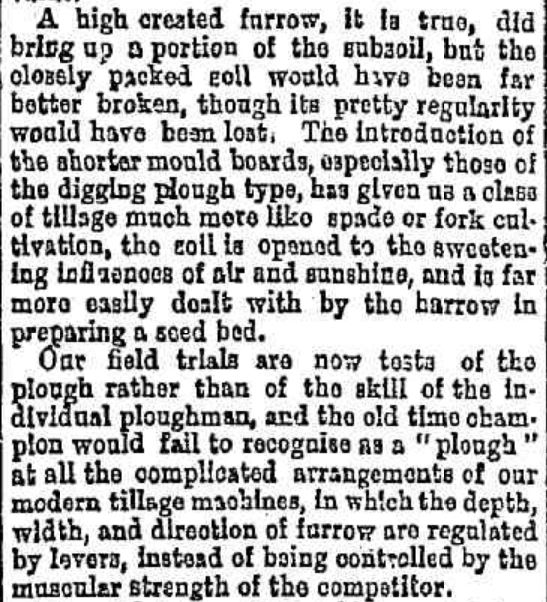

“Ploughing Matches.” The McIvor Times and Rodney Advertiser (Heathcote, Vic. : 1863 – 1918) 23 January 1896: 1 (Supplement to the McIvor Times.). Web. 1 http://nla.gov.au/nla.news-article90151643
Ploughing match results offer another insight into the lives of our Western District families. They often have a comment on the highlight of the day and list the farmers’ place of residence.



 Western District Families
You must be logged in to post a comment.