Passing of the Pioneers

The 86th edition of Passing of the Pioneers includes obituaries from February. Among them are a missionary, two men who lost sons during WW1, a teacher, and the operator of refreshment rooms in the Otways.

ARNOTT, Alfred Edward-Died 28 February 1905 at Hamilton. Alfred Arnott was born in Manchester, England around 1864 but as a child, his parents moved to Scotland. As a young person, he didn’t keep good health, and a doctor suggested he might be better suited to the Australian climate. Alfred arrived in Victoria and started work for the National Bank. He was the ledger keeper at the Hamilton branch for four years before moving to Casterton for another two years. While in Hamilton, Alfred built a strong connection with the local Presbyterian church.

ST ANDREW’S PRESBYTERIAN CHURCH, HAMILTON c1890. Image courtesy of the State Library of Victoria http://handle.slv.vic.gov.au/10381/69513

He was the secretary of the church fellowship association, sang with the choir, and taught bible classes. He also had a desire for missionary work and in 1899 an opportunity came to travel to China for that reason. On 28 August 1899, Alfred left Hamilton by train with his fiancé Mary McCormack of Scarsdale. They made their way to Sydney before travelling to Shanghai to complete two years of training in preparation for missionary work.

Alfred and Mary no doubt left with the knowledge that there was growing danger for missionaries in China. In the north of the country, there was increasing dissent towards foreigners and Christianity, which culminated in what is known as the Boxer Rebellion. There were missionaries killed and by 1900, Western countries including Australia were moving troops into the area.

Mary wrote to her Hamilton church friends, telling them about the dangers they faced. One letter was sent to Elizabeth Brown, only to arrive in Hamilton the day after Elizabeth’s death at the age of 32. Catherine Anketell received a letter from Mary in October. Mary wrote she had heard from Australian friends that there were reports all of their missionary group of 1899 had been murdered, and their photos were in the newspapers.

Mary’s sources were correct. The Critic from Adelaide published a photo of the group, including Alfred and Mary, in July 1900 suggesting their demise.

 Critic, 14 July 1900, p.12 http://nla.gov.au/nla.news-article212144442

Mary also wrote that Alfred was working in an accountant’s office in Shanghai. In 1901, Alfred and Mary married in China, and in 1903, a son John was born there.

In February 1904, Reverand Morton spoke at Penshurst about his missionary work in China. He used projected lantern slides to illustrate his talk. A slide of Alfred Arnott’s image was among them.

The Arnotts returned to Australia later that year. It is difficult to trace their movements although it appears Mary arrived ahead of Alfred. A report on 23 July from The Brisbane Courier mentioned Alfred was on board the SS Australian which stopped at Pinkenba, Brisbane en route to Sydney. It was said he was returning for a holiday. Meanwhile, Mary was in Hamilton on 25 August 1904, when she gave a speech at a public meeting hosted by the Hamilton branch of the Women’s Christian Temperance Union (WCTU) at the Hamilton Temperance Hall. She mentioned Alfred had returned from China to the Percy Islands off Queensland where he received instructions to go to Brisbane.
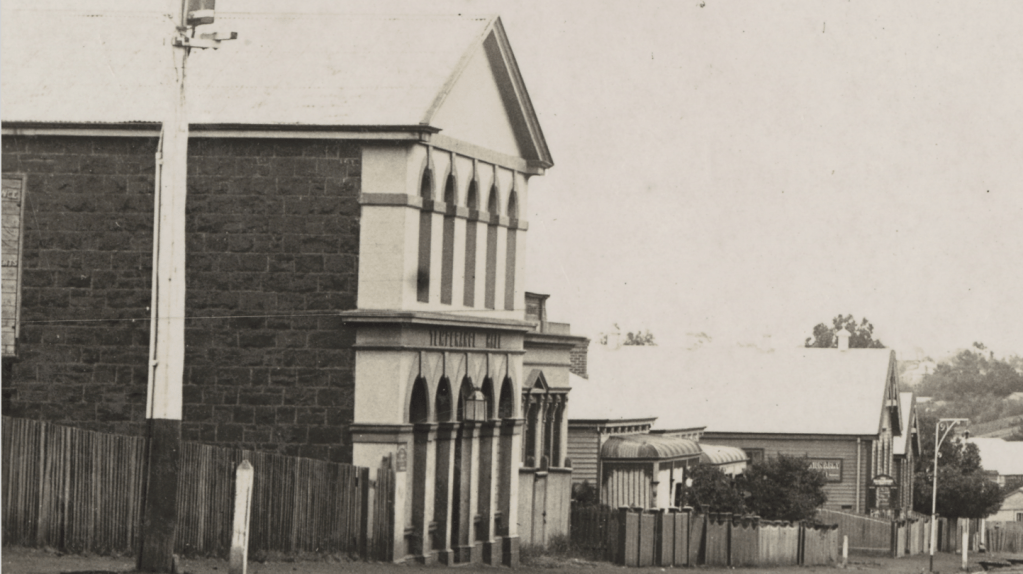
HAMILTON TEMPERANCE HALL, KENNEDY STREET, HAMILTON c1910. Image courtesy of the State Library of Victoria http://handle.slv.vic.gov.au/10381/399044

Alfred was in Sydney in early 1905 when he fell ill. His illness lingered but despite that, he wanted to fulfill his wish to return to Hamilton, the place he called home. He arrived on Saturday 25 February but on arrival at the Hamilton Railway Station, he was very weak. He was transported to the home of Martha Thomson in Gray Street where he died three days later.

In October 1905, The Express and Telegraph in Adelaide reported Mary was returning to China.
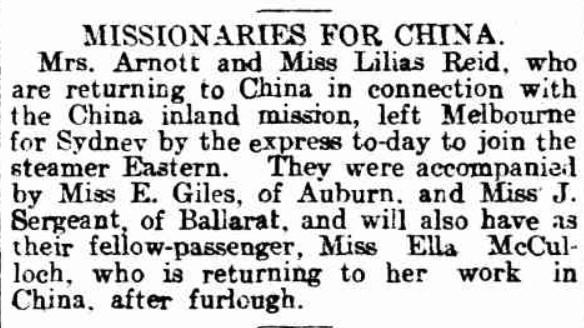
She married again to David Urquhart and they spent time living in Hawthorn. She also attended a school reunion at Scarsdale in 1918. In 1921, she suffered another loss when her and Alfred’s son John died at Hawthorn on 31 December.

“Family Notices” The Argus, 2 January 1922, p 1 http://nla.gov.au/nla.news-article4720628

John was buried with his father at the Hamilton General Cemetery.

GRAVE OF ALFRED ARNOTT, HAMILTON “OLD” CEMETERY. Image WDF

GELLERT, Wilhelmine-Died 4 February 1909 at Croxton East. Wilhelmine Gellert was born in Prosen, Prussia (now in Poland). around 1838. She arrived in Adelaide with her family on the Hermann von Beckerath in 1847.

After a few years in South Australia, the Gellert family made their way to Victoria. In 1866, Wilhelmine married Christian Matuschka. They settled at Croxton East, near Penshurst, and went on to raise six children. Wilhelmine was buried at the nearby Tabor Cemetery.

GRAVE OF WILHELMINE MATUSCHKA (nee GELLERT), TABOR CEMETERY. Image WDF

COOKE, Sarah-Died 21 February 1915 at Mortlake. Sarah Cooke was born in Belfast, Ireland around 1822. She arrived in Victoria in the 1840s and found herself in Port Fairy where she married George Hyde in 1858. They settled in Mortlake and George worked as a bootmaker. They went on to have five children. George died in 1881. In 1914, Sarah fell and broke her thigh and was hospitalised at Warrnambool. She died the following year and was buried at the Mortlake Cemetery.

COWELL, James-Died 25 February 1917 at Mortlake. James Cowell was born in Cambridgeshire, England around 1838. He arrived in Victoria in the 1850s and from the 1860s was living in Mortlake, and working as a butcher. He then became a road contractor, taking jobs with the Mortlake Shire, remaining in that line of work until his early 1870s. When WWI broke, three of his sons enlisted, and one, Harry was killed at Gallipoli in May 1915. After the death of James, a second son Charles died from disease in England in October 1917. James Cowell was buried at the Mortlake Cemetery.

RYAN, Thomas-Died 5 February 1918 at Hamilton. Thomas Ryan was born in Tipperary, Ireland around 1837. He arrived in Victoria in the 1860s and proceeded to the Ballarat diggings. In the 1870s, he arrived in the Hamilton district and worked with Victorian Railways until retirement. In 1893, while working as a porter at the Hamilton Railway Station, he badly injured his elbow while coupling railway trucks.

HAMILTON RAILWAY STATION. Image courtesy of the State Library of Victoria http://handle.slv.vic.gov.au/10381/399071

Thomas was a long-time member of the Hamilton branch of the Hibernian Australasian Catholic Benefit Society (HACBS) and served in the role of president. He died in 1918, leaving two sons and two daughters. He was buried at the Hamilton General Cemetery.
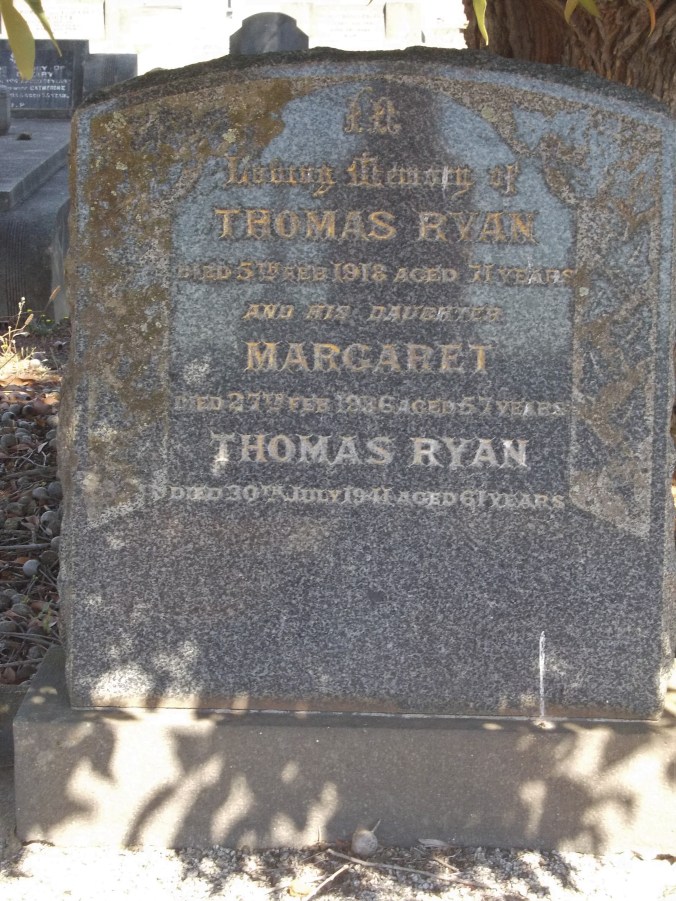
GRAVE OF THOMAS RYAN, HAMILTON “OLD CEMETERY”. Image WDF

CURTIS, Mary Ann-Died February 1928 at Geelong. Mary Ann Curtis was born around 1860 and spent much of her life in the Otways. She married James Granger Henderson in 1883 and they settled in the Lorne district and raised a family. Around the early 1900s, James had his leg amputated as a result of a sawmill accident.

It was also in the early 1900s, the Benwerrin Post Office and Refreshment Rooms were for sale. At some point, James and Mary purchased the business.
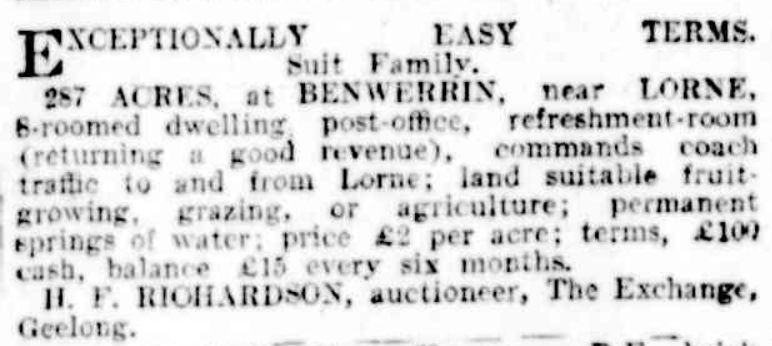
“Advertising” The Argus  24 December 1904, p.10 http://nla.gov.au/nla.news-article10357060

The Benwerrin Post Office, inland from Lorne, opened in 1886 and William Mountjoy was awarded the contract to run a mail coach between Birregurra and Lorne via Dean’s Marsh and Benwerrin. In 1889, the Deans Marsh Railway Station opened but a coach was still required from the station to Lorne, passing through Benwerrin. It was uphill from Deans Marsh to Benwerrin then downhill to Lorne, a trip taking about four hours. The coach stopped at the Benwerrin post office and soon refreshment rooms opened to cater to the passing tourists and proved popular to break their coach trip to Lorne.
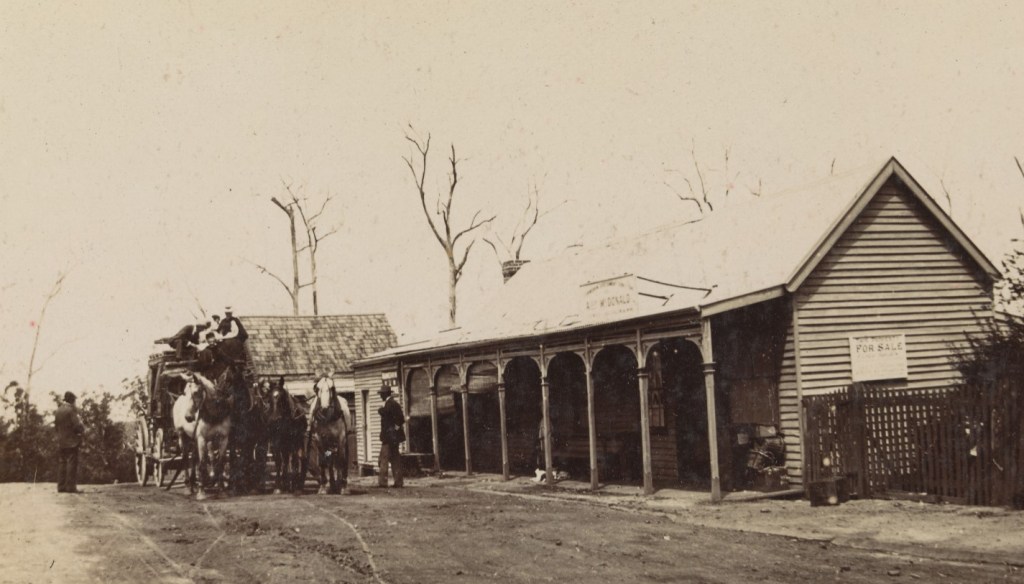
BENWERRIN POST OFFICE AND REFRESHMENT ROOMS c1901. Image courtesy of the State Library of Victoria http://handle.slv.vic.gov.au/10381/4189378

In 1906, fire swept through the district and the refreshment rooms were lucky to survive after catching fire twice. The stables and barn were destroyed.

In 1925, James died and in 1927, Mary closed the refreshment rooms due to falling clientele brought about by the increasing number of motor cars and the opening of the Great Ocean Road to the east of Lorne in 1922. Mary moved to Geelong but died only months later.

After the closure, a journalist from the Geelong Advertiser remembered stopping at the refreshment rooms…”Tables laden with all sorts of delicious homemade edibles that would tempt anyone to eat. And above all, succulent strawberries of super size, fresh from the garden, and an abundance of cream produced on the place. To have them once was to create a longing for the return journey when another issue would certainly be demanded.”
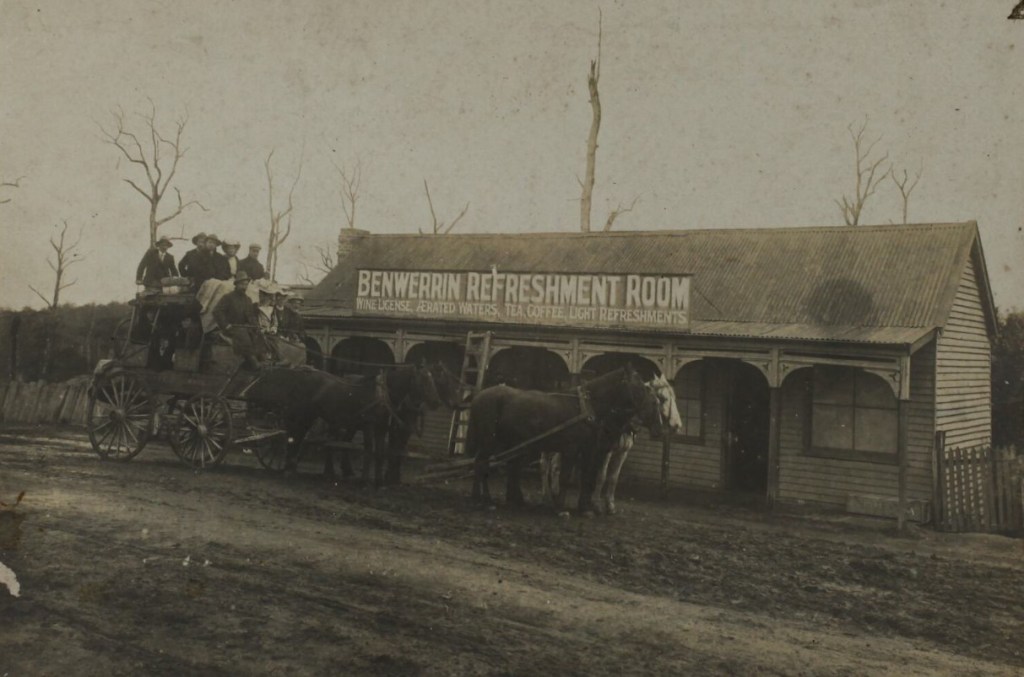
BENWERRIN POST OFFICE AND REFRESHMENT ROOMS. Image courtesy of the Museums Victoria Collections https://collections.museumsvictoria.com.au/items/788846

CASS, Michael-Died 4 February 1933 at Hamilton. Michael Cass was born in Kilkenny, Ireland around 1852. When he first arrived in Australia he went to Queensland where he eventually worked for Cobb & Co. He found the weather too hot and made his way south to Victoria, taking up residence in Harrow.

Michael eventually moved on to Chetwynd where he spent 50 years farming. He married Rose Bermingham in 1881 and they raised a family. In 1916, Michael and Rose saw two sons go off to war. One of them, John died from his wounds the following year, while the other, Peter received severe wounds and returned to Australia in early 1918.

Michael retired but suffered another loss in 1922 when Rose died at Coleraine. He later moved to Portland and took up residence at Sandilands in Percy Street, a boarding house at the time.
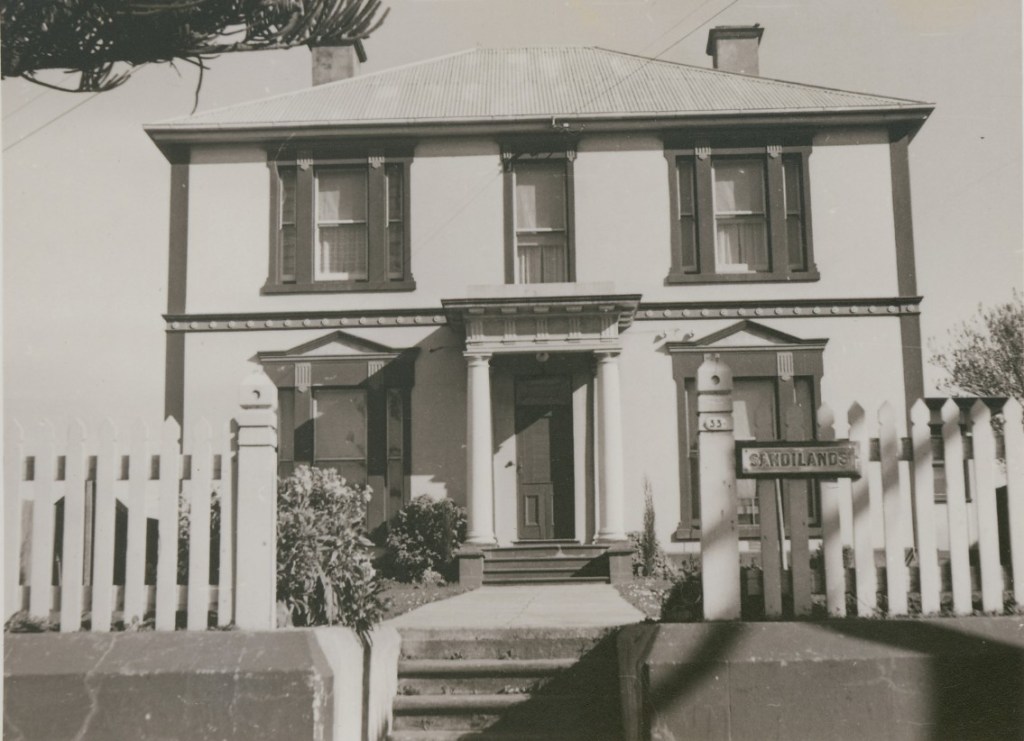
SANDILANDS, PORTLAND 1949. Photographer: Colin Caldwell. Image courtesy of the State Library of Victoria http://handle.slv.vic.gov.au/10381/72666

With his health failing, Michael went to live with his son in Hamilton and it’s where he died in January 1933. Michael’s burial took place at Coleraine with Rose, and friends came from all around to farewell a quiet man known for his sense of humour.

SCHMIDT, Augustus Henrietta-Died 23 February 1953 at Camperdown. Augusta Smith was born in 1866 near Maryborough. She became a teacher and her first school was Dunach, south of Maryborough in 1884. Over the next four years, she taught in the Central Highlands area before an appointment at Tanjil in West Gippsland where she remained for two years. In 1890, Augusta was posted to Newfield School near Port Campbell. She remained teaching until 1895 and married the following year to William McKenzie. They settled at Port Campbell and went on to have three sons and one daughter.

PORT CAMPBELL. Image courtesy of the State Library of Victoria http://handle.slv.vic.gov.au/10381/66706

Augustus died in 1953 and was buried at the Port Campbell Cemetery. You can view the teaching record of Augustus at the Public Record Office of Victoria (PROV) on the link-Teacher’s record

Passing of the Pioneers

One of the best things about finishing a Passing of the Pioneers post is adding the new pioneers to the Pioneer Obituary Index.  If they have family already in the index, I link them up. When you look at the index, you will see parents, siblings, spouses, aunties, uncles, and/or cousins listed beside some of the pioneers. It’s to make it easier for you if you come across a relative in the index. There will be some linking to do now I’ve finished this post.  Previous passing pioneers Alice Sandry will “reunite” with her husband, Mary Ann Skilbeck with her brother, and David Hutton will have his son join him.  Don’t forget to click on underlined text throughout the post to read more information about a subject.

WYLIE, James Roxburgh – Died 20 May 1876 at Hamilton. James Wylie was born in Scotland around 1843, a son of Hugh Wylie and Margaret Roxburgh.  He attended the University of Glasgow where he studied medicine. After some time as an assistant physician in Glasgow, he took a position as a staff surgeon with the Peninsular and Oriental Steam Navigation Company (P&O), in Alexandria, Egypt. It was during the time of a cholera epidemic in 1865-6.

JAMES AND MARY WYLIE c1872. Image courtesy of the State Library of Victoria http://handle.slv.vic.gov.au/10381/402115

By 1867, James had travelled to Batavia in the Dutch East Indies (now Jakarta, Indonesia) remaining for three years.  In 1868, he married Mary Thompson in Singapore and their first child Charles was born in Batavia in 1870.  The Wylies arrived in Melbourne later that year, 

A listing in the Government Gazette in late 1870, revealed James had been added to the list of legally qualified Medical Officers in Victoria.  James, Mary, and baby Charles then proceeded to Hamilton where James took over the practice of Dr. Jenkins at the Manor House while Jenkins travelled to England.

THE MANOR HOUSE, HAMILTON

Advertising (1871, April 19). Hamilton Spectator , p. 3. http://nla.gov.au/nla.news-article196305691

Dr Jenkins returned and needed his home back so James moved his family and practice to a cottage on Gray Street opposite the post office.

Advertising (1871, July 12). Hamilton Spectator p. 2. http://nla.gov.au/nla.news-article196306880

His time in Hamilton was short but James left a lasting legacy, Roxburgh House in Thompson Street. Tenders from builders were called for in the latter half of 1873.

Advertising (1873, September 10). Hamilton Spectator, p. 3.  http://nla.gov.au/nla.news-article226074995

William Holden and William Dunn won the tender and began work. The Wylie family was able to take up residence in mid-1874.

Advertising (1874, August 22). Hamilton Spectator p. 2.  http://nla.gov.au/nla.news-article226076370

Roxburgh House still stands today.

ROXBURGH HOUSE

In 1874, James was appointed deputy Coroner of Victoria acting from Hamilton and was appointed as the Public Vaccinator for Victoria. Away from medicine, James was on the committee of Hamilton’s Alexandra Ladies’ College (below).

ALEXANDRA LADIES’ COLLEGE. Image courtesy of the State Library of Victoria http://handle.slv.vic.gov.au/10381/399135

James and Mary went on to have a further three children, girls Margaret, Harriet, and Josephine but In 1875, two-year-old Harriet died. She was buried at the Hamilton (Old) Cemetery.  By the end of 1875, Mary was pregnant again.

Tragedy struck again on 20 May 1876, when James died after a short illness leaving a pregnant Mary and three children.  It was found he died of a heart complaint at just thirty-three. Throughout his time in Hamilton, James was extremely busy with his various roles.  He was also visiting patients in surrounding towns and at Macarthur, he and Dr James had set up a surgery in the months prior to his death.  James was buried at the Hamilton (Old) Cemetery with his daughter Harriet.

HEADSTONE OF JAMES ROXBURGH WYLIE, HAMILTON (OLD) CEMETERY.

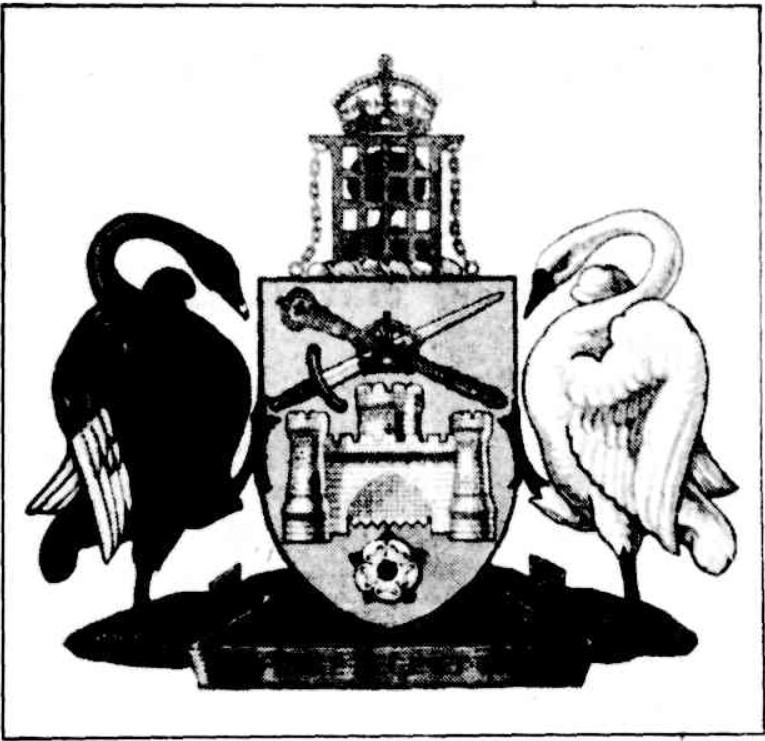
On the 1 August 1876, a daughter Millicent Birmingham Wylie was born to Mary at Roxburgh House.  Mary and the children later left Australia for England and Mary remarried. Her son Charles returned to Australia to live around 1924. Charles was am an interesting character. He was a writer under the pen name “Flinders Barr”.  In 1928 he won a competition for the design of a Canberra Coat of Arm still in use today.

CANBERRA COAT OF ARMS. (1929, May 2). The Argus, p. 5. http://nla.gov.au/nla.news-article4002833

Charles Roxburgh Wylie died at Warrawee, New South Wales on 17 November 1947.

ARNOTT, William – Died 2 May 1900 at Hamilton. William Arnott was born in Fifeshire, Scotland in 1842. With his parents, William arrived at Williamstown in 1850 and they made their way to Fiery Creek station (Streatham) where his father had work. He was then employed at William Skene’s station, Kanonalla on the Wannon River. On the way there, the family passed through Hamilton when it was known as The Grange and most of the settlement at the time was around the Grange Burn near Portland Road.

After five years at Kanonalla, the family moved to Hamilton. By that time William was fourteen and he went to work for blacksmith and wheelwright George Brownlees in Lonsdale Street as an apprentice.  Once qualified, William went into business with John Jones.

Advertising (1865, December 20). Hamilton Spectator and Grange District Advertiser, p. 1.  http://nla.gov.au/nla.news-article194470707

The partnership was dissolved in late 1874 and William entered into business with William Betts.  They took over the blacksmith business of the retiring John Denholm.

Advertising (1875, January 23). Hamilton Spectator p. 3. http://nla.gov.au/nla.news-article226076945

Around the same time, William entered into the retail trade with his brother James, taking over Mrs Fulton’s grocery business in Gray Street.

Advertising (1874, November 11) Hamilton Spectator., p. 1. http://nla.gov.au/nla.news-article226076157

Arnott and Betts then took over the undertaking business of David Arnott. They offered a free coach for those who couldn’t afford it and erected headstones and grave fences. They even had photos of the latest monument designs. 

Advertising (1876, May 31). Hamilton Spectator p. 1. http://nla.gov.au/nla.news-article226039620

In his personal life, William married Alice Sandry in 1869, and they went on to have nine children.  The family lived in a cottage behind the grocers in Gray Street.  In 1879, the couple’s infant son George died and in 1886, the couple lost their young son Norman Dundas. On 9 May 1887, their nine-year-old son Frederick died as a result of a fall from a wagonette near the Wannon. 

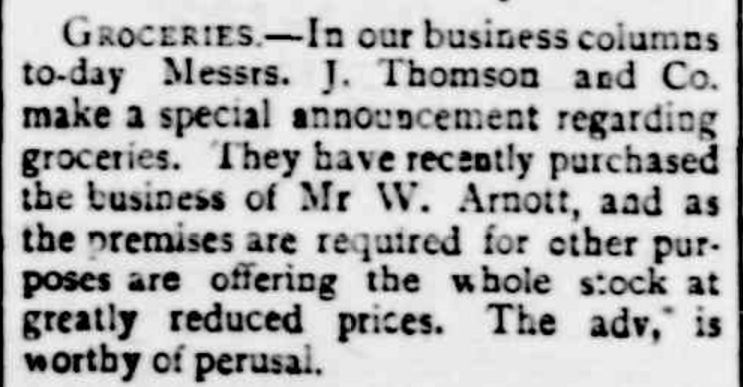
William was a Hamilton Borough Councillor from 1881 to 1887.  He was also a member of Hamilton’s Princess Alice Lodge of the Manchester Unity Independent Order of Oddfellows. He continued in his grocery business, eventually trading alone. By the end of the 1880s, he was operating as the Beehive Store, a cash grocer with produce and a steam chaff mill. In 1898, William sold to neighbouring store John Thompson & Co. who extended into his store.

The Portland Guardian,.” Portland Guardian  21 Dec 1898: 2 Edition: EVENING.

After the sale, the Arnotts moved to Cox Street, Hamilton. Less than eighteen months later, William was dead at the age of fifty-eight, leaving Alice, five sons, and one daughter.  He was buried at Hamilton (Old) Cemetery with his three sons and later Alice.

HEADSTONE OF WILLIAM ARNOTT AND FAMILY, HAMILTON (OLD) CEMETERY

HARRIS, George Cornfield – Died May 1904 at Colac. George Harris was born around 1831 in Coventry, England. He arrived in Melbourne in 1852 aged twenty-one.  Two years later he married Elizabeth Columbine and the couple settled in Prahran and started a family. In the early 1860s, George moved his family to Barongarook near Colac, however, Elizabeth died in 1863 leaving George with young children. On 10 June 1865, he remarried to Elizabeth Hilton of Geelong and they went on to have a large family together.

George was instrumental in the construction of a church and Sunday school at Barongarook West.  He was also the Barongarook West correspondent for the Colac Herald.  George’s obituary mentioned his “brightly” written pieces ensured the “wants and requirements of the forest country were brought before the public, and especially under the notice of the Colac Shire Council.”. Given that description, it would seem the following Barongarook update from the Colac Herald in 1894 may have been the work of George Harris.

BARONGAROOK. (1894, July 3). The Colac Herald, p. 3. http://nla.gov.au/nla.news-article91882409

At the time of his death, George had eight living children with four predeceasing him.

HUTTON, John Alexander – Died 2 May 1908 at Penshurst.  John Hutton was born in Tasmania around 1840.  When John was six his father David Hutton took up the Cheviot Hills run near Penshurst which he held until his death in 1875. At that time, John and his brother Thomas took up the property. In 1877, John married Christina Aitken of Penshurst and they went on to have two sons.

Fire touched Cheviot Hills a number of times but one deliberately lit during February 1892 caused much damage to the property. John and Thomas lost 2000 acres of grass, fencing, and valuable Merino rams.  John almost lost his life when fire encircled him while rounding up stock. 

EXTENSIVE BUSH FIRES. (1892, February 9). Hamilton Spectator p. 3. http://nla.gov.au/nla.news-article226163601

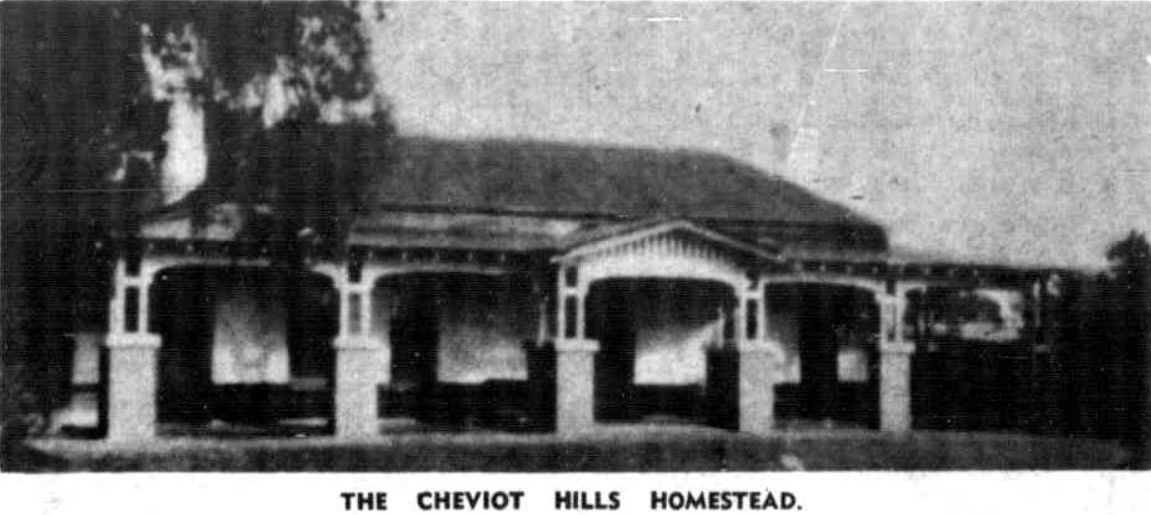
In 1900, Thomas died and the following year Cheviot Hills was subdivided.  John retained a portion including the homestead. 

FAMOUS PASTORAL PROPERTIES: Cheviot Hills Adjoins Penshurst in Rich Volcanic Country (1942, January 3). The Australasian p. 24. http://nla.gov.au/nla.news-article142415846

John was an active member of the Penshurst Presbyterian Church and sat on the Mt Rouse Shire council from 1887 until his death and was Shire President for much of his last ten years. He was also a trustee of the Penshurst Mechanics Institute. In September1905, a gig John was travelling in hit a rock and tipped over and John was thrown out.  He broke his thigh and suffered shock.  He died three years later aged sixty-eight leaving his widow Christina and two sons, Stanley and Oswald. He was buried at Port Fairy Cemetery.

JACKMAN, James – Died 27 May 1916 at Woodford.  James Jackman was born around 1847 near Tower Hill. He married Margaret Barry in 1867 and they went on to have ten sons and three daughters.  James was a champion ploughman, participating in ploughing matches as a participant and judge.  He was a crop and a dairy farmer, and his was considered a model farm.  James was also a director of the Farnham Cheese & Butter Factory.

GILL, James Bruce – Died 8 May 1918 at Sandford.  James Gill was born around 1849 in Aberdeen, Scotland, the son of a watchmaker. He arrived in Queensland in 1867 aged eighteen. After some time there, he travelled south and purchased Runneymede near Sandford in 1880.

‘RUNNYMEDE’ HOMESTEAD NEAR CASTERTON, 1977. Image courtesy of the J.T. Collins Collection, La Trobe Picture Collection, State Library of Victoria. http://handle.slv.vic.gov.au/10381/217175

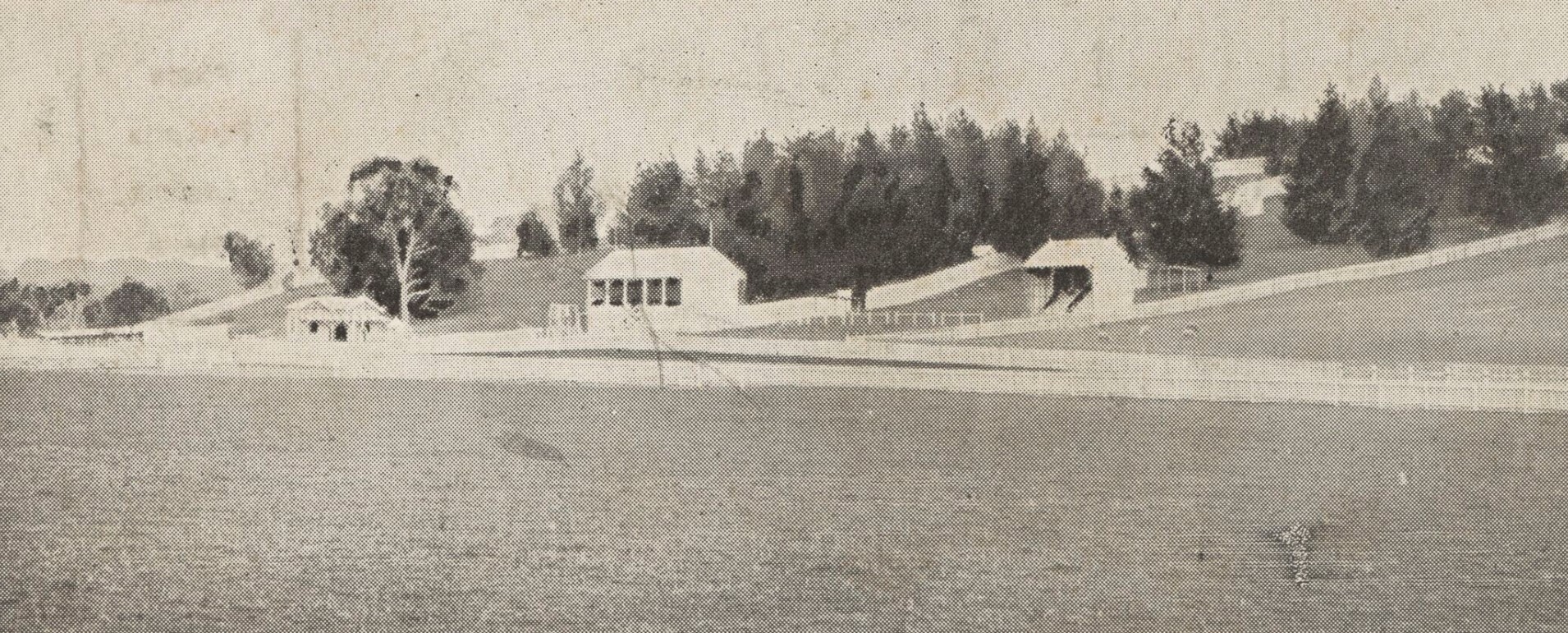
James was widely known in racing circles not only as President of the Casterton Racing Club for thirty years but also as an owner at metropolitan courses during the 1880s and 1890s. During his time with the Casterton Racing Club, the course was remodelled to take advantage of the hill on which the grandstand now sits. He also contributed half of the costs of the changes.

CASTERTON RACECOURSE c1905.
Image courtesy of the State Library of Victoria http://handle.slv.vic.gov.au/10381/399152

The next photo shows a meeting at the Casterton Racecourse in 1914 at a time James was president of the club.

CASTERTON RACECOURSE 1914. Image courtesy of the State LIbrary of Victoria https://collections.museumvictoria.com.au/items/767564

James also enjoyed hunting and was a member of the Melbourne Hunt Club while his paddocks at Runnymede became a retirement haven for retired hunters.  In 1894, artist Herbert Woodhouse completed the work below showing sixty prominent members of the Melbourne Hunt Club. Among them are several Western District ladies and gentlemen including those by the name of Manifold and Chirnside.  James was also depicted and I have coloured his jacket below.  You can view the work and the names of those illustrated on the link to the State Library of NSW – A Meeting of the Melbourne Hunt Club

‘A MEETING OF THE MELBOURNE HUNT CLUB’. Image courtesy of the Mitchell Library, State Library of New South Wales https://search.sl.nsw.gov.au/permalink/f/1cvjue2/ADLIB110332134

On 15 July 1885, James married Ruth Pennycuick at the Christ Church, Warrnambool. Ruth was the daughter of the Mayor of Warrnambool James Pennycuick and a granddaughter of William Rutledge late of Port Fairy and Farnham Park, Dennington.  The couple did not have children.

James was a familiar sight around the district driving his black ponies, four in hand, and would often drive them as far as Warrnambool for the races. His obituary remembered that “…beneath a brusque. blunt exterior, he carried a warm and sympathetic nature; being distinctly one for whom esteem increased on acquaintance. He was very generous to his employees, and was ready at all times to do a good turn to anyone”.  From a noted family, James’ older brother was Sir David Gill a Scottish astronomer and he was among a group of colonists named in Burkes Colonial Gentry in 1891.  He was buried at the Casterton New Cemetery.

VAGG, Laban – Died 8 May 1920 at Bostock’s Creek.  Laban Vagg was born around 1837 in Somersetshire, England. Laban joined the British Navy and in 1855, was part of naval activities during the Crimean War (1853-1856). In the late 1850s, he joined the rush to Australia and arrived at Geelong.  He found himself at Ewen’s Hill, Cobrico near Camperdown, and met Jonas Jeffers. He went on to do fencing work with Jonas and he also married Jonas’ sister or maybe daughter Elizabeth in 1863.  They went to have eight sons and two daughters. 

About 1890, Laban and his family moved to Bostocks Creek district where he took up dairy farming.  He was a member of the Hampden and Heytesbury Shire Pastoral & Agricultural Society for more than twenty-five years and a director of the Camperdown Cheese and Butter factory.

Elizabeth died in 1891 aged forty-seven.  Her youngest child was just four at the time. Laban died in 1920 aged eighty-three leaving eight sons and two daughters. He was buried at the Camperdown Cemetery.

SKILBECK, Richard – Died 12 May 1924 at Koroit.  Richard Skilbeck was born in 1838 in Compton, England. He arrived in Victoria in 1858 aboard the Salem.  He headed to Yangery Grange near Koroit owned by his uncle John Midgley.  He started work for them on the farm. In 1860, Richard purchased land in High Street, Koroit and built a small cottage. The following year he married his cousin Sarah Midgley.  Their new home was opposite the newly built Methodist Church which was most convenient as Richard was a devout Methodist and had been one of those who assisted with the construction of the church.   He was also a lay preacher and treasurer with the church.  In 1867, a new Methodist church was built (below).

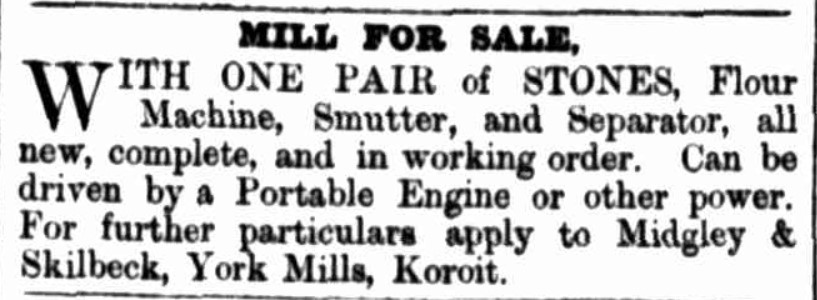
Richard acquired more land around Koroit and began growing tobacco used to treat scab in sheep. It proved to be a successful crop. In 1864, he became a part-owner in the York Mill at Koroit with his brother-in-law William Midgley but they only kept it for two years.

Advertising (1866, October 10). Hamilton Spectator and Grange District Advertiser (South Melbourne, Vic. : 1860 – 1870), p. 3. Retrieved May 24, 2020, from http://nla.gov.au/nla.news-article194471135

In 1866, Richard took over the management of Yangery Grange after the death of John Midgley.  Richard’s successful farming practices saw the property become well known in the district.  In 1889, Yangery Grange was the equal runner up in a Prize Farms competition conducted by the government.  The judges found Richard’s farm was, “certainly one of the very best, neatest and most profitably managed holdings in the Tower Hill district”

GOVERNMENT PRIZE FARMS’ COMPETITION. (1889, September 21). Leader (Melbourne, Vic. : 1862 – 1918, 1935), p. 10. Retrieved May 24, 2020, from http://nla.gov.au/nla.news-article198058642

It’s was said, Richard was the first in the district to use a threshing machine in partnership with Mr Holden of Port Fairy.  He eventually owned three threshing plants that worked full time at harvest time.


AN EXAMPLE OF A THRESHING PLANT, 1910. Image courtesy of the Museums Victoria Collections https://collections.museumvictoria.com.au/items/771220

Richard was on the committees of the Warrnambool and Koroit Pastoral and Agricultural Societies and served as President of both. He also was an exhibitor, showing his pigs, sheep, and cattle.  About 1890, he bought into the Koroit Butter Factory.  At the time, the factory wasn’t going well so Richard personally guaranteed the bank so the factory could continue to operate.  He was also chairman of the butter factory board for a good part of his thirty years involvement and chairman at the time of his death. He also represented the Koroit factory on the board of directors of the Western District Cooperative Produce and Insurance Company.

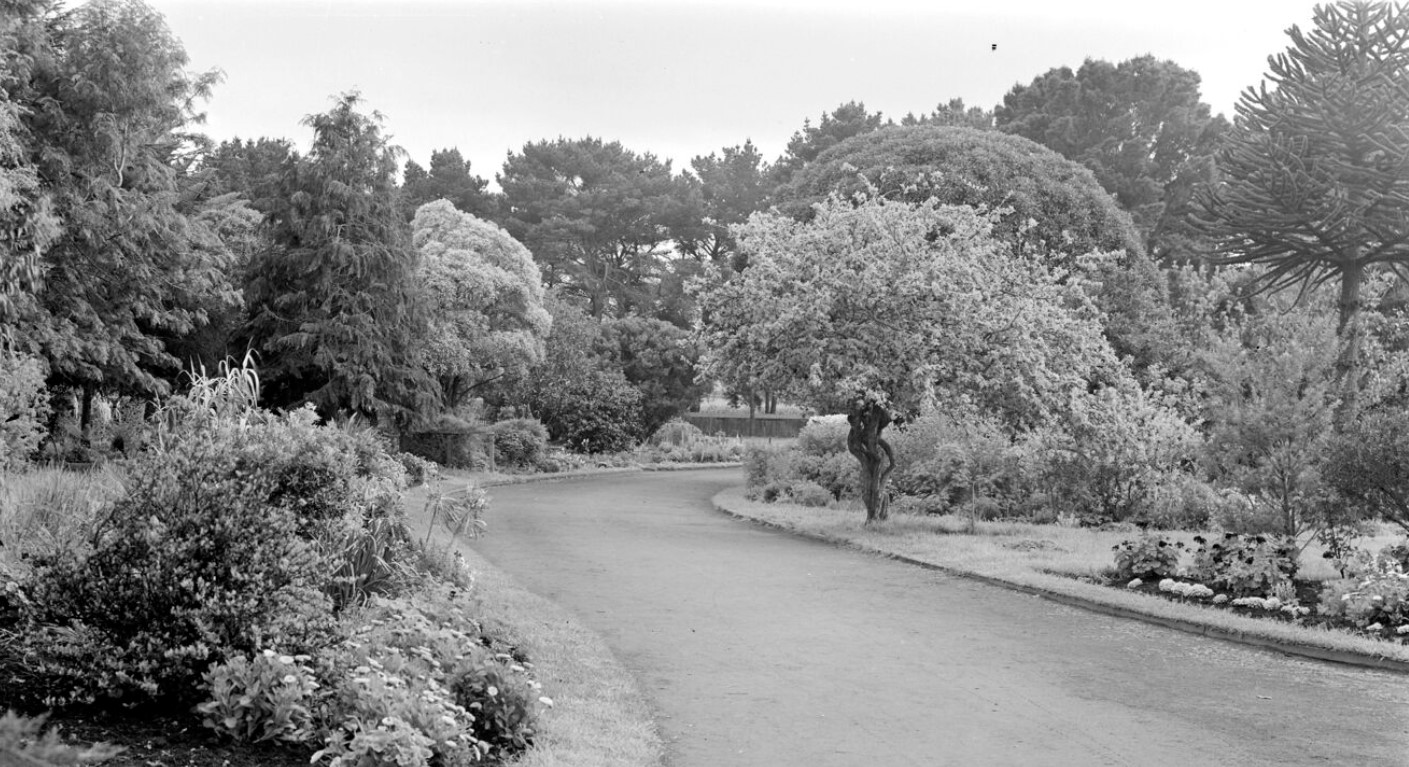
As a Methodist, Richard led a life of temperance and was the founding member of the Koroit Independent Order of Rechabites, a temperance organisation. He also collected funds to build a Temperance Hall in Koroit which also incorporated the Koroit Mechanics Institute.  He was also a trustee of the Koroit Botanic Gardens.

KOROIT BOTANIC GARDENS. Image courtesy of the State Library of Victoria http://handle.slv.vic.gov.au/10381/443593

In 1893, Sarah died aged sixty-one.  In 1907, at the age of 70, Richard travelled to his home town in England and married a woman he knew before he left for Australia, Charlotte Dunn (nee Stables).  Charlotte herself had married after Richard left for Australia but was widowed.  Back in Australia, they settled into life at Yangery Grange and remained there until Richard retired when they moved to nearby Hillcrest owned by his son Alfred. Richard died at Hillcrest in 1924 aged eighty-seven, leaving five children. Two sons and one daughter predeceased him. Charlotte died on 5 October 1922 at Hillcrest

Richard’s obituary in the Koroit Sentintal mentioned his

Strength of character, intelligence, thrift, courage and other sterling qualities were possessed by their departed brother. Few men were so widely known throughout the State – certainly none in a Methodist connection – as Richard Skilbeck. He had known him for over 40 years and had on numerous occasions enjoyed his hospitality, and he knew that the inmates of his home were very dear to him. He not only founded a Christian home, but constantly showed his interest in the house of God. It was largely owing to him that the church was founded at Koroit and he had been an officer and administrator from its beginning. He would be sadly missed from the life of the church throughout the State.

In 1967, Harry McCorkall of Koroit edited and published The Diaries of Sarah Midgley and Richard Skilbeck: A Story of Australian settlers 1851-1864 which is a great read. More information about the Midgley and Skilbeck families can also be found at the Midgley family website

McCANN, Margaret Jane – Died 27 May 1947 at Dartmoor. Margaret McCann was born at Sandford in 1864.  As a young woman, Margaret was a good rider and would accompany her brother Peter on kangaroo hunts.  She married Daniel Sullivan in 1885 and they went on to have seven children.  After the birth of her own children, she acted as a midwife in the Dartmoor district. 

Margaret’s son Joseph enlisted in 1916 with the 38th Battalion while Margaret did her bit at home.  She was involved with the Dartmoor Red Cross, the local Comforts Fund, and the Catholic Church committee.  Sadly, Joseph was killed on 15 April 1918 in France. 

Margaret was eighty-four at the time of her death leaving three sons and two daughters.  Three of her siblings were still living, Peter aged eighty-five and Bella at Sandford aged eighty-seven, both of Sandford and Ann at Tallangatta.  Margaret was buried at the Dartmoor Cemetery.