Trove Tuesday – The Oldest Man in Victoria

The intention for this week’s Trove Tuesday post was brevity.  But as often the way, as I investigated my chosen article further, I discovered a few twists and turns.

Mentioned last week, The Australasian has arrived at Trove and I’ve been searching for photos relevant to the Western District.  That is how I discovered Aaron Weller, the subject of a photo in The Australasian in 1897.

THE OLDEST MAN IN VICTORIA. (1897, July 24). The Australasian (Melbourne, Vic. : 1864 - 1946), p. 23. Retrieved February 23, 2014, from http://nla.gov.au/nla.news-article139744803

THE OLDEST MAN IN VICTORIA. (1897, July 24). The Australasian (Melbourne, Vic. : 1864 – 1946), p. 23. Retrieved February 23, 2014, from http://nla.gov.au/nla.news-article139744803

On 24 July 1897, The Australasian published an article and photograph of Aaron Weller, headlined “The Oldest Man in Victoria”.  A Mr George Baird had come across Aaron, living in the Balmoral area, listened to his story and took a photograph.  Aaron told George he was born in Wimbledon, England on 11 August 1790.  By the 1830s, he was in Tasmania where he worked for the Circular Head Company.  Later in the ’30s, aboard the Henry he sailed to Port Phillip, obtaining work as a shepherd with Phillip Rose at his pastoral run Rosebrook, near Horsham.  Mr Rose must have felt something for Aaron as, on a trip back to England, Phillip picked up Aaron’s birth certificate.  It was later destroyed in a fire at the Rosebrook homestead during Black Thursday, 1851.

After 1851, Aaron was working for Mr Robertson at his property Mount Mitchell near Lexton.  With the discovery of gold just south at Ballarat,  all the property’s labourers took off to try their luck, all except Aaron. He was content to stay on as a shepherd and besides, he was into his 60s.  He then headed across the Murray, continuing as a shepherd until he gained employment with Alex McIntosh at his property Glendinning near Balmoral where Aaron remained for 22 years.  After the death of Alex McIntosh,  Aaron moved to nearby Rocklands and even after he passed the age of 100, he was still chopping wood.

The digitised copy of the article is very faint but you can read it in full on the following link, http://nla.gov.au/nla.news-article139744803, but it concluded in this way:

THE OLDEST MAN IN VICTORIA. (1897, July 24). The Australasian (Melbourne, Vic. : 1864 - 1946), p. 23. Retrieved February 23, 2014, from http://nla.gov.au/nla.news-article139744803

THE OLDEST MAN IN VICTORIA. (1897, July 24). The Australasian (Melbourne, Vic. : 1864 – 1946), p. 23. Retrieved February 23, 2014, from http://nla.gov.au/nla.news-article139744803

And that’s the story of Aaron Weller.  Well at least I thought it was, but I wanted to know how far past 107 Aaron had lived.  The story turns sad as Aaron only lived a short time after 24 July 1897, the date of his article’s publication.   The Balmoral correspondent for the Hamilton Spectator reported that almost to the hour the 24 July edition of The Australasian landed in Balmoral, the townspeople were bidding farewell to Aaron at the local cemetery.  According to his wishes, he was buried close to Alex McIntosh, the man who employed him for over twenty years and whom he held in such high regard.

After his death, the Horsham Times remembered Aaron Weller through the reminisces of Rocklands owner, Mr Turnball.  Aaron had told him tales of the Duke of Wellington and Waterloo,  George III and William IV.  Maybe delirious in his last days, he claimed he was off to Melbourne to retrieve a sum of £40,000, the dividend of a £100 investment, money given to him by Angela Burdett-Coutts, a 19th English philanthropist and her husband the Marquis of Westminster.

The Horsham Times. (1897, August 3). The Horsham Times (Vic. : 1882 - 1954), p. 2. Retrieved February 23, 2014, from http://nla.gov.au/nla.news-article73121416

The Horsham Times. (1897, August 3). The Horsham Times (Vic. : 1882 – 1954), p. 2. Retrieved February 23, 2014, from http://nla.gov.au/nla.news-article73121416

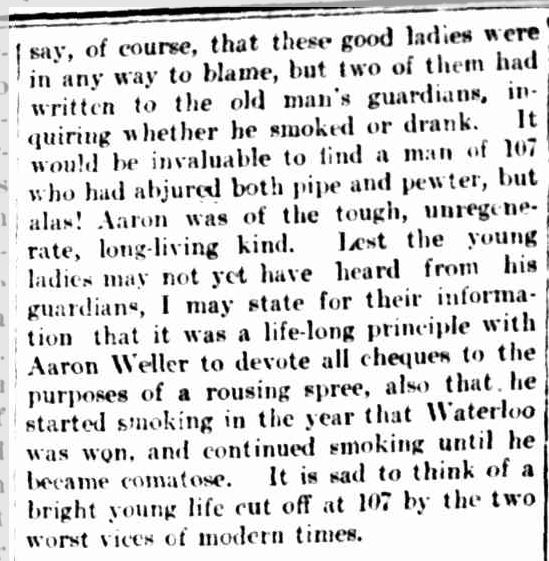
The Australasian article, probably published without Aaron’s knowledge, was thought to have brought unwanted attention to him.  He had spent sixty years keeping to himself in Victoria, living a simple life with dogs as companions. But he’d been in the papers before when he turned 100 and again when he turned 106.  On that occasion, Mr Turnbull held a celebration in Aaron’s honour    How much Aaron knew about The Australian article, which in no way mentioned his liking for a drink or his pipe, and the resultant public reaction is unknown but reports after his death suggest he may have had some knowledge.  The Australian responded to his passing,

aw3

TALK ON 'CHANGS. (1897, August 7). The Australasian (Melbourne, Vic. : 1864 - 1946), p. 32. Retrieved February 23, 2014, from http://nla.gov.au/nla.news-article139745269

TALK ON ‘CHANGS. (1897, August 7). The Australasian (Melbourne, Vic. : 1864 – 1946), p. 32. Retrieved February 23, 2014, from http://nla.gov.au/nla.news-article139745269

While they said they were not blaming the Women’s Christian Temperance Union (W.C.T.U.) as such, they weren’t exactly shying away from the possibility.  Not so subtle was the Freeman’s Journal (Sydney), a Catholic newspaper that in 1942 merged with the Catholic Press to become the Catholic Weekly.  The Freeman’s Journal was not an official publication of the Catholic Church, but it offered news of a Catholic and Irish nature.
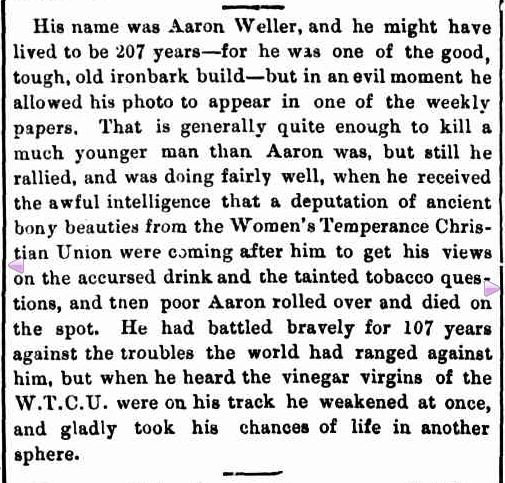
 ACTA POPULI. (1897, September 18). Freeman's Journal (Sydney, NSW : 1850 - 1932), p. 8. Retrieved February 24, 2014, from http://nla.gov.au/nla.news-article115469610

ACTA POPULI. (1897, September 18). Freeman’s Journal (Sydney, NSW : 1850 – 1932), p. 8. Retrieved February 24, 2014, from http://nla.gov.au/nla.news-article115469610

If the article about Aaron had not been published, would he have lived for another year or two?  Or was his time up anyway?  Looking back at the concluding paragraph of the original article, Aaron was tiring.  Maybe, if the W.C.T.U. did write a letter to Aaron’s guardians, presumably the Turnballs. maybe they too could sense his weariness through his photo and words.

Aaron’s story was interesting.  Interesting enough to see what else could be found.  A search of Australian records at Ancestry.com.au revealed within the New South Wales and Tasmania Australia Convict Muster records (1806-1849),…Aaron Weller, assigned to Mr John Sinclair, 1833.  On to the English records and there was Aaron Weller in the Australian Convict Transport Register 1791-1868, convicted at Kent and sentenced to transportation for seven years.  His crime, listed in the England & Wales Criminal Registers, 1791-1892, was fraud.  Next, across to Tasmania’s Heritage website and the convict index and there again was Aaron Weller,  transported aboard the Gilmour from London on 27 November 1831, arriving at Tasmania on 22 March 1832.

After all of that, I couldn’t find the age of the said convict, Aaron Weller.  If it was Aaron of Balmoral, he would have been forty-one at the time of his departure from England.  I did find one other Aaron Weller, and of Kent, in the UK Land Tax Redemption Records from 1798, eight years after Aaron’s birth.

Back to Trove, and I searched for Aaron Weller through the 1830s and, looking to confirm some of Aaron’s story, I searched for the Henry, the ship Aaron said he sailed aboard to Victoria.  Despite not having any ages to match up Aaron, the results of my two searches found something that may get me a little closer to confirming Aaron Weller of Balmoral came to Australia as a convict.  In May 1836, convict Aaron Weller, only three years into his seven-year term, was granted a ticket of leave.  Coincidentally, on 15 July 1836, the Henry, Balmoral Aaron’s ship, sailed from Launceston to Port Phillip.
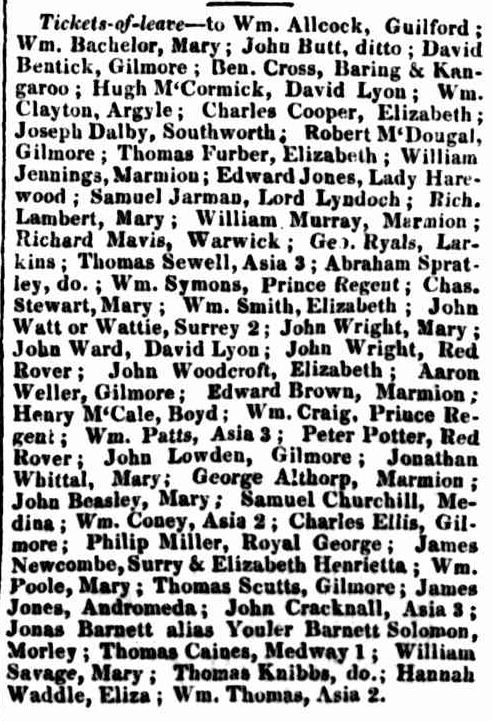
Classified Advertising. (1836, May 20). The Hobart Town Courier (Tas. : 1827 - 1839), p. 1. Retrieved February 24, 2014, from http://nla.gov.au/nla.news-article4176331

Classified Advertising. (1836, May 20). The Hobart Town Courier (Tas. : 1827 – 1839), p. 1. Retrieved February 24, 2014, from http://nla.gov.au/nla.news-article4176331
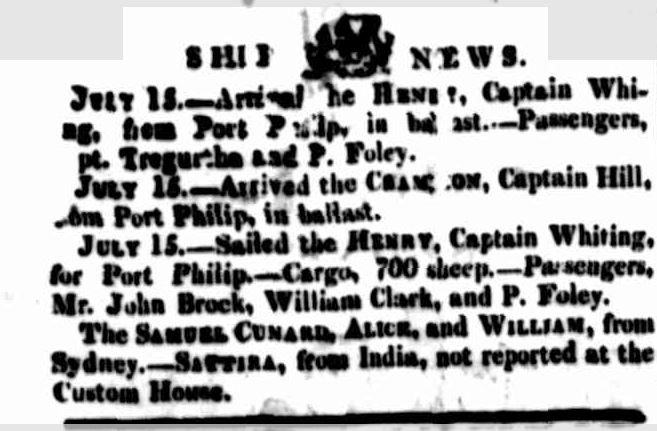
SHIP NEWS. (1836, July 16). The Cornwall Chronicle (Launceston, Tas. : 1835 - 1880), p. 2. Retrieved February 24, 2014, from http://nla.gov.au/nla.news-article65950241

SHIP NEWS. (1836, July 16). The Cornwall Chronicle (Launceston, Tas. : 1835 – 1880), p. 2. Retrieved February 24, 2014, from http://nla.gov.au/nla.news-article65950241

Bric-a-Brac

You may have noticed mostly Trove Tuesday posts and monthly Passing of the Pioneers from me lately, but there’s been a good reason.  Aside from  school holidays, that always slow me down, and family keeping me busy in general,  I’ve been writing the history of the Harman family of Byaduk for a Diploma in Family Historical Studies.  So for something different, I thought I would share some snippets from my research so far and some other news.

It’s been difficult for me to get to the out-of-town places that may hold information to help my Harman research, but I’ve found ways around it.  I’ve mentioned in a earlier post about an email enquiry to the Port Fairy Historical Society that resulted in some wonderful Harman history forwarded to me.  I have also contacted both Macarthur Historical Society and Hamilton Historical Society by email to first find out what they have, to weigh up a visit.  Unfortunately, I can cross Macarthur H.S. off my list but Hamilton H.S. do have some other bits and pieces relevant to the Harmans’ lives in Byaduk that will help develop their story.  There is still the Port Fairy Genealogical Society , somewhere I hoped to visit during a short holiday to the town in January.  The heat got the better of me and the beach won out.  I will now have to resort to an email enquiry.

HARMAN VALLEY,  BYADUK

HARMAN VALLEY, BYADUK

I’ve known for sometime that the State Library of Victoria held a copy of a letter written about the voyage of the “Duke of Richmond” to Portland in 1853, the same voyage that brought James and Susan Harman to Victoria.  I’ve always had great intentions to get to the library and view it, but I realised that was not going to happen.  Instead, I made use of the Library’s wonderful copying service and last week I received a copy of a beautiful letter from 1853 written by Mrs Maria Taylor (nee Ridgeway), just after her arrival at Portland.  She describes aspects of the voyage including the food and the crew and the conditions on arrival at Portland including the price of vegetables and employment opportunities.

Archival Access has been a life saver for records from the Public Records Office of Victoria (PROV).  Recently I received a disc in the mail with a copy of the Victorian Inquest file for a cousin, Charles Frederick Ward, who died in the Ballarat Asylum in 1928.  I am trying to build a profile of Charles, knowing little of him except his birth and death dates and that his mother, Isabella Harman, died while giving birth to him, an only child.

The most significant thing I had found to date, thanks to James Harman’s will, was that Charles’ aunt, spinster Henrietta Harman, a  daughter of James, played a big part in his upbringing.  Henrietta is the person who my Harman history will revolve around and to know more about Charles is vital in reaching my final conclusions.  Details from the inquest were useful and I discovered he was only in the asylum a matter of weeks ,taken there by the police after being found in a malnourished and agitated state in Ballarat.  He was 42 when he died.

IMG_1830 (800x600)
Also on my Archival Access disc were Wills and Probate records for my gg grandfather, Reuben James Harman, gg aunt Henrietta Harman and ggg uncle Jonathan Harman.  Well, well, well.  The things I have found out about the Harman family dynamic, particularly those I am directly descended from is amazing and while not altogether surprising, it was still confronting to see the written proof.  Henrietta’s will is an absolute gem and some of the items she bequeathed where her Mason & Hamlin organ and framed photos of her parents James and Susan Harman, her brother Albert, her nephew Charles Ward and herself.  What I would do to see a photo of Henrietta.  I still have some more  Probate records to get from PROV, so I will again call on the  wonderful services of Archival Access.

So that’s my thesis, but I’ve been up to a some other things.  My I’ve Lived in Hamilton, Victoria Facebook group continues to grow. now with 2313 members and over 1800 photos.  I highly recommend anyone with a family link to Hamilton and even the surrounding towns to check it out.   We have some keen family and local historians among the members and those that have joined for research purposes have had success.  I have found that someone usually knows something about most topics raised and we have all enjoyed learning more about our hometown.

hamo4

THE TOWN OF HAMILTON.
THE NORDENFELT GUN IN ACTION : A SKETCH ON THE DETACHED SQUADRON. (1881, July 16). The Australasian Sketcher with Pen and Pencil (Melbourne, Vic. : 1873 – 1889), p. 225. Retrieved February 20, 2014, from http://nla.gov.au/nla.news-article60622490

Some mini-reunions have evolved from the group, but on the past weekend, over 30 former Hamilton residents attended a reunion in Brisbane.  They had a fantastic day and are planning another for 2015.  Thank you to Helen for getting the reunion up and running and those that helped her with memorabilia and other arrangements. It really has been wonderful to see not only the reunions, but the collaboration among members to solve mysteries, share stories and discuss current Hamilton events and issues.

Don’t forget the Western District Families Facebook page.  “Likes” are about to reach 150 which is exciting and it’s been great to see others sharing photos to the page.

As mentioned,  I was in Port Fairy in January and amassed an array of photos.  Currently, I’m slowly preparing two posts, each on the Port Fairy Cemetery.  I hope to get a least one of them out soon .  Also, I have ideas for posts coming out my ears, but I will just have put them on hold until the second half of the year, but there will be some good things to look forward to in the meantime.  We will continue The Vagabond‘s journey through the Western District, finishing off the Portland area and then on to Warrnambool, and  I still have many photos from a Portland trip two years ago to share.  And I have some more Hamilton photos along with some interesting stories I’ve picked up from the Hamilton group and of course some more great stories about my Western District Families.

A Hint of Port Fairy

A Hint of Port Fairy

To close, may I share a little from Edna Harman’s history of the Harman family of Port Fairy.  Edna was a granddaughter of George Hall Harman.  Unmarried, she served with the RAAF in WW2 and after that devoted much of her time to recording and preserving the history of Wangaratta, writing a book and tirelessly volunteering with the Wangaratta Historical Society.  The following is an excerpt from her closing paragraph about her maternal grandparents the Grahams of Port Fairy.  The subject is Edna’s great-grandmother Mary Graham.

“My eldest cousin often tells me she can recall seeing great Grandmother (Mary) Graham and she remembers her bests as a ‘little old lady sitting up in bed, smoking, of all things a pipe’.  Mary Graham died in 1898 at the age of 93 years” (Harman Family History,(1970), Held by the Port Fairy Historical Society)

Trove Tuesday – The Australasian

Editions of The Australasian Melbourne (1864-1946) began arriving at Trove in early January and since there has been five further updates.  On my first search of the paper, and there are still many issues “coming soon”, I was pleased to find many articles, with photos, that are of interest to me.

The Australasian grew out of the  Weekly Argus (1855), Examiner and Melbourne Weekly News (1857), Yeoman and Australian Acclimatiser (1861), with the first issue published on October 1, 1864.  Later,  Bells Life in Victoria and the Australasian Sketcher (1873) merged with The Australasian.  Sold as a “town and country” paper,  it includes plenty of news from Western District towns.  The Australasian became the Australasian Post in 1946.

There was one photo I was keen to get access to from The Australasian, that of “Bewsall”, the home of Robert Stapylton Bree of Hamilton.  I have searched everywhere for a photo of the house which no longer exists,  but I had seen one in Don Garden’s book, “Hamilton, A Western District History” (1984), sourced, including others in the book, from The Australasian.  Well, the photo of “Bewsall” is now available and you can see it below.

HAMILTON. (1903, May 2). The Australasian (Melbourne, Vic. : 1864 - 1946), p. 27. Retrieved February 18, 2014, from http://nla.gov.au/nla.news-article138684187

HAMILTON. (1903, May 2). The Australasian (Melbourne, Vic. : 1864 – 1946), p. 27. Retrieved February 18, 2014, from http://nla.gov.au/nla.news-article138684187

The following photo is of Hamilton’s main street, Gray Street, published in 1903.  The Christ Church steeple is in view as well as the black face of the Hamilton Post Office clock, later changed to white.

IN AND AROUND HAMILTON, INLAND METROPOLIS OF THE WESTERN DISTRICT. (1903, May 2). The Australasian (Melbourne, Vic. : 1864 - 1946), p. 26. Retrieved February 18, 2014, from http://nla.gov.au/nla.news-article138684186

IN AND AROUND HAMILTON, INLAND METROPOLIS OF THE WESTERN DISTRICT. (1903, May 2). The Australasian (Melbourne, Vic. : 1864 – 1946), p. 26. Retrieved February 18, 2014, from http://nla.gov.au/nla.news-article138684186

Influence from Bells Life in Victoria,  a  sports newspaper, is present in The Australasian, which has some great sporting photos, including the following from the 1902 Hamilton Golf Tournament.

HAMILTON GOLF MEETING. (1902, August 9). The Australasian (Melbourne, Vic. : 1864 - 1946), p. 33. Retrieved February 18, 2014, from http://nla.gov.au/nla.news-article139129326

HAMILTON GOLF MEETING. (1902, August 9). The Australasian (Melbourne, Vic. : 1864 – 1946), p. 33. Retrieved February 18, 2014, from http://nla.gov.au/nla.news-article139129326

As I page through the many illustrated articles from The Australasian, I can see that there are still many more articles with photos to come from the Hamilton district.  Thank you Trove, for once again providing us with such a wonderful newspaper.

Trove Tuesday – Hong Sip of Cavendish

One of the great things about the Facebook group “I’ve Lived in Hamilton, Victoria”, is you just never know what is going to turn up.

Over the weekend, member Emma posted photos of a Hamilton Spectator dated Saturday 11 March 1876, found in the roof of Emma’s house undergoing renovations.  One of the photos was of the Dundas Shire Rate valuations for the South Riding.  On the list were my Haddens.  Emma posted a photo of the entire list, and there was another name that caught my interest: Hong Sip.  I mentioned to the group that I would find out more about him and headed to Trove, the first place I go when there are history queries in the group.  As usual, I got a result.

In 1869, a cook, Hong Sip, married a local girl, Margaret Moran.  The Cavendish correspondent was unsure of the name of Hong Sip’s bride, but unlike him, I have access to marriage records.  However, he wrote a lovely account of the occasion and displayed a very optimistic outlook about accepting Interracial marriages.

[No heading]. (1869, April 19). Illustrated Australian News for Home Readers (Melbourne, Vic. : 1867 - 1875), p. 90. Retrieved February 9, 2014, from http://nla.gov.au/nla.news-page5732859

(1869, April 19). Illustrated Australian News for Home Readers, p. 90.  http://nla.gov.au/nla.news-page5732859

To follow-up, I also found this reference to Hong Sip, known as John, after his death in 1885.

[No heading]. (1885, May 9). The Argus (Melbourne, Vic. : 1848 - 1957), p. 6. Retrieved February 10, 2014, from http://nla.gov.au/nla.news-page271825

(1885, May 9). The Argus, p. 6. http://nla.gov.au/nla.news-page271825

From there, I learnt of the sad demise of Hong Sip. On 13 December 1884, while working at Muntham Station near Coleraine, Hong Sip was callously assaulted.  Two men, John Fleming and George Traill, were arrested for the assault.  On 12 January 1885, Hong Sip was admitted to the Hamilton Hospital with inflammation of the lung and died there on 28 January.  The charges against Fleming and Traill were upgraded to manslaughter, and Margaret gave evidence at the trial.  They were found guilty, and Fleming served three months imprisonment and Trail, two months. 

“THE MUNTHAM OUTRAGE INQUEST.” Hamilton Spectator (Vic. : 1870 – 1918) 5 February 1885: <http://nla.gov.au/nla.news-article225656599&gt;.

Margaret and her children, at least five, remained in Cavendish. Margaret died in 1921 at Hamilton aged 69. Her burial took place at the old Cavendish Cemetery on the banks of the Wannon River.

Trove Tuesday – Beasts of Burden

While researching my great-great-uncle Reuben Edward Harman for the Harman family history I’m writing, I’ve been scouring Trove for everything I can find on the 13th Light Horse Regiment, with whom Reuben served during WW1.  Letters home from the boys in the trenches are a great way to get a feel for their war experience.  Daily routines, the sights and smells, and mentions of other soldiers, either from the same battalion or from the same hometown, can all help our understanding of how our family members spent their time in the armed forces during wartime.

The following extract from a letter by Sergent A. Louis Dardel of Batesford Victoria, caught my eye because it mentions the donkeys that worked so hard for the Australian troops, and those of other countries, carting supplies, and injured soldiers over the rough terrain of ANZAC Cove.  The 13th LHR were at Gallipoli, minus their horses.  They were kept back in  Egypt because the Turkish terrain was not considered suitable for them.  The nimble donkeys were their substitutes.

SERGT. A. L. DARDEL. (1915, December 4). Geelong Advertiser (Vic. : 1857 - 1918), p. 8. Retrieved February 3, 2014, from http://nla.gov.au/nla.news-article130708312

SERGT. A. L. DARDEL. (1915, December 4). Geelong Advertiser (Vic. : 1857 – 1918), p. 8. Retrieved February 3, 2014, from http://nla.gov.au/nla.news-article130708312

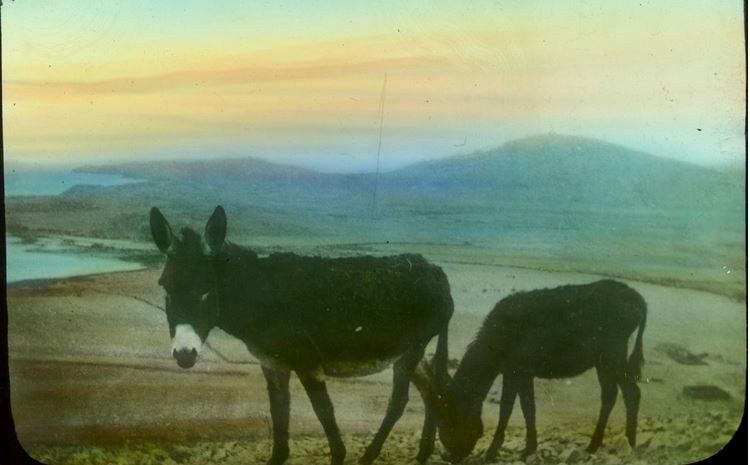
There had to be photos of the WW1 donkeys, so I searched Trove and found many photos from various sources including the Australian War Memorial and the State Library of Victoria.  The following are a selection of those.

This photo was taken before the Gallipoli landing.  The donkeys were purchased on Lemnos en route to Gallipoli travelling aboard the HMT Ascot.

DONKEYS ABOARD THE HMT ASCOT EN ROUTE TO GALLIPOLI, APRIL 1915 P05927.011.002http://www.awm.gov.au/collection/P05927.011.002

DONKEYS ABOARD THE HMT ASCOT EN ROUTE TO GALLIPOLI, APRIL 1915 P05927.011.002http://www.awm.gov.au/collection/P05927.011.002

This little donkey is the closest I could find to the donkey laden with water bottles mentioned in Sargent Dardel’s letter.

Image Courtesy of the Australian War Memorial. Image No. P01116.009 http://www.awm.gov.au/collection/P01116.009

Image Courtesy of the Australian War Memorial. Image No. P01116.009 http://www.awm.gov.au/collection/P01116.009

No, this is not John Simpson.  In fact, it is Pte. Richard Alexander Henderson, a member of the New Zealand Expeditionary Force, leading the donkey.  Later in the war, he received a Military Medal.

Image Courtesy of the Australian War Memorial. Image no. P03136.001 http://www.awm.gov.au/collection/P03136.001

Image Courtesy of the Australian War Memorial. Image no. P03136.001 http://www.awm.gov.au/collection/P03136.001

Just as the letter suggests, there was some time out for the donkeys.

DONKEYS AT GALLIPOLI. Image courtesy of the State Library of Victoria. Image no. H83.103/218 http://handle.slv.vic.gov.au/10381/43371

DONKEYS AT GALLIPOLI. Image courtesy of the State Library of Victoria. Image no. H83.103/218 http://handle.slv.vic.gov.au/10381/43371

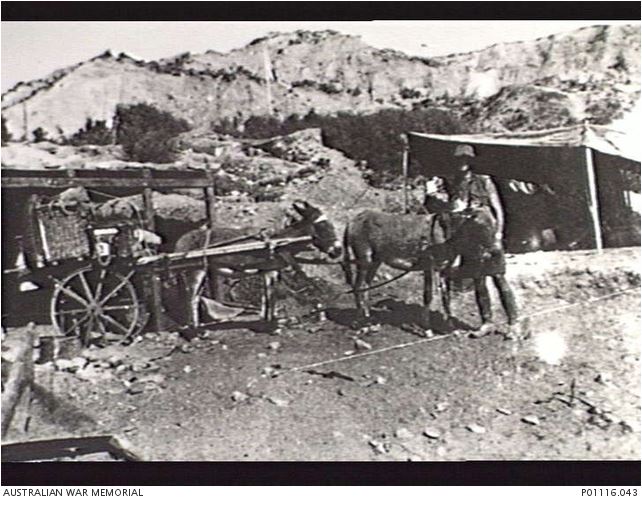
Donkeys were also used to pull carts.

Image Courtesy of the Australian War Memorial. Image no. P01116.043 http://www.awm.gov.au/collection/P01116.043

Image Courtesy of the Australian War Memorial. Image no. P01116.043 http://www.awm.gov.au/collection/P01116.043

As we draw closer to the centenary of WW1, when we take time to remember those that fought for our country, we should also remember the animals that made the task easier, donkeys, horses, and dogs.  They had no choice in being there and not only did many lose their lives they also worked under extreme conditions.

Image Courtesy of the State Library of Victoria. Image no, P02282.012 http://www.awm.gov.au/collection/P02282.012

Image Courtesy of the State Library of Victoria. Image no, P02282.012 http://www.awm.gov.au/collection/P02282.012

Passing of the Pioneers

A small band of pioneers for January, ranging from the rich and influential through to a bullock wagon driver who drove produce to the ports, to aid the rich and influential become more so. There is also the obituary of Catherine Grady, an Irish Famine orphan.

Francis HENTY: Died January 1889 at Kew.  Francis Henty featured here several times, was one of the Henty brothers, early European settlers at Portland. Francis had a house at Portland, one that I have written a post about, Claremont, but he spent much of his time at the Henty property, Merino Downs, and in later in life, his home Field Place in Melbourne where he passed away. Noted in his obituary, that while his presence was often not felt in the town, post the settling of Merino Downs, Francis Henty’s donations over the years were much appreciated.

The Portland Guardian,. (1889, January 16). Portland Guardian (Vic. : 1876 - 1953), p. 2 Edition: EVENING. Retrieved January 29, 2014, from http://nla.gov.au/nla.news-article63591640

The Portland Guardian,. (1889, January 16). Portland Guardian (Vic. : 1876 – 1953), p. 2 Edition: EVENING. Retrieved January 29, 2014, from http://nla.gov.au/nla.news-article63591640

FRANCIS HENTY (c1890) Artist unknown.  Image courtesy of the State Library of Victoria.  Image no. H24630 http://handle.slv.vic.gov.au/10381/91524

FRANCIS HENTY (c1890) Artist unknown. Image courtesy of the State Library of Victoria. Image no. H24630 http://handle.slv.vic.gov.au/10381/91524

Catherine GRADY: Died 3 January 1916 at Macarthur. Catherine Grady was born around 1836 in Wexford, Ireland and arrived in Port Fairy at seventeen. She married Archibald Hamilton there are they moved to Mt. Napier station where they remained for many years, then on to Macarthur where they both remained until their deaths.  Catherine was a nurse and it was said she attended over 300 maternity cases. Catherine and Archibald raised a family of twelve children.  I found Catherine on the Famine Orphan Girl Database on the Irish Famine Memorial (Sydney) website.

John Sinclair COX: Died 11 January 1918 at Hamilton. John Cox was born in Ireland in 1850 and travelled to Victoria with his family around 1857.  He resided in the Hamilton district almost from that time and ran a successful butcher shop. At one time, he ran for the Shire of Dundas but was unsuccessful. John passed away at Greenwood Park, Hamilton and left a widow, two sons and one daughter.

Matthew TOWNSEND: Died January 1916 at Portland. Matthew Townsend was born in Cambridgeshire in 1832 and arrived in Adelaide in 1857, but travelled on to Digby. In 1865, he opened a store in Digby that he ran for forty-three years, including forty as postmaster. Matthew married around 1867. He had many stories to tell of the old times in Digby included four-in-hand coaches, wool wagons and visits by Adam Lindsay Gordon. In his later years, Matthew moved to Portland where he passed away. He was buried at Digby cemetery.

Mary Ann MURPHY: Died 26 January 1918 at Willaura. Mary Ann Murphy was an early pioneer, born around 1843, and she and her husband Patrick Nicholson, settled at Warracknabeal in the “early days of agricultural development”. Around the turn of the century, Mary Ann and Patrick moved to the Ararat district, taking up a sub-division at Willaura,  Mary-Ann and Patrick raised a family of fourteen.

Elizabeth Jane PETERS: Died January 1923 at Warracknabeal.  Elizabeth Peters was born at Digby on “Black Thursday” 1851, her father having arrived with the Hentys some years before. After her marriage to Henry Lang in 1872, they settled at Merino. After Henry’s death, Elizabeth moved to the north-west of Victoria to live with her son, where she remained until her death.

Mark KERR: Died 31 January 1925 at Portland. Mark Kerr was born around 1850 at Portland, and it was noted he was born in the “Police Paddock”, not far from the place he died seventy-five years later. Having been born in a paddock, it was fortunate Mark’s father was a doctor, but it was thought he didn’t practice in Portland. Mark Kerr worked as a teamster, driving bullock wagons from the north with wool and other produce for the Port of Portland. At one time, he owned the Emu Flats Hotel at Kentbruck, built by another Passing Pioneer, John Johnstone. He later returned to Portland where he remained until his death.

Eliza HAZELDINE: Died 12 January 1941 at Portland. Born around 1857 at Portland, Eliza Hazeldine, a former student of John Hill of Portland, joined the Education Department at 15 and the first school she taught at was North Portland. She later taught at Koroit, Corindhap, Queenscliff, Coleraine and Casterton. Mary Ann was a resident of Casterton for about five years and it was there she met her future husband Job Lea. After marriage, she left teaching but Job passed away after two years of marriage, leaving Mary Ann with two babies. After nineteen years, she returned to Portland before opening a store at Condah Swamp, including the first post office there. Condah Swamp was later named Wallacedale, where she resided for twenty-two years. In 1919, she again returned to Portland and remained there until her death. One of Mary Ann’s son, Charles was killed at Gallipoli in 1915.

William BOYLE: Died 3 January 1942 at Camperdown. William Boyle was born in Ireland around 1868 and arrived in Victoria as a 15-year-old. Keen to see Australia, he travelled along the southern coast and then inland, droving stock from Central Australia to the Western District. William later established newsagents in Camperdown that he ran for 50 years. He was also a foundation member of the Camperdown Bowling Club and was playing up until weeks before his death.

Trove Tuesday – Dear Cinderella

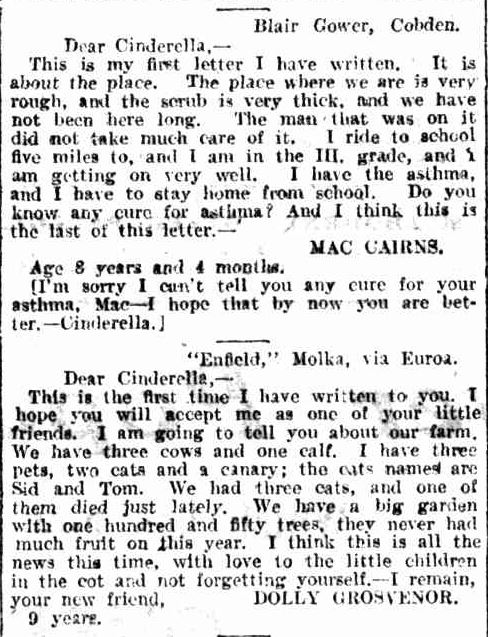
Back in the 1910s, the Leader newspaper, a weekly town and country paper published by The Age, ran a column for children called “Dear Cinderella”.  The letters, mostly written by country children, tell much about life during those times as seen through the eyes of a child.  I have selected a few of the letters to share this Trove Tuesday, with a couple from the Western District.

While many children wrote letters to Cinderella, only a handful were published each week.  Therefore the children often mentioned the number of times they had previously written, hoping Cinderella would finally pick them.  Most times she gave a short reply as she did with Lawrence McCartin of Leongatha.  Lawrence had told of the burnt bush around his home and about school life.  Cinderella then ticked him off for not giving his age.

cin

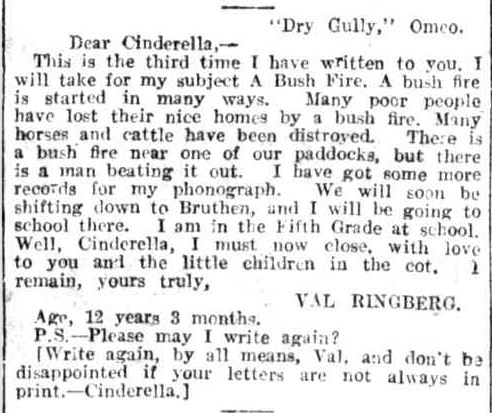
Val Ringberg of Omeo also wrote of fires and some new phonograph records.

CINDERELLA'S MENAGERIE. (1914, May 16). Leader (Melbourne, Vic. : 1914 - 1918), p. 59. Retrieved January 27, 2014, from http://nla.gov.au/nla.news-article89309559

CINDERELLA’S MENAGERIE. (1914, May 16). Leader (Melbourne, Vic. : 1914 – 1918), p. 59. Retrieved January 27, 2014, from http://nla.gov.au/nla.news-article89309559

In the following group of letters, Edith O’Neil gave a great description of the shops in Koondrook in 1914, including five fruit and lollie shops with another lollie shop under construction.  You can never have enough lollie shops.

cin3cin4cin5

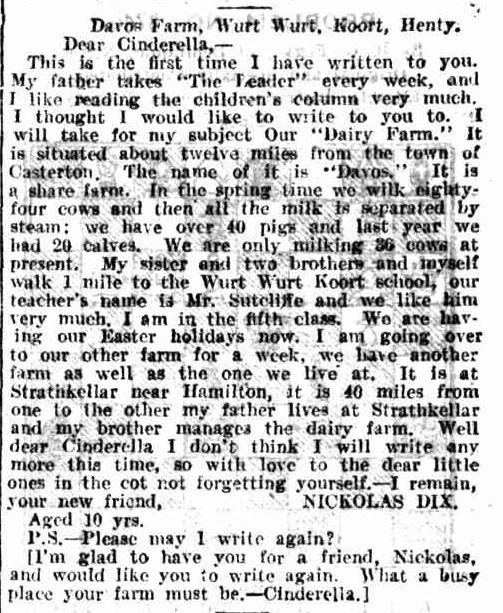
The following letter from Nickolas (sic) Dix, takes us right into the countryside that Major Thomas Mitchell called Australia Felix.  Nicholas lived at Davos Farm at Wurt Wurt Koort near Merino.

CORRESPONDENCE. (1914, June 13). Leader (Melbourne, Vic. : 1914 - 1918), p. 58. Retrieved January 27, 2014, from http://nla.gov.au/nla.news-article89313857

CORRESPONDENCE. (1914, June 13). Leader (Melbourne, Vic. : 1914 – 1918), p. 58. Retrieved January 27, 2014, from http://nla.gov.au/nla.news-article89313857

Nicholas wrote about the Wurt Wurt Koort School he attended and his father’s other farm at Strathkellar, near Hamilton.

Because Nicholas’ family lived in the area largely focused on by Daryl Povey’s site Glenelg & Wannon Settlers and Settlement, I thought it worth a search for the Dix family and I found them.  Nicholas was the son of James Nicholas Dix and Margaret Theresa Doyle and was born in Casterton in 1903, one of fourteen children. Something interesting I found was that Nicholas’ younger brother was Anthony Strathkellar Dix, named after the location of the other Dix farm.

Even more interesting was that when young Nicholas grew up, he joined the Royal Australian Navy in 1918 and by WW2 he was a Chief Petty Officer and recipient of a Distinguished Service Medal (DSM).  Thank you, Daryl, for the extra information about Nicholas.  Back to Trove, and I found a photo of Nicholas Dix.  It’s not a clear photo of him, but we can see the little boy from the Western District who wrote to Cinderella in 1914, thirty years later as a forty-one-year-old Naval Officer.

FLINDERS NAVAL DEPOT—school for sailors. (1944, September 16). The Australian Women's Weekly (1933 - 1982), p. 17. Retrieved January 27, 2014, from http://nla.gov.au/nla.news-article47502246

FLINDERS NAVAL DEPOT—school for sailors. (1944, September 16). The Australian Women’s Weekly (1933 – 1982), p. 17. Retrieved January 27, 2014, from http://nla.gov.au/nla.news-article47502246

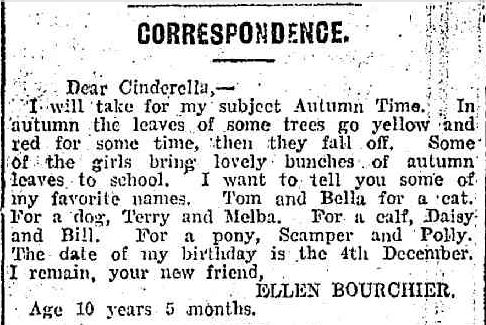
Back to the “Dear Cinderella” letters and I love this one from Ellen Bourchier.  She writes about her favourite names for dogs, cats, calves and ponies.

CORRESPONDENCE. (1915, June 19). Leader (Melbourne, Vic. : 1914 - 1918), p. 55 Edition: WEEKLY. Retrieved January 27, 2014, from http://nla.gov.au/nla.news-article91366815

CORRESPONDENCE. (1915, June 19). Leader (Melbourne, Vic. : 1914 – 1918), p. 55 Edition: WEEKLY. Retrieved January 27, 2014, from http://nla.gov.au/nla.news-article91366815

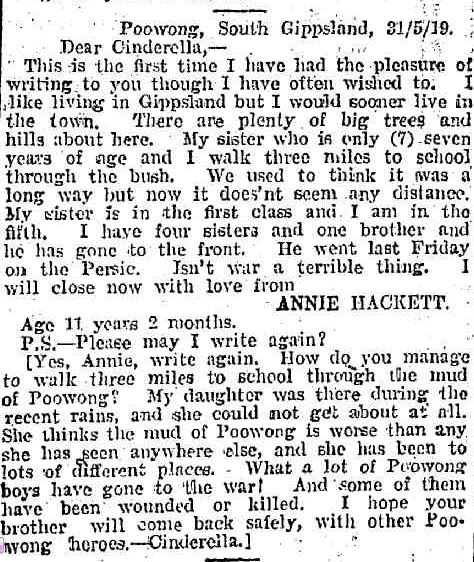
Cinderella wrote a longer reply than most, for Annie Hackett of Poowong.  She wondered how the children managed the three-mile walk to school after rain, such as that experienced by Cinderella’s daughter during a visit to Poowong.  (first I knew Cinderella had a daughter).

cin8

These charming letters are well worth reading with most found with a search at Trove of “Dear Cinderella”.  If you include a town name, you can narrow the search down.

Australia Day

Because of time restrictions, I’m not participating in the 2014 Australia Day Blogging Challenge.  Don’t despair, some great geneabloggers have written posts for the 2014 Australian Day Challenge, a Geneameme, C’Mon Aussie created by Pauline Cass of the Family History Across the Seas blog.

Instead, I will re-visit my 2012 and 2013 posts, Wealth for Toil – William Hadden and The Drover’s Wife

The 2012 Challenge was about occupations and the phrase “wealth for toil” from the Australian National Anthem.  “Toil” stood out for me and I chose to write about my gg grandfather, William Hadden of Cavendish, and his work of almost 70 years, at Mokanger Station.  Full Post

The following year threw up a new challenge and for 2013, the task was to write the story of my first ancestor to arrive in Australia.  I decided not to go with my ggg grandparents Thomas Gamble and Ellen Barry, both early arrivals, because I had told their stories on other occasions.  Instead I chose Sarah Hughes, another ggg grandmother, who I had suspected arrived in 1840.

Sarah married James Bishop in 1852 and after time in Mt Gambier and the goldfields of Ararat, they settled around Byaduk and later Macarthur.  Jim was a drover and my post explores life for the wives when their husbands were away for long periods on the road. I enjoyed writing this post and I have only now read again it for the first time in a year.  As I say in the post…pass the tissues please.  Full Post

WATTLE & WILDFLOWERS 1886,  Image courtesy of the State Library of Victoria.  Image no. IAN13/11/86/SUPP http://handle.slv.vic.gov.au/10381/253970

WATTLE & WILDFLOWERS 1886, Image courtesy of the State Library of Victoria. Image no. IAN13/11/86/SUPP http://handle.slv.vic.gov.au/10381/253970

Trove Tuesday – Halls Gap in Pictures

Since the Grampians and Halls Gap have been in the news this week for the unfortunate reason of a bush fire, I thought this week for Trove Tuesday, we should visit this beautiful place in Victoria’s West.

Halls Gap particularly is a special place for me because Dad has lived there for almost 40 years.  So just as I grew up in Hamilton, I grew up in Halls Gap too.

Along with the history books I have collected about Halls Gap, I’ve collected newspaper articles found at Trove.  But I had never searched Trove for Halls Gap/Grampians photos.  Of course, I wasn’t disappointed with the results and it was difficult to narrow down the photos to share.

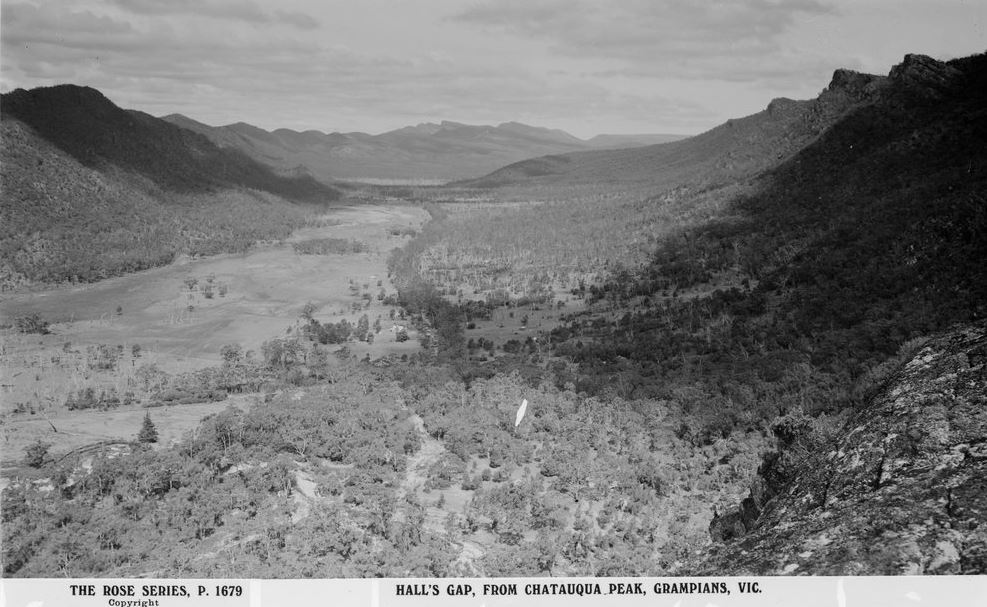
The Rose series of postcards, held by the State Library of Victoria, are an ever reliable source for photos of Western Victoria and there was little doubt that I would find some great photos of Halls Gap among them.  It’s hard to date the Rose postcards as they are all dated 1920-1954, so most times it’s guess-work based on cars, dress and buildings.  Photos such as the following from Sundial Peak, looking over Halls Gap, is pretty well impossible to date.

Image Courtesy of the State Library of Victoria.  Image no,. H32492/2391  http://handle.slv.vic.gov.au/10381/63933

Image Courtesy of the State Library of Victoria. Image no,. H32492/2391 http://handle.slv.vic.gov.au/10381/63933

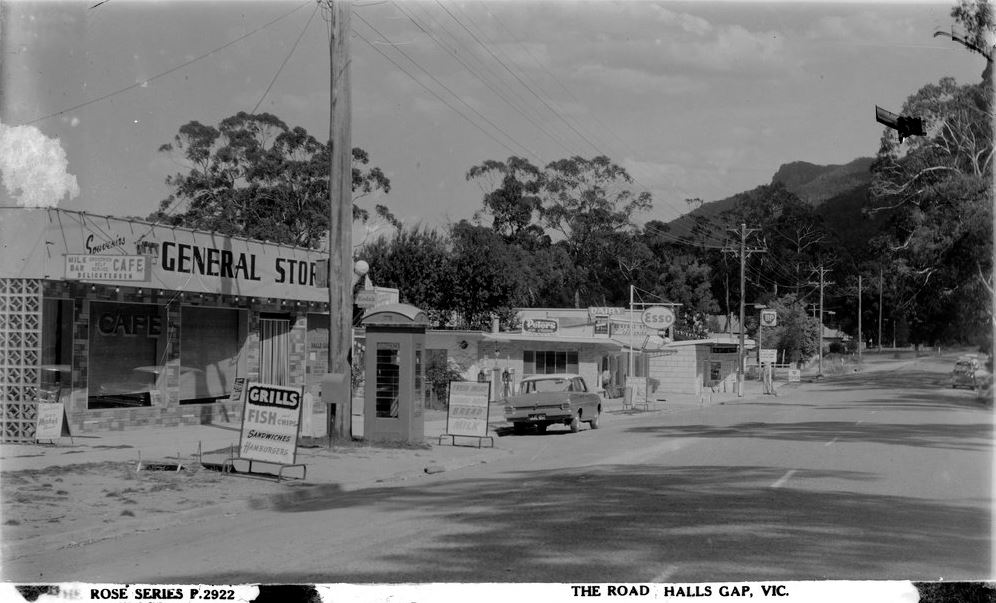
There were two photos of Halls Gap’s main street in the series, several years apart.  The General Store in the second photo, looking almost as it does today, is not in the first photo.  However, I think the first building on the right, with the Holiday House sign, still stands today.

MAIN STREET, HALLS GAP.  Image courtesy of the State Library of Victoria.  Image no,  H32492/8694 http://handle.slv.vic.gov.au/10381/58172

MAIN STREET, HALLS GAP. Image courtesy of the State Library of Victoria. Image no, H32492/8694
http://handle.slv.vic.gov.au/10381/58172

Despite the date range on the postcards being up to 1954, and correct me if I’m wrong, there is an EH Holden parked in the main street.  Holden produced the EH between 1963 and 1965.  There were also two petrol stations, today there is one.

MAIN STREET, HALLS GAP. Image courtesy of the State Library of Victoria,  Image no. H32492/4136 http://handle.slv.vic.gov.au/10381/62227

MAIN STREET, HALLS GAP. Image courtesy of the State Library of Victoria, Image no. H32492/4136 http://handle.slv.vic.gov.au/10381/62227

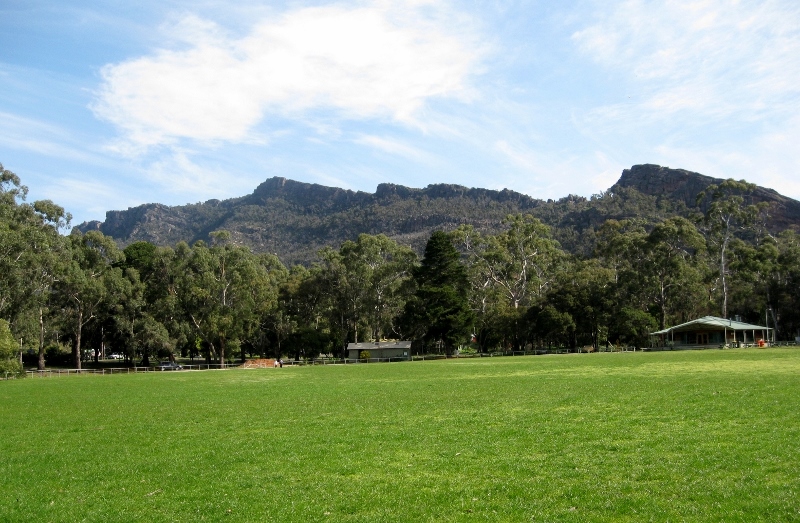
The main street 2012.

Halls Gap

The Mountain Grand Guest House, built in 1944,  still stands today.  This is how I remember the Mountain Grand when I first went to Halls Gap in 1975, but it has changed somewhat over the years due to renovations.

MOUNTAIN GRAND GUEST HOUSE, HALLS GAP.  Image Courtesy of the State Library of Victoria.  Image no. H32492/7789  http://handle.slv.vic.gov.au/10381/60702

MOUNTAIN GRAND GUEST HOUSE, HALLS GAP. Image Courtesy of the State Library of Victoria. Image no. H32492/7789
http://handle.slv.vic.gov.au/10381/60702

FYANS VALLEY, HALLS GAP.  Image Courtesy of State Library of Victoria.  Image no. H32492/2399  http://handle.slv.vic.gov.au/10381/63181

FYANS VALLEY, HALLS GAP. Image Courtesy of State Library of Victoria. Image no. H32492/2399 http://handle.slv.vic.gov.au/10381/63181

IMG_0811 (800x523)

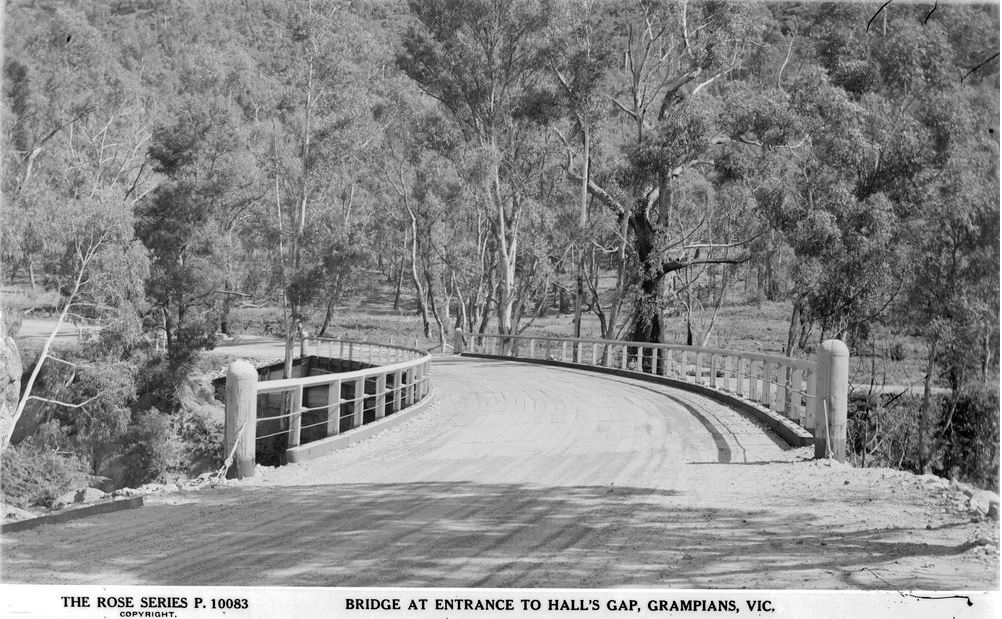
The Delleys Bridge, named after a pioneering family, welcomes visitors from the east into Halls Gap.  Since those first pioneers arrived in the valley, different bridges have spanned the Fyans Creek, one of the few access points into town, and now there is a modern bridge. The bridge in the photo is the style I’m most familiar with, except since the photo, it was widened and a pedestrian lane added.  Just beyond the bridge, a road runs of to the left.  Dad lived a few hundred metres down that road for many years and now still lives close by to the bridge.  I have been over the bridge, under the bridge and ridden nervous horses across while fearing altercations with cars and the long drop over the side.

DELLEY'S BRIDGE, HALLS GAP.  Image Courtesy of the State Library of Victoria.  Image no.  H32492/6669 http://handle.slv.vic.gov.au/10381/58616

DELLEY’S BRIDGE, HALLS GAP. Image Courtesy of the State Library of Victoria. Image no. H32492/6669 http://handle.slv.vic.gov.au/10381/58616

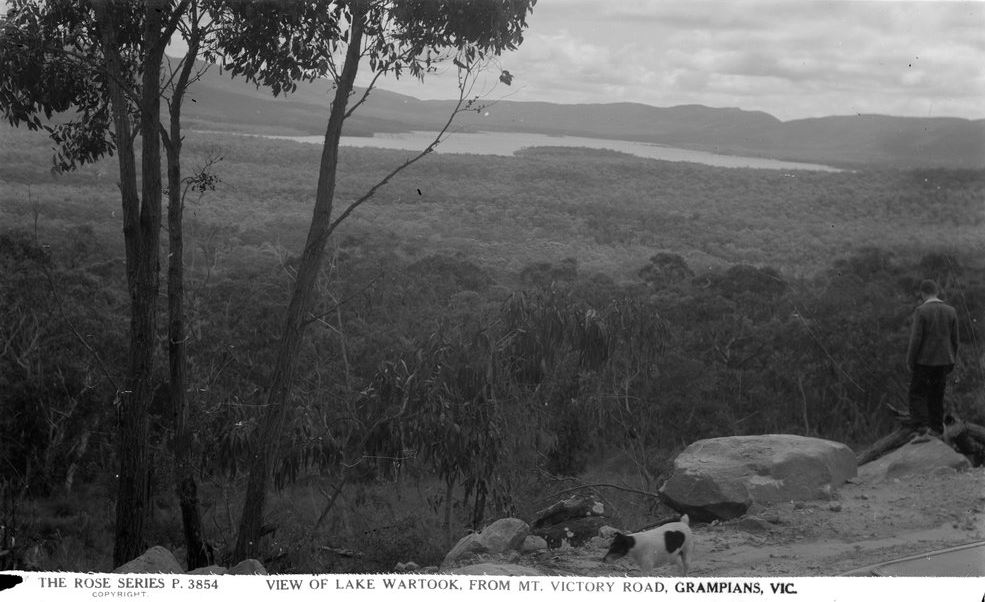
Just over the mountain from Halls Gap is Lake Wartook and the Wartook Valley.  While Halls Gap remained untouched, this part of the Grampians suffered greatly in the fires last week and the level of damage is yet to be fully assessed.

LAKE WARTOOK, GRAMPIANS.  Image Courtesy of the State Library of Victoria.  Image no.  H32492/5317 http://handle.slv.vic.gov.au/10381/59375

LAKE WARTOOK, GRAMPIANS. Image Courtesy of the State Library of Victoria. Image no. H32492/5317 http://handle.slv.vic.gov.au/10381/59375

The last of the Rose postcards was a real surprise for me.  It is of the Halls Gap Bowling club that I didn’t know existed.  I’m guessing from the mountain range behind, it was located on the western side of the township. I will ask a couple of born and bred locals when next there exactly where the greens were.

HALLS GAP BOWLS CLUB. Image courtesy of the State Library of Victoria.  Image no. H32492/4224 http://handle.slv.vic.gov.au/10381/62069

HALLS GAP BOWLS CLUB. Image courtesy of the State Library of Victoria. Image no. H32492/4224 http://handle.slv.vic.gov.au/10381/62069

The Victorian Railways collection, also held by the State Library of Victoria, is another great source of Western District town photos.  I just love this photo of the Pinnacle, a popular lookout at the top of the Wonderland Range.  The unfortunate part about this photo is that it does not give you a feeling of how high up the lookout is.  Well, I’m suffering vertigo just looking at those brave trekkers.  Thankfully, the fence was later extended down the side of the lookout.

THE PINNACLE, HALLS GAP.  Image no. H91.50/1002  http://handle.slv.vic.gov.au/10381/97372

THE PINNACLE, HALLS GAP. Image no. H91.50/1002 http://handle.slv.vic.gov.au/10381/97372

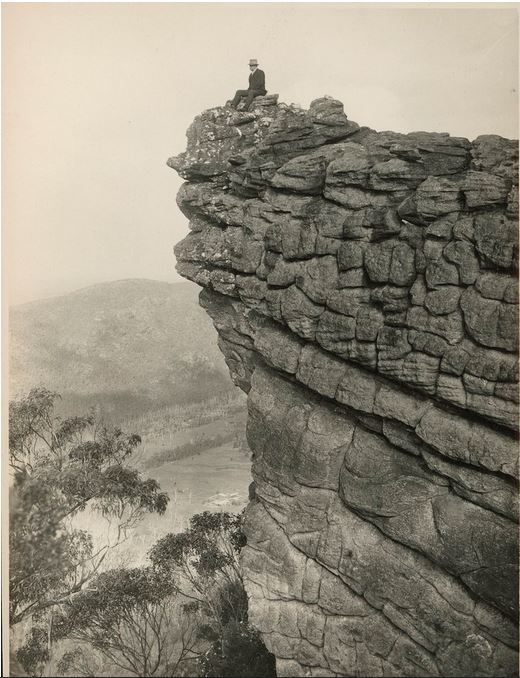
I thought they were brave until I found this photo, before the fence.   The photo was dated 1910-1930 however I have found a newspaper article from 1918 that mentions the fence, so it must be closer to 1910.

The gentleman in the photo is not as daring as Halls Gap photographer, Gilbert Rogers (1880-1950).  A photo in Ida Stanton’s book Bridging the Gap: the history of Halls Gap from 1840 (1988) shows Gilbert hanging from a ledge below the Pinnacle, with his camera and tripod, capturing the best views of the mountains.  Crazy.

THE PINNACLE, HALLS GAP.  Image courtesy of the State Library of Victoria.  Image no. H84.461/488 http://handle.slv.vic.gov.au/10381/51930

THE PINNACLE, HALLS GAP. Image courtesy of the State Library of Victoria. Image no. H84.461/488 http://handle.slv.vic.gov.au/10381/51930

Not only do kangaroos and emus, call the Grampians their home, so to do deer, a legacy of the homesick gentry of the 19th century.  This sketch from 1881 gives some clue as to how long they have roamed the mountains.

DEER IN THE GRAMPIANS.  Imprint by Alfred May and Alfred Martin Ebsworth,(1881) Image Courtesy of the State Library of Victoria.  Image no. A/S31/12/81/420 http://handle.slv.vic.gov.au/10381/258236

DEER IN THE GRAMPIANS. Imprint by Alfred May and Alfred Martin Ebsworth,(1881) Image Courtesy of the State Library of Victoria. Image no. A/S31/12/81/420 http://handle.slv.vic.gov.au/10381/258236

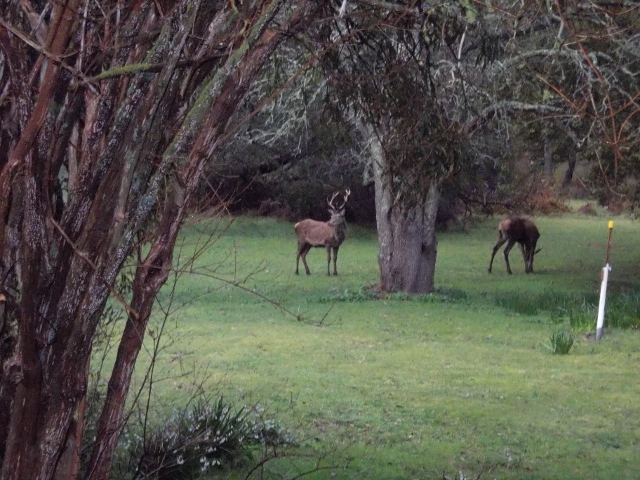
These are deer in Dad’s backyard, descendants of those in the 1881 sketch.  Last Friday evening, with fires burning in the mountains three kilometres away, a stag ate fallen pears from one of Dad’s trees, oblivious.

014 (640x480)

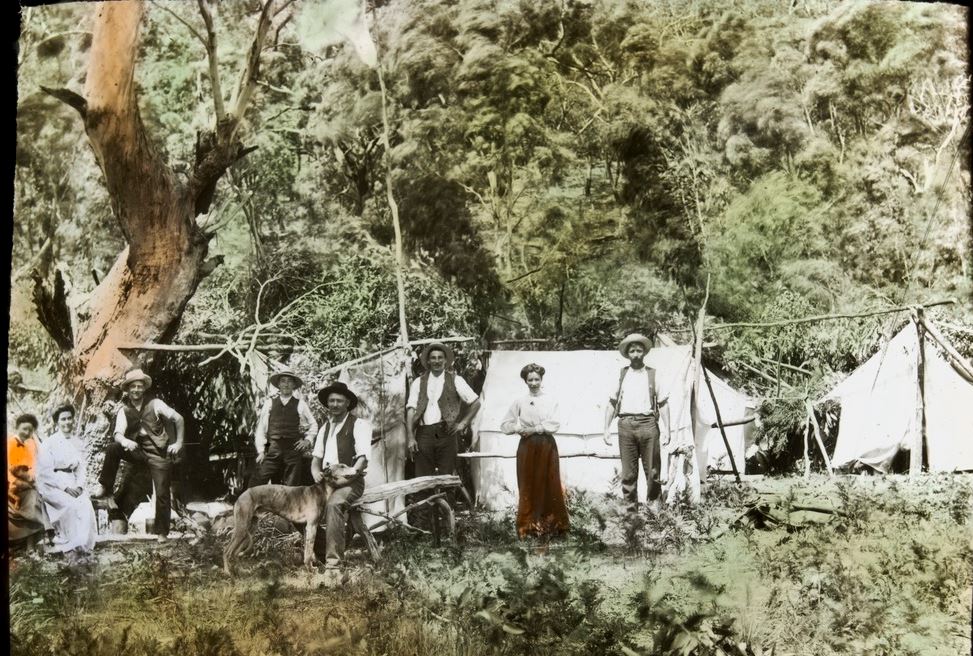
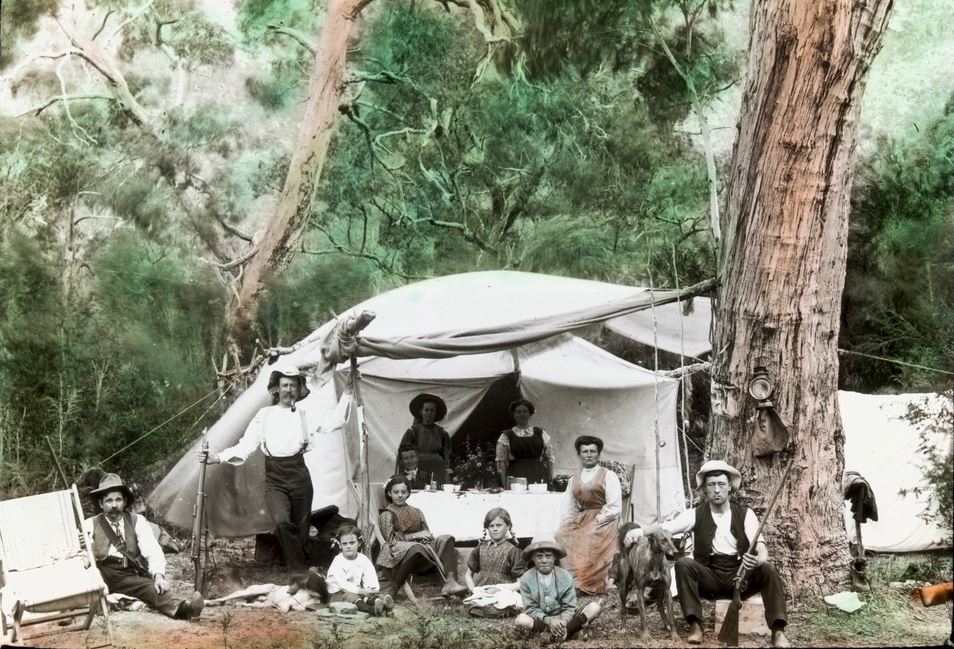
The next series of photos are real treasures.  Again, they are held at the State Library of Victoria and are from a collection gathered by Richard Holdsworth.  The date range for the magic lantern slides is 1860-1930.

gramps1

Image Courtesy of the State Library of Victoria. Image no. H2012.90/51 http://handle.slv.vic.gov.au/10381/245940

THE GRAMPIANS. Image No. H2012.90/54.  Image courtesy of the State Library of Victoria. http://handle.slv.vic.gov.au/10381/245952

THE GRAMPIANS. Image No. H2012.90/54. Image courtesy of the State Library of Victoria. http://handle.slv.vic.gov.au/10381/245952

Image courtesy of the State Library of Victoria.  Image no. H2012.90/56 http://handle.slv.vic.gov.au/10381/245952

Image courtesy of the State Library of Victoria. Image no. H2012.90/56 http://handle.slv.vic.gov.au/10381/245952

Image Courtesy of the State Library of Victoria.  Image no. H2012.90/50http://handle.slv.vic.gov.au/10381/245959

Image Courtesy of the State Library of Victoria. Image no. H2012.90/50http://handle.slv.vic.gov.au/10381/245959

Finally. one of the photographers.  Funnily enough the gentleman with the camera looks very much like my gg grandfather Richard Diwell, himself a keen photographer.

Image Courtesy of the State Library of Victoria.  Image no. H2012.90/49 http://handle.slv.vic.gov.au/10381/245996

Image Courtesy of the State Library of Victoria. Image no. H2012.90/49 http://handle.slv.vic.gov.au/10381/245996

Halls Gap is a busy tourist town, but the Grampians fire last week will bring financial strain to the businesses there, as did the 2006 fires that burned a lot closer to the township.  The town has now reopened to the public and it is business as usual, but with the fear created, thanks to sensational journalism that spread through social media, it will be hard work to get the word out that Halls Gap is safe. Now is the time to visit and support the wonderful people living there.

Elsie, Rupert… and Mike.

So intrigued was I by the photo from the State Library of Victoria that accompanied my Trove Tuesday post this week, Leopard on the Loose, I just had to find out more about the photo.

LEOPARD AT HOBART ZOO.  Image courtesy of the State Library of Victoria.  Image no.  H37687/17 http://handle.slv.vic.gov.au/10381/56312

LEOPARD AT HOBART ZOO. Image courtesy of the State Library of Victoria. Image no. H37687/17 http://handle.slv.vic.gov.au/10381/56312

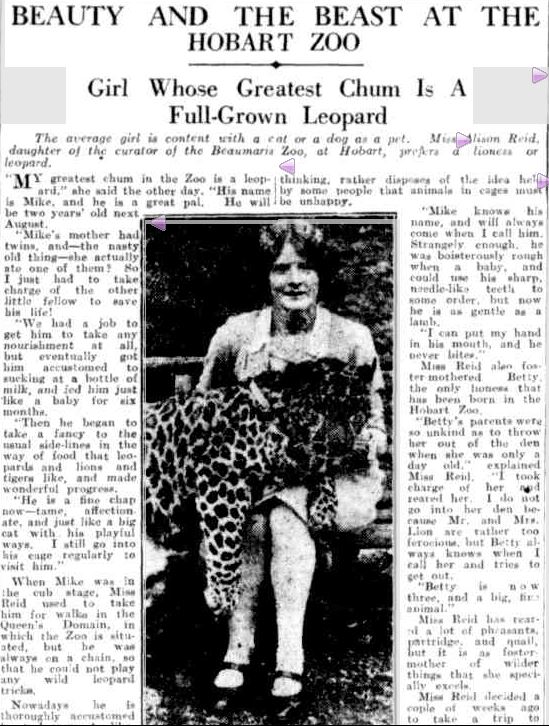
It wasn’t too hard really.  Another search at Trove for “Leopard Hobart Zoo” uncovered the following article.

BEAUTY AND THE BEAST AT THE HOBART ZOO. (1930, May 17). The Register News-Pictorial (Adelaide, SA : 1929 - 1931), p. 7. Retrieved January 5, 2014, from http://nla.gov.au/nla.news-article54241041

BEAUTY AND THE BEAST AT THE HOBART ZOO. (1930, May 17). The Register News-Pictorial, p. 7.  http://nla.gov.au/nla.news-article54241041

You can read the full article on this link – Beauty and the Beast – but in short, the leopard was two-year-old “Mike” hand-reared by the Hobart Zoo’s curator’s daughter Alison Reid had rescued the cub after his mother, an exhibit at the zoo, ate Mike’s brother, and she could not let him suffer the same fate.

So what happened to Mike after his photo with Alison? While I couldn’t find anything specific about his life after 1930, the history of the Hobart Zoo, also known as the Beaumaris Zoo, gives some clues. Beaumaris Zoo was originally a private zoo owned by Mrs Mary Grant Roberts. After her death, the Hobart City Council took over the zoo and, in 1923, it opened to the public. During the 1920s the zoo expanded, bringing in animals from other Australian zoos and overseas, but when the Depression hit, the zoo struggled throughout the 1930s until the Council closed it in 1937. During those troubled times, the last thylacine in captivity died at the zoo in 1936.

Reports during the 1930s didn’t give Mike much hope. In 1932, a leopard and lion were destroyed to save money, although the newspaper report suggested they were older animals. Other animals were also sold off to the circus, including Leopards. So where Mike ended up is not clear.

ZOO UNPROFITABLE AT HOBART. (1935, July 9). Advocate (Burnie, Tas. : 1890 - 1954), p. 2 Edition: DAILY. Retrieved January 7, 2014, from http://nla.gov.au/nla.news-article86569164

ZOO UNPROFITABLE AT HOBART. (1935, July 9). Advocate (Burnie, Tas), p. 2  http://nla.gov.au/nla.news-article86569164

While reading the 1930s articles, I found that my research had gone full circle. One article, from 1934, mentioned none other than radio stars Elsie Day and my 2nd cousin, 3 x removed, Rupert Alexander Hazell. Rupert and Elsie had visited the zoo on an earlier trip to Tasmania, and Elsie and Mike had their photo taken together. The photo proved a hit back in England, bringing publicity to the zoo and Tasmania.

NORTHERN NOTES. (1934, March 7). The Mercury (Hobart, Tas. : 1860 - 1954), p. 5. Retrieved January 6, 2014, from http://nla.gov.au/nla.news-article24916596

NORTHERN NOTES. (1934, March 7). The Mercury (Hobart, Tas), p. 5.  http://nla.gov.au/nla.news-article24916596

After reading this article, I added it to my “Rupert Hazell” list at Trove. As I scrolled up, I realised I already had, 18 months ago, when I was originally researching Rupert for the post, Everybody Happy. When I originally found the photo of the leopard for the Trove Tuesday post, I didn’t think this was where I would end up. If only I could find the photo of Elsie and Mike. I have tried the British Newspaper Archive with no success.

I found an interesting blog with posts about Beaumaris Zoo if you would like to read more about the zoo’s history:

Australasian Zoo & Circus Animals Historical Journal – Beaumaris Zoo (Hobart) Zoo Part 1 – The Legacy of Beaumaris