In The News – June 1, 1928

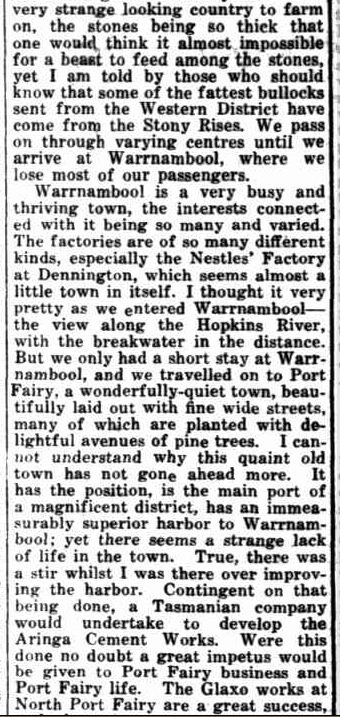
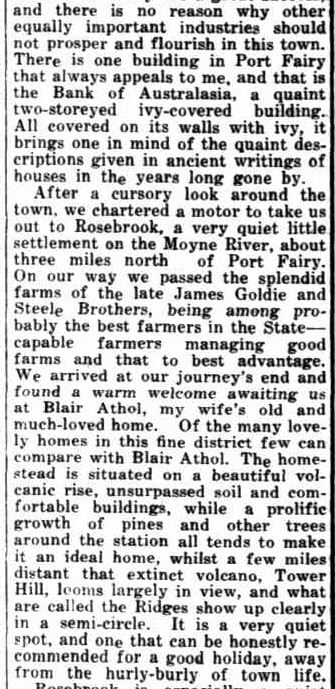
For those of you who have not visited the south-west of Victoria, the following article gives a wonderful description from Camperdown through to Port Fairy.   Published on June 1, 1928 in the Hurstbridge  Advertiser, the correspondent, “Mernda”  journeys by bus to Port Fairy.  There are descriptions of some of the towns and their industries as well as the volcanic countryside.

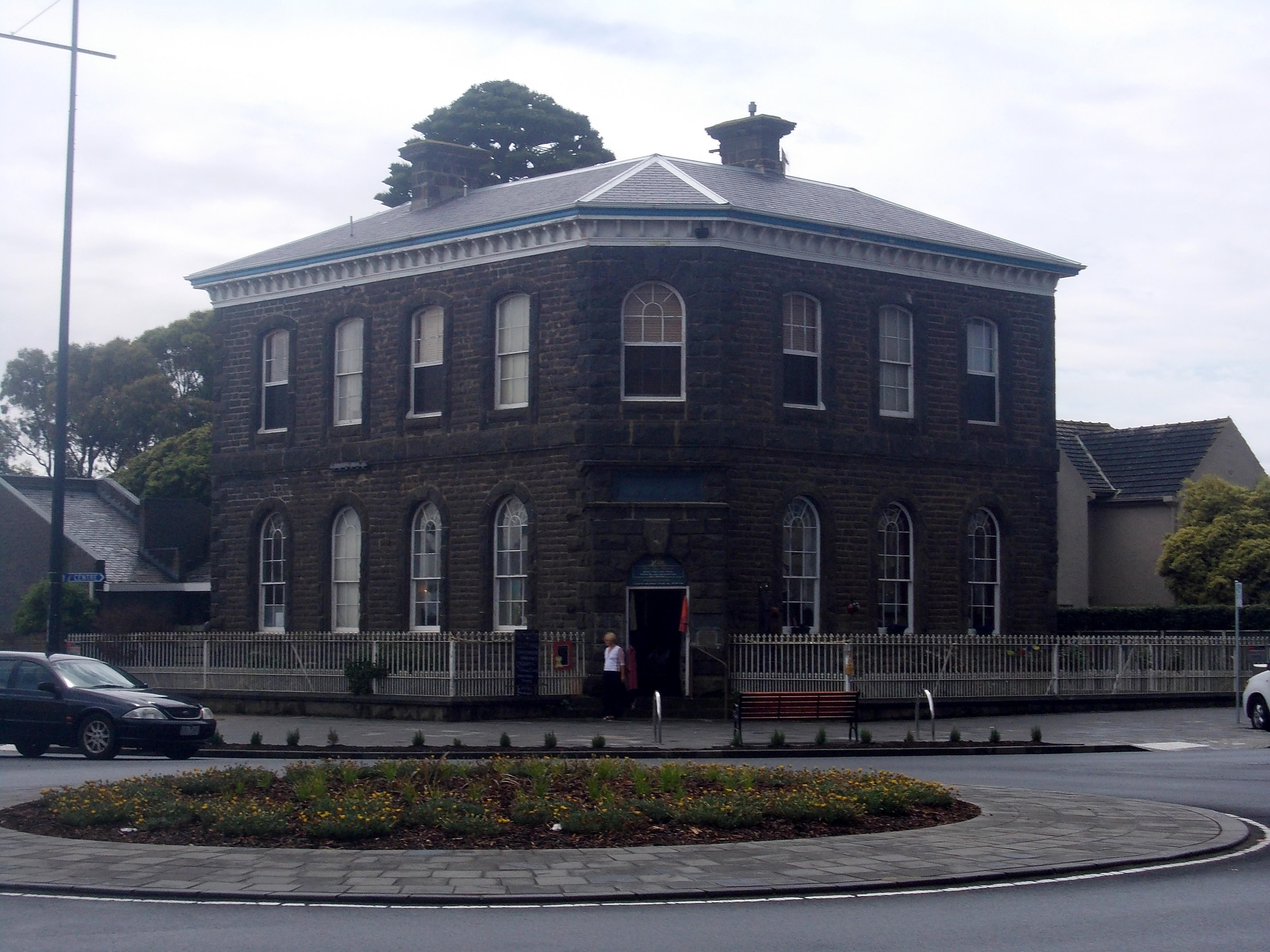
The former Bank of Australasia (below) was a highlight for “Mernda” in Port Fairy.

214

Of interest is the Glaxo works in Port Fairy, considered by “Mernda” as a “great success”.  Glaxo produced high quantities of milk powder, from milk sourced from the local area.  In the 1940s, the company name changed to Glaxo Laboratories and still exists today in Port Fairy as GlaxoSmithKline.

Nestle at Dennington, just outside Warrnambool, was another milk powder manufacturer that caught “Mernda’s” eye.  Nestle operated from 1911 until 2005 when Fonterra bought the factory. To read a history of the Nestle factory at Dennington, follow the link http://www.standard.net.au/news/local/news/general/flavours-of-switzerland-linger-a-century-on/2073943.aspx?storypage=1

MY TRIP TO THE WESTERN DISTRICT. (1928, June 1). Advertiser (Hurstbridge, Vic. : 1922 – 1939), p. 4 Edition: AFTERNOON.. Retrieved May 31, 2012, from http://nla.gov.au/nla.news-article57757397

Old Portland Cemetery – Part 1

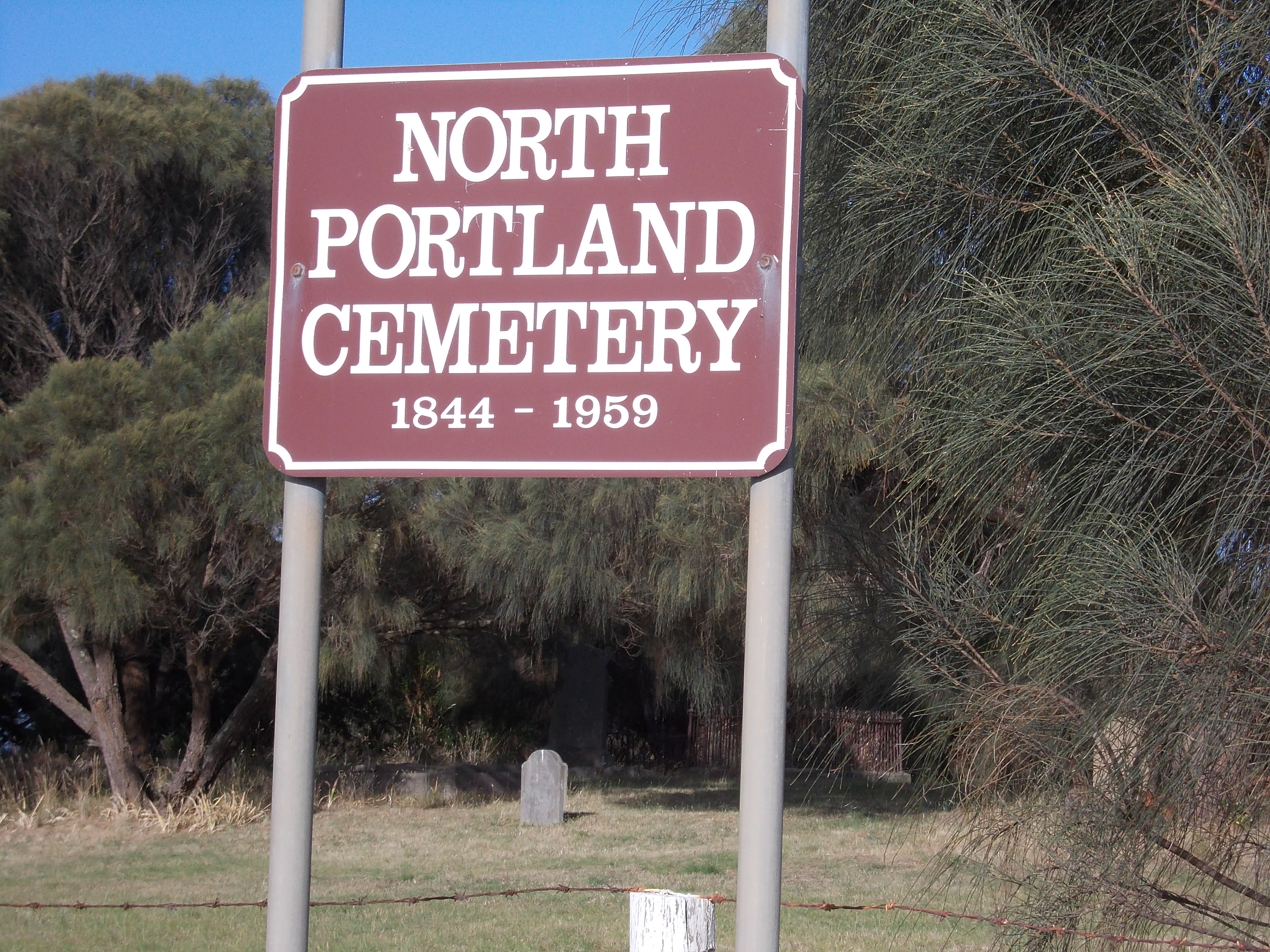
During our holiday to Portland in January, we visited the North Portland Cemetery also known as the Old Portland Cemetery.  Thanks to a handy brochure I picked up at the Tourist Information Centre it was something we could do as a family.

The guide outlines some of the more notable graves in the cemetery. Each of those graves has a number marker.  There are also arrows pointing to the next grave of interest.  This made visiting the cemetery fun and educational for the small research assistant.  Finding each of the numbered graves and reading the corresponding information in the brochure kept his interest on our circumnavigation of the cemetery.

The number one grave is the Robb family memorial.  William was a local stonemason.

Robb Family Grave

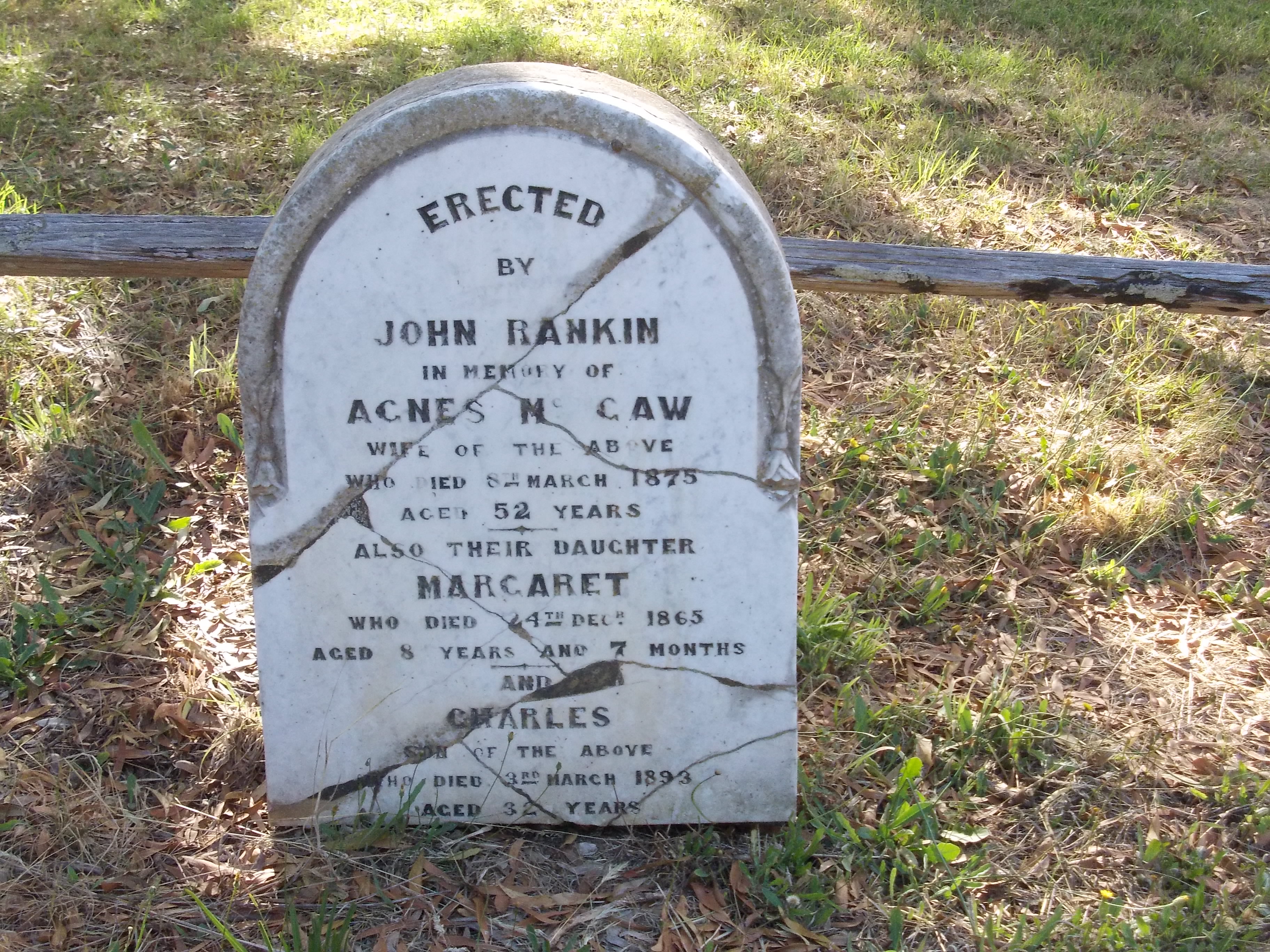
Despite fires in the past, the wooden fence around the Rankin grave still stands, the last of its kind in the cemetery.  The grave belongs to Agnes, Margaret and Charles Rankin

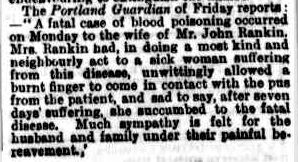
Agnes died from blood poisoning in 1875.

UNIVERSITY LAW EXAMINATIONS. (1875, March 17). The Argus (Melbourne, Vic. : 1848 – 1956), p. 7. Retrieved May 21, 2012, from http://nla.gov.au/nla.news-article11513825

GRAVE OF AGNES, MARGARET AND CHARLES RANKIN

Several members of the Haggestton family lie in the Haggestton plot.  Frederick, Sara, Joseph, and John Haggestton, the children of Joseph and Mary Haggestton and Joseph and Mary themselves are all buried here. At the time of Joseph senior’s death in 1907, he owned several properties around Portland.  Nineteen properties, including The Royal Hotel, were auctioned on 20 February 1908.   The Haggestton headstone was vandalised, along with others, in 1986.  It was restored by Parker & Sons, a Portland stonemason.

HAGGESTTON FAMILY GRAVE

The graves face out over Portland Bay where many of those buried first entered Victoria.

This unusual headstone dates back to 1841 before the cemetery opened.  It belongs to six-year-old Henrietta Earls.  Her mother Harriet was also buried in the plot in 1854.

EARLS FAMILY GRAVE

You can read more about the cemetery on the link:

OLD PORTLAND CEMETERY PART 2

Western Victoria Remembers

A little while ago I came across a great video on YouTube that I have been saving for a suitable time to share.  This week I found another with a similar theme.  As this is ANZAC Day, I thought it was the perfect time to share the videos.  Each is about small Western Victorian towns remembering those who served in World War 1. One is the story of the restoration and revitalisation of the old and the other, the unveiling of the new.

Beau Nieuwveld’s video was impressive, not only because of the story it told but it was great to see a teenage boy with an interest in his town’s history.  Not only that, his video was the overall winner of the 2009 10MMM Youth Film Festival held in Hamilton.

Beau’s town is Dartmoor in the south-west of Victoria.  Faced with the dilemma of many other towns, the trees in the Avenue of Honour were deteriorating.  How could the integrity of the Avenue be maintained while ensuring the safety of the residents?

The result is fantastic.  Family members of the soldiers with memorial trees were happy and the town now has a great tourist attraction!  For more information about the Dartmoor Avenue of Honour, check out the Glenelg & Wannon Settlers website  http://www.swvic.org/dartmoor/avenue.htm

On October 31, 2009, the people of Rupanyup in the Wimmera, celebrated the unveiling of a new memorial to remember local men who served with the 4th Light Horse at Beersheba on October 31, 1917.  One of those, Colonel James Lawson is given special recognition on the memorial.

I love this video because of the community spirit it depicts.  Rupanyup is a town of under 800 people and I think they were all there on the day.  I am assuming, but can’t be sure,  that those depicting the Light Horse soldiers were members of the Creswick Light Horse Troop,  a fantastic group of people keeping the memory of the Light Horse alive.

To see the horses at the ceremony is moving as one remembers the heroics of not only the soldiers but also the horses.  The bond between man and horse was deep.

LEST WE FORGET

Easter Touring in the Western District

Easter, with its four day holiday, has long been a popular time for people to get away in the car and travel to a holiday destination.  I spent around twenty Easters working in Halls Gap, always overflowing with visitors there for the mountains and the ever popular Stawell Gift.  Just tonight, there as been a steady flow of cars passing my house, as people head off for the long weekend.

The early 20th century was no different.  The arrival of the car gave people new freedom.  Not restricted to railway routes, they could take off in any direction. 

THE NEWTON FAMILY. Photographer: Wilf Henty. Image courtesy of the State Library of Victoria http://handle.slv.vic.gov.au/10381/38667

The RACV began producing tour maps and providing driving tips.  In 1912, The Argus proclaimed the educational and health benefits of touring in a car.  Autumn, it suggested, was the appropriate season to travel.

EASTER OUTINGS. CHARM OF AUTUMN TOURING. (1912, April 3). The Argus (Melbourne, Vic. : 1848 – 1956), p. 10. Retrieved April 5, 2012, from http://nla.gov.au/nla.news-article11665234

It may have been 1912, but the roads of the Western District were considered some of the best in the state.  Anyone who has driven the roads of the Western District in recent years will probably say that is no longer the case.   

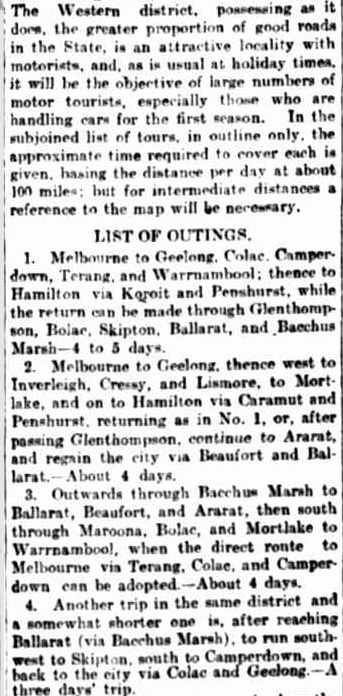
Four Western District touring routes were suggested by The Argus. They were similar to those travelled today, only the estimated travel times have changed.

EASTER OUTINGS. CHARM OF AUTUMN TOURING. (1912, April 3). The Argus (Melbourne, Vic. : 1848 – 1956), p. 10. Retrieved April 5, 2012, from http://nla.gov.au/nla.news-article11665234

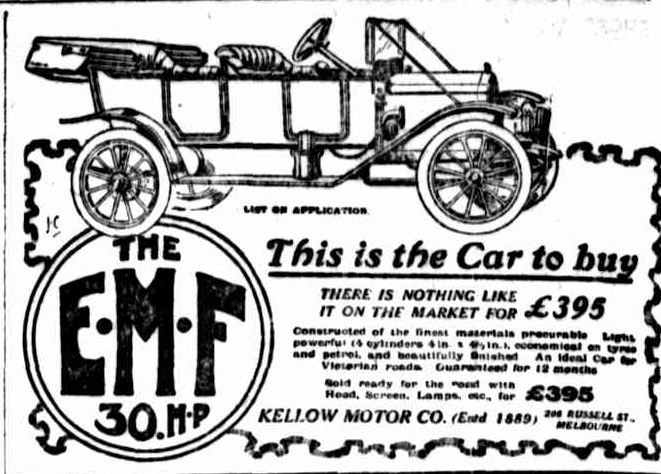
What might those able to afford a motor car driving through the Western District?  Maybe an E.M.F 30hp.

(1912, April 3). The Argus (Melbourne, Vic. : 1848 – 1956), p. 10. Retrieved April 5, 2012, from http://nla.gov.au/nla.news-page381590

The Sultan of Shelly Beach

This was going to be a post about our visit to Shelly Beach in January, a trip to rekindle childhood memories of visits there.  Along with photos and an article which described the beauty of the beach,  I had it covered. However, as is usually the case, I could not settle at that.  I had to search Trove for more information on Shelly Beach and what I found has given the post a twist as I introduce you to a wonderful character who had a link to Shelly Beach in the 1930s.

Firstly, here is part of the article “Beautiful Shelly Beach” that was going to feature.

Beautiful Shelly Beach. (1939, March 30). Portland Guardian (Vic. : 1876 – 1953), p. 3 Edition: EVENING.. Retrieved March 26, 2012, from http://nla.gov.au/nla.news-article64392283

When I returned to Trove, I was keen to find a photo of Shelly Beach.   What I found was beyond my expectations.

No title. (1933, June 24). The Argus (Melbourne, Vic. : 1848 – 1956), p. 5. Retrieved March 26, 2012, from http://nla.gov.au/nla.news-article4744401

The caption reads:  “These camels are employed in removing grit from Shelly Beach, near Portland.  Each carries two bags each weighing 2cwt. each and makes 15 trips daily over the sandhills.   The owner is over 70 years old and has four wives”.

Well, I couldn’t leave it there.  Back to the Portland Guardian, I went to search “camels Shelly Beach”.  From that, I discovered a lot more about the mysterious man with the camels.  Jumping ahead two years from the original picture I found the following “Letter to the Editor” from the man himself:

Camels at Portland. (1935, January 24). Portland Guardian (Vic. : 1876 – 1953), p. 1 Edition: EVENING.. Retrieved March 26, 2012, from http://nla.gov.au/nla.news-article64287962

From one letter, so much is learnt.   Sultan Aziz, it seems, was giving rides to tourists on the North beach at Portland during the summer and carting shell grit at Shelly Beach during the winter.  He was working for Mr Vivian Jennings, a local carrier.  Why were the camels being used to cart the shell grit?  The next article explains:

CARTING SHELL GRIT. (1933, May 16). The Horsham Times (Vic. : 1882 – 1954), p. 5. Retrieved March 26, 2012, from http://nla.gov.au/nla.news-article72660392

Sultan Aziz appears to have been in Portland from at least 1933, but he did travel around the south-west and into South Australia.  In 1934, he and his camels were the star attraction of the Mt. Gambier Tourist Promotion Association parade on 21 February 1934.  Sultan Aziz arrived the day before after travelling along the coast from Portland.

T.P.A. CARNIVAL. (1934, February 20). Border Watch (Mount Gambier, SA : 1861 – 1954), p. 1. Retrieved March 26, 2012, from http://nla.gov.au/nla.news-article77960150

From this, we now know that the Sultan had a son, Abdul.

Mt. Gambier embraced Aziz, if the front page of the Border Watch on 22 February 1934, was any indication.  My favourite photo was that of the mayor, dressed in cameleers robes, riding one of  Sultan Aziz’s camels.

MAYOR LEADS CARNIVAL PROCESSION ASTRIDE CAMEL. (1934, February 22). Border Watch (Mount Gambier, SA : 1861 – 1954), p. 1. Retrieved March 26, 2012, from http://nla.gov.au/nla.news-article77960232

There were five photos on the front page that day, all of which included the camels! Sultan Aziz spent at least a month in South Australia selling camel rides at the Mt. Gambier Showgrounds.   It was not a profitable exercise as discussed at a meeting of the Mt. Gambier A & H Society in March 1934.

MOUNT GAMBIER A. & H. SOCIETY. (1934, March 3). Border Watch (Mount Gambier, SA : 1861 – 1954), p. 3. Retrieved March 26, 2012, from http://nla.gov.au/nla.news-article77960562

On his way back to Portland, Aziz called in at Allendale East, south of  Mt. Gambier.  The camels were once again a source of excitement.

REPORTS FROM RURAL CENTRES. (1934, March 20). The Advertiser (Adelaide, SA : 1931 – 1954), p. 19. Retrieved March 26, 2012, from http://nla.gov.au/nla.news-article47544800

In October 1934, the Sultan applied to the Portland Council to have his camels on the South Beach over the summer, however, the council decided he should stay on the North Beach.

Borough Council. (1934, October 4). Portland Guardian (Vic. : 1876 – 1953), p. 3 Edition: EVENING.. Retrieved March 27, 2012, from http://nla.gov.au/nla.news-article64286951

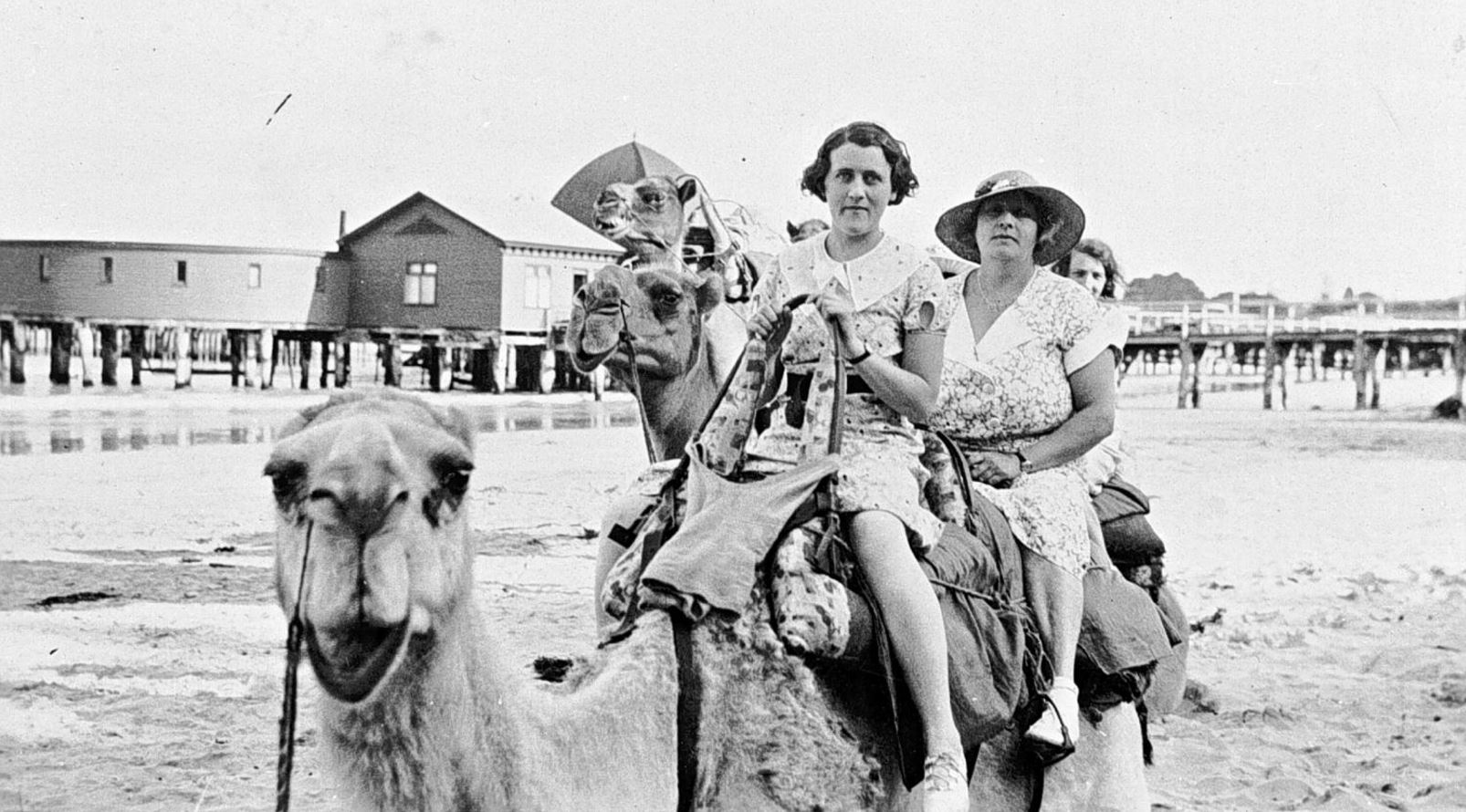
The following photo was taken during summer 1935 at Portland.  The former Portland Baths are in the background.  Enjoying the novelty of a camel ride are Eileen Hickmer, Gladys Read and Jean Ainsworth.

SULTAN AZIZ’S CAMELS ON PORTLAND BEACH IN 1935. Image courtesy of the Museums Victoria Collections https://collections.museumvictoria.com.au/items/773643

This takes us to the time of the “Letter to the Editor” of January 1935.  The Sultan only stayed in Portland another six months, leaving just as another southern winter hit.  He returned home to Broken Hill.  It may well have been a combination of cold weather and the discontent over his camels he spoke of in his letter.  His trip to Portland made news in Broken Hill’s Barrier Miner.

Long Trek On Camels. (1935, October 5). Barrier Miner (Broken Hill, NSW : 1888 – 1954), p. 7 Edition: SPORTS EDITION. Retrieved March 27, 2012, from http://nla.gov.au/nla.news-article46707350

An interesting part of this story is Sultan Aziz’s age.  The photo I found from 1933, gives his age as over 70.  Eight years later in 1941, he was claiming he was 112 which would have made him 104 when the photo on Shelly Beach was taken! I don’t know about that.

“God Is Good” Says Sultan Aziz. (1941, May 16). Barrier Miner (Broken Hill, NSW : 1888 – 1954), p. 1 Edition: HOME EDITION. Retrieved March 27, 2012, from http://nla.gov.au/nla.news-article48407504

A year later he was back in the news, claiming he, at 113 was the oldest person in the Commonwealth.
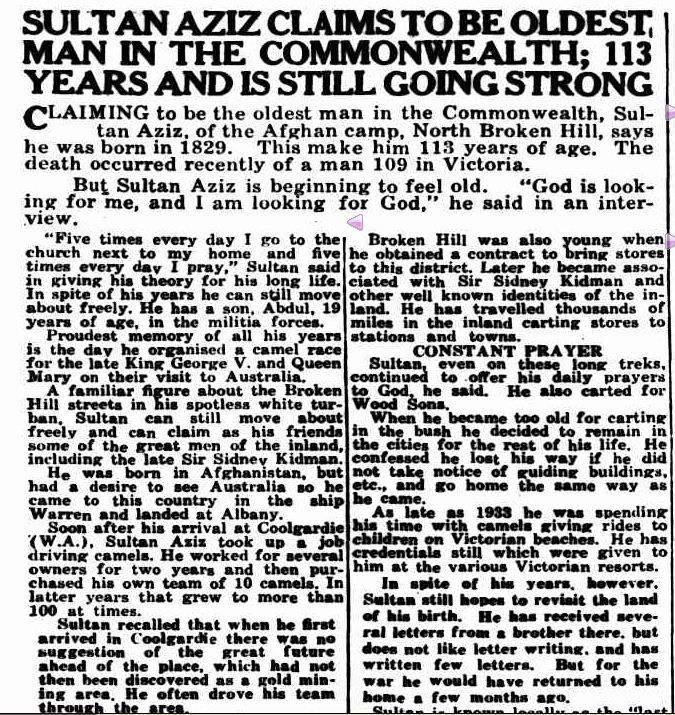
SULTAN AZIZ CLAIMS TO BE OLDEST MAN IN THE COMMONWEALTH; 113 YEARS AND IS STILL GOING STRONG. (1942, August 13). Barrier Miner (Broken Hill, NSW : 1888 – 1954), p. 3. Retrieved March 27, 2012, from http://nla.gov.au/nla.news-article48401748

Sadly, age did catch up with Sultan Aziz.  He passed away in 1950.  His age was given as 105.

AFGHAN DIES AT 105. (1950, August 16). Barrier Miner (Broken Hill, NSW : 1888 – 1954), p. 12. Retrieved March 27, 2012, from http://nla.gov.au/nla.news-article49578554

Summarising Sultan Aziz’s life in Australia through the newspaper articles,  I found he was born in Afghanistan and arrived in Albany, Western Australia via India,  around 1885.  His memories from that time included organising a camel race for His Royal Highness, The Duke of York and Cornwall who would, in 1910, become King George V.

An article from the Northern Times, Carnarvon, Western Australia on March 23, 1912, saw Aziz still in W.A. However, he was selling his camels and then sailing for South Australia to take camels back overland to Carnarvon.  I don’t think he made it all the way back as he ends up in Broken Hill with a carting contract around that time. Many other cameleers from Afghanistan were camped at Broken Hill.  He carted goods into central Australia with his camels, working for Sir Sidney Kidman.  At one time he claims to have owned up to 200 camels.  In the 65 years he was in Australia, he must have racked up some miles on his camels.  The trip from Broken Hill to Portland alone was over 900 kilometres.

He had a least one son, Abdul Aziz, who accompanied his father on his trip to Victoria.  Abdul attended school while in Portland and went on to serve in WW2.

In his later years, Sultan Aziz was the caretaker of the mosque in Broken Hill and tended his fowls.

Of course, this is mostly information provided by Sultan Aziz himself and is still to be supported by other sources.

I also did a search for marriages for Sultan Aziz, because I had to know if he did have up to four wives.  However, I did not find a harem, rather a marriage in 1923 to Bigham Kahn at Broken Hill.  This could be Abdul Aziz’s mother.  It is possible that Sultan Aziz had wives he left in Afganistan, which was not unusual for the cameleers.

It really is a great story of another colourful character to find his way into the Western District of Victoria.  I wonder if any of my relatives saw their first camel or paid a penny for a ride on the North Portland Beach.

Further Reading:

If you would like to learn more about the cameleers who helped explorers and pastoralists venture into inland Australia, the website Australia’s Muslim Cameleers is worth a visit.  There is so much information about the Muslim cameleers, including biographies. Yes, Sultan Aziz’s biography is among them.  One interesting fact is that at least 2000 cameleers arrived in Australia during the fifty years from 1870 to 1920 and 20,000 camels!  Most Australians would know Central Australia today has a lot of camels but would have no idea how and why they are there.

There is also a book by Phillip Jones and Anna Kenny, Australia’s Muslim Cameleers.  It includes a biographical listing of over 1200 cameleers.

The Age, on January 3, 2012, published an article entitled Afghans, cameleers and the massacre of Broken Hill.  It includes photos of cameleers and a mining registration form belonging to Sultan Aziz.  This was from 1939 and according to his own calculations at the time, he would have been around 110!  There is a photo, so see what you think.

I also located the WW2 service record of Abdul Aziz.  This was sad to read.  Abdul, born in 1923, enlisted in the Australian Military Service in 1942, aged 18 and later the A.I.F. in 1944.  He was sent to Bougainville in 1945 and after only four months, he received life-threatening wounds to his leg, thanks to a shell.  He returned to Australia.

Further on in the service record,  I found a letter from 1958 of Thora Aziz’s application to buy a home with help from Legacy.  Her husband Abdul had died in 1951.  He would have been only 28.  Such a short life for the son of a centenarian.
St. Patrick’s Day in Western Victoria

There is plenty of Irish blood flowing through the veins of the people of the Western District, particularly the south-west.  Port Fairy (formally Belfast), Koroit, and Killarney, in particular, saw the settlement of large Irish families.

The earliest Western District St. Patrick’s Day reference I found was from the Portland Guardian and Normanby General Advertiser, from March 4, 1843.  Enthusiastic preparations were underway for a dinner on March 17th.

LOCAL INTELLIGENCE. (1843, March 4). Portland Guardian and Normanby General Advertiser (Vic. : 1842 – 1876), p. 3. Retrieved March 16, 2012, from http://nla.gov.au/nla.news-article71569103

St Patrick’s Day was for a time, a public holiday and races were popular, both the horse and human kind.

HAMILTON. (1858, March 19). Portland Guardian and Normanby General Advertiser (Vic. : 1842 – 1876), p. 2 Edition: EVENINGS.. Retrieved March 16, 2012, from http://nla.gov.au/nla.news-article64570752

In 1869 at Portland, the Rechabite Society fete for the Band of Hope children was a feature of the day.

ST. PATRICK’S DAY. (1869, March 18). Portland Guardian and Normanby General Advertiser (Vic. : 1842 – 1876), p. 2 Edition: EVENINGS. Retrieved March 16, 2012, from http://nla.gov.au/nla.news-article64691997

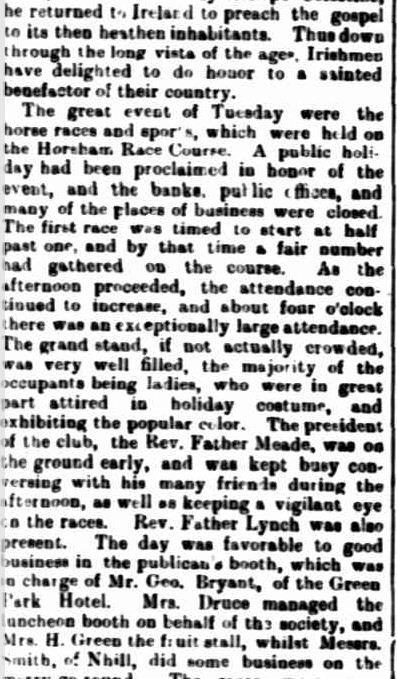
The Horsham Times of March 20, 1903, explains the reason behind the wearing of a green ribbon on St. Patrick’s Day and the story of St Patrick. The people of Horsham went to the races on March 17, 1903.

ST. PATRICK’S DAY. (1903, March 20). The Horsham Times (Vic. : 1882 – 1954), p. 3. Retrieved March 16, 2012, from http://nla.gov.au/nla.news-article72838336

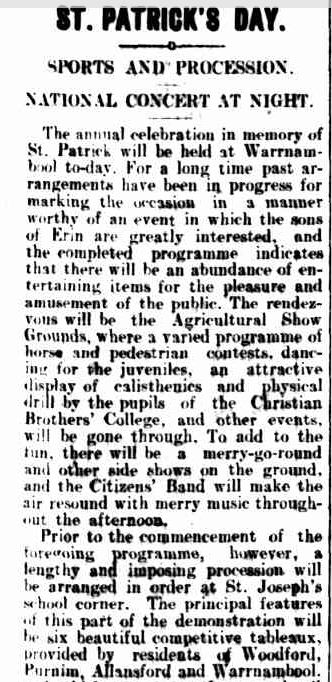
At Warrnambool, in 1914, plans were underway for the annual St. Patrick’s Day celebration, which included a parade in the afternoon and a concert in the evening.

ST. PATRICK’S DAY. (1914, March 14). Warrnambool Standard (Vic. : 1914 – 1918), p. 3 Edition: DAILY.. Retrieved March 16, 2012, from http://nla.gov.au/nla.news-article73467140

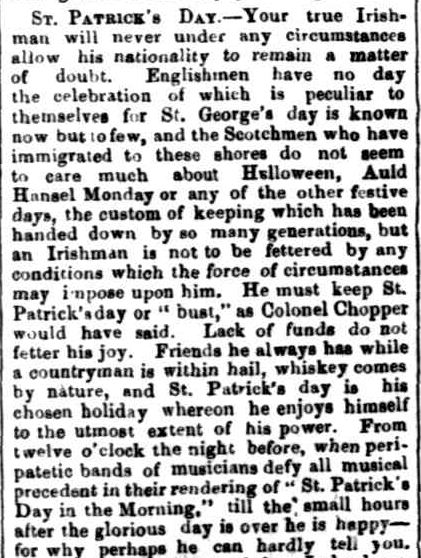
Finally, a reporter for the Star in Ballarat in 1858, observed that while the English barely remembered St. George’s day and the Scots were not interested in Halloween, the Irish would never let St Patrick’s Day be forgotten.  The Irish miners would be pleased St. Patrick’s Day is still celebrated today, minus the public holiday.

Local and General News. (1858, March 18). The Star (Ballarat, Vic. : 1855 – 1864), p. 3. Retrieved March 17, 2012, from http://nla.gov.au/nla.news-article66047115
MLA citation

Another “What the Dickens?” Moment

To mark the 200th birthday of Charles Dickens, I posted about Alfred Tennyson Dickens who lived in my hometown of Hamilton.  Entitled “What the Dickens?“, the post describes my amazement that a son of Charles Dickens could have lived in Hamilton.  Alfred left the town due to the accidental death of his wife Jessie.

Yesterday I was in Hamilton for several reasons, one of which was to visit the Hamilton Old Cemetery in search of the grave of Jessie Dickens, and as a result, I had another “What the Dickens?” moment.

My visits to Hamilton are infrequent day trips, so I try to cram in as much as possible. Visits to the cemetery are quick, usually to search for a specific grave or graves. Yesterday was no different, except I had absolutely no idea where in the cemetery Jesse was buried.  With Mum, we headed to the oldest and biggest graves.

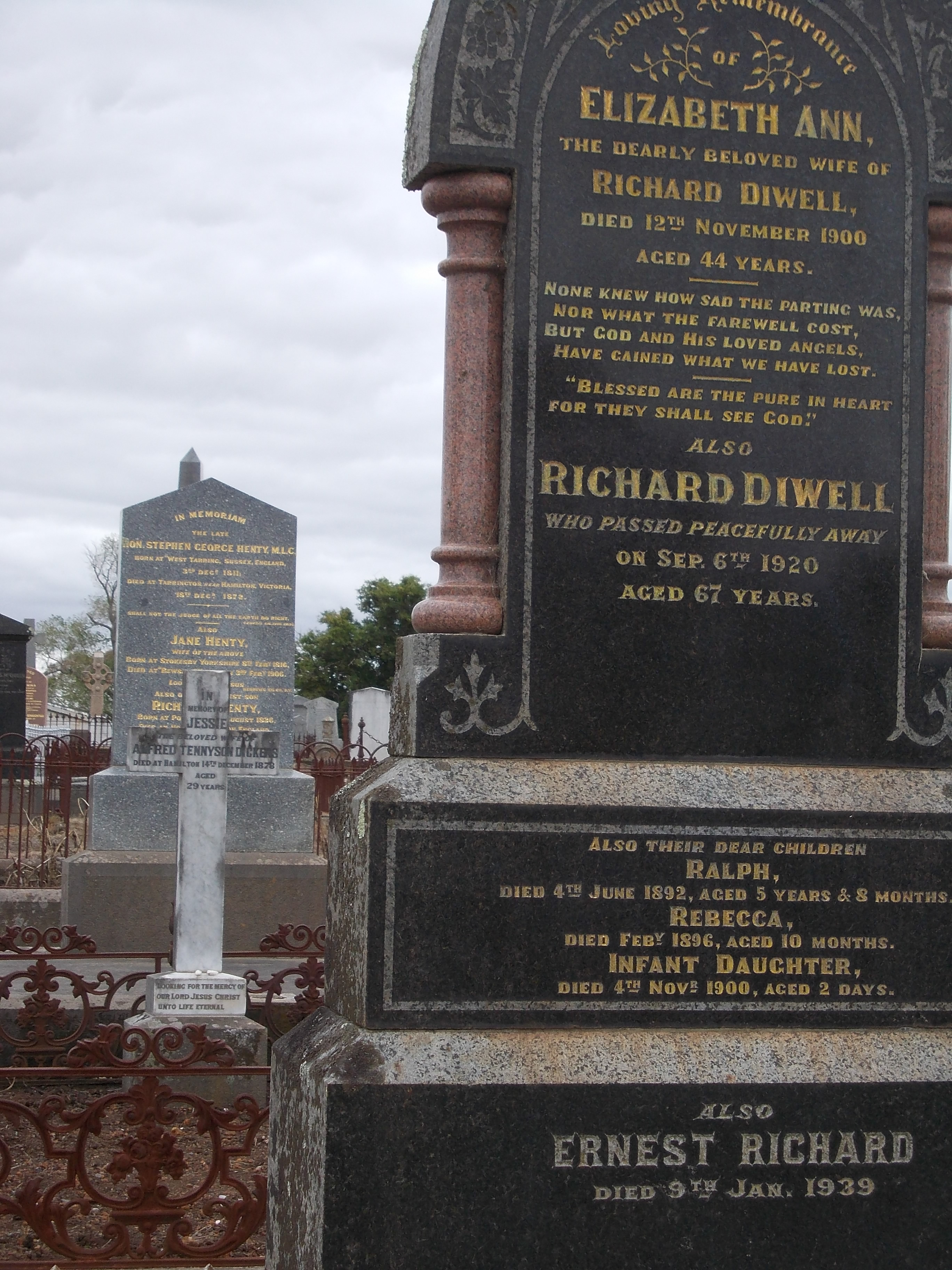
We found the grave quicker than expected.  It turns out the grave of Jessie Dickens is immediately behind my gg grandparents Richard Diwell and Elizabeth Jelly who I have posted about before.  We couldn’t believe we had previously visited the Diwell plot before, unaware the grave of the daughter-in-law of Charles Dickens was right behind. As we were earlier unaware of the Dickens link to Hamilton, we had not made the connection.

What I couldn’t believe was that I had missed the grave immediately behind Jessie’s. It was that of Stephen George Henty, one of the Henty brothers, Victoria’s first settlers.  Stephen, thought to be the most influential of the brothers, was the first to settle inland from Portland, at Muntham, Merino Downs, and Sandford stations.

DIWELL, DICKENS & HENTY GRAVES


Both the Diwell and Dickens headstones were chosen by heartbroken husbands, shattered by their wives’ premature deaths. Jessie was only 29, thrown from a horse-drawn carriage on Portland Road in 1878 and Elizabeth died at 44 due to complications of childbirth in 1900. I have updated the “What the Dickens?” post with a photo of Jessie’s grave.

When I came home, I checked the photos I already had of the Diwell grave, and sure enough, you can see the two other graves in the background.  One of these photos appears on the post “Elizabeth Ann Jelly“.

The thing that struck me was that within a distance of about 6 metres lay the remains of 10 people.  Great Victorian pioneers, Stephen George Henty and wife Jane and their son, Richmond; the wife of the son of one of the greatest novelists of all time and my gg grandparents, Richard and Elizabeth Diwell and four of their children, Ralph, Rebecca, Ernest, and an unnamed baby.  Wow!

To Catch A Thief

Well, well, well, what an exciting surprise. While searching the newly released digitised copies of the Mt Gambier paper, the Border Watch, I discovered that in 1877, ggg grandfather James Bishop was nabbed for horse theft and remanded pending trial.

I suppose the find was more exciting than surprising. Why wasn’t I surprised?  Well, Jim was a drover and the article revealed he was also a dealer.  Many horses would have passed through his hands, probably unbranded. Being a drover/stockman I would doubt bookkeeping was a strong suit and after reading many Pound Notices in the newspapers of the time, a lot of horses were wandering the countryside.  Mix-ups could easily happen.

SUMMARY OF NEWS. (1877, October 27). Border Watch (Mount Gambier, SA : 1861 – 1954), p. 3. Retrieved February 28, 2012, from http://nla.gov.au/nla.news-article77048847

I was, however, very excited about this new discovery. Enough to tweet about it!  To find some “dirt” is always exciting.  Why is it we always get the most satisfaction from finding a record of an ancestor’s misfortune?  Criminal records, wills, and obituaries are favourites of mine, but don’t forget inquests and asylum records.  Obviously, some of the excitement is just because we have found something, anything, but it also makes the family member more interesting.  These finds give them character.  An extra dimension.

On the point of character, I would have assumed Jim was nothing but respectable.  A Harman/Bishop marriage (that of my gg grandparents) took place in the same year as the arrest with another in the years following. With the Harmans being self-respecting church people, I am sure neither would have occurred if there were any doubts about Jim.

I had to find the outcome of the matter.  I had thought of going to the Ballarat Archives Centre (PROV) where the Branxholme court registers are held (Series VPRS 4892 Court of Petty Sessions Registers).  This however, would not shed much more light on the trial itself.  Surely there was more than one newspaper report.  Country newspapers reported on even the smallest of stories, and the fact James was remanded made it newsworthy.  Now that I had the date of the court case, I could narrow a Trove search down.  Believe me, this is a great help when searching a name like Bishop where a match to the Bishop of Ballarat is more likely than any members of my Bishop family.

I narrowed down a search of “Bishop Branxholme” to 1877 and bingo, the top two matches were about James.  One, I had already found, but the other from the Portland Guardian reported on Jim’s trial in November 1877 after his first court appearance.  While I had searched the same paper for the Bishops, I had not found this article.  The value of dates!  Oh and some knowledge too.  If I had found the article earlier I may have picked up it was one of my Bishops but I would have been unsure which one.

The barter system was alive and well in the Western District in the 1870s, with James trading a horse and £5 for a buggy.  The question was where did the horse come from and was it one of Mr Officer’s of Harton Hills Station

Upon questioning on this matter, Jim replied he did not know how he came to have the horse. Not a good start.

Evidence then moved to that of Constable Foster, who arrested Jim in a plain clothes operation.  Who would have thought?  Jim didn’t.  When asked by the plain-clothed Constable at Lower Byaduk, prior to his arrest, if he had sold mares at Branxholme lately, Jim said “…no, he had none to sell”  but added that Mr. Madison had sold two colts for him at Branxholme.  As two of the four missing horses were colts, Foster arrested Jim and sent him to the lockup.

While incarcerated, Jim had plenty of time to think over his recent conversations and must have realised he said the wrong thing to Foster and raised it with him.  Jim told Foster he had thought he was “…one of Chalico’s men come to look after some of my horses, and this is why I told you I sold no mares at Branxholme.”

Then it became clear Jim was not a good bookkeeper, with him stating at the time of sale he did not get a receipt from Ted Lee the postman from whom he had bought the horse.  Then Ted was hurt, so Jim went to Belfast (Port Fairy) to get a receipt from Ted, but he was too sick.  Oh dear, things were not looking good.

At last, a savior.  Witness Samuel Taylor took the stand.  He had seen Jim and Ted Lee together with four horses.  Ted told Samuel he had sold the horses to Jim.  The horses were then agisted at Taylor’s property for the next fortnight.  Phew.  Case dismissed, and Jim was off the hook.

BRANXHOLME. (1877, November 5). Portland Guardian (Vic. : 1876 – 1953), p. 2 Edition: EVENINGS.. Retrieved March 2, 2012, from http://nla.gov.au/nla.news-article63339852

So Jim didn’t go to jail, but if it wasn’t for Samuel Taylor’s evidence, he may have. I hope he had Ted Lee lined up as a witness.

Now the excitement has subsided and I can continue to consider Jim Bishop an honest man.  But deep down inside, a small part of me is crying…I could have searched prisoner records!  Sorry, Jim!

New Site – Settlers in the Glenelg & Wannon Region of SW Victoria

Today I heard the South West Victorian content on the Ballarat & District Genealogical Society website now has a stand alone site.  Entitled “Settlers in the Glenelg & Wannon Region of SW Victoria” there is plenty of information for those with Western District families.  Hosted by Daryl Povey, I have used the site so much in it’s former guise.  Daryl intends to keep expanding it too. Some of what you can find includes:

  • Articles
  • Maps
  • Town Histories
  • WW1 Memorials
  • Pastoral Runs
  • Links, lots of them

I first “met” Daryl through the Rootsweb Western District of Victoria mailing list over 10 years ago and I quickly found he has a vast knowledge of Western Victorian history.  If anyone has a question for the list, Daryl is never far away with an answer.  He has helped me out a number of times.  It is also worth joining the mailing list if you have Western District links.  It doesn’t have as much traffic as it used to, social media has something to do with that, but you will find some wonderful people like Daryl, just an email away willing to help with your queries.

As a result of the changes, the Casterton & District Historical Society now has a new link.  I have updated my Western District Links page with the new sites.

Back to Hamilton February 24, 1923

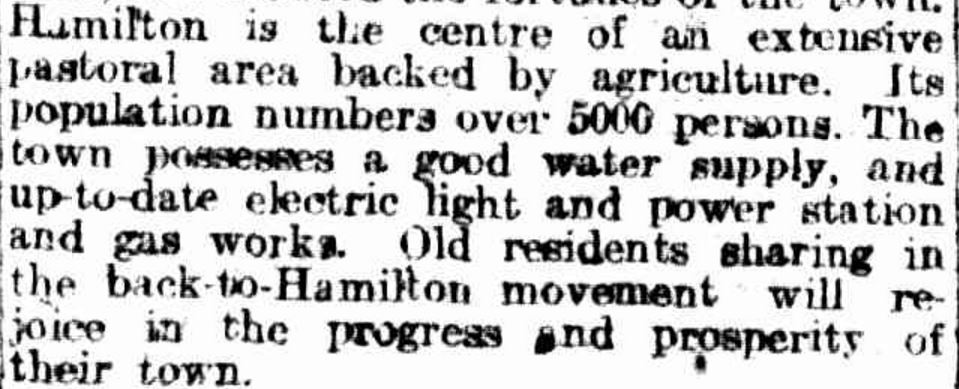
After months of planning, Saturday 24 February 1923 was the first day of the “Back to Hamilton” celebrations, an event which ran until the following Sunday 3 March.

“BACK TO HAMILTON.”. (1923, February 19). Portland Guardian (Vic. : 1876 – 1953), p. 2 Edition: EVENING.. Retrieved February 21, 2012, from http://nla.gov.au/nla.news-article64101957

Activities planned included band recitals, back to school visits, ancient and modern dance socials and terrier coursing.

bh

bh1

bh2

“BACK TO HAMILTON.” The Age (Melbourne, Vic. : 1854 – 1954) 23 Feb 1923: <http://nla.gov.au/nla.news-article203778556&gt;.

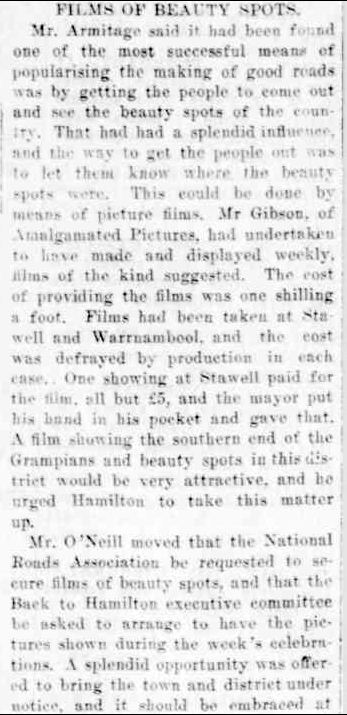
Visits to beauty spots around Hamilton were a feature as were “picture entertainments”.  I wonder if that included films of “Beauty Spots” as proposed in the following article.  Such a film was discussed during a meeting of the National Roads Association who were looking at development of roads through the Grampians to enhance tourism .  The film would be a way to show off the area and reinforce that good roads were necessary throughout the Grampians.  The “Back to Hamilton” celebrations were an opportunity to screen it.

Roads to Grampians. (1923, January 30). The Horsham Times (Vic. : 1882 – 1954), p. 3. Retrieved February 23, 2012, from http://nla.gov.au/nla.news-article72743674

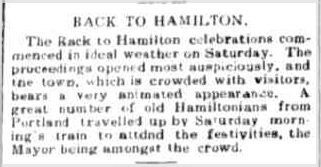
Over the first weekend, Hamilton was full and visitors were enjoying the celebrations in fine weather.

BACK TO HAMILTON. (1923, February 26). Portland Guardian (Vic. : 1876 – 1953), p. 2 Edition: EVENING.. Retrieved February 21, 2012, from http://nla.gov.au/nla.news-article64101997

Many visitors arrived by train and bands welcomed them at the station “Home, Sweet Home”

“BACK TO HAMILTON.”. (1923, February 27). The Argus (Melbourne, Vic. : 1848 – 1956), p. 11. Retrieved February 23, 2012, from http://nla.gov.au/nla.news-article1879114

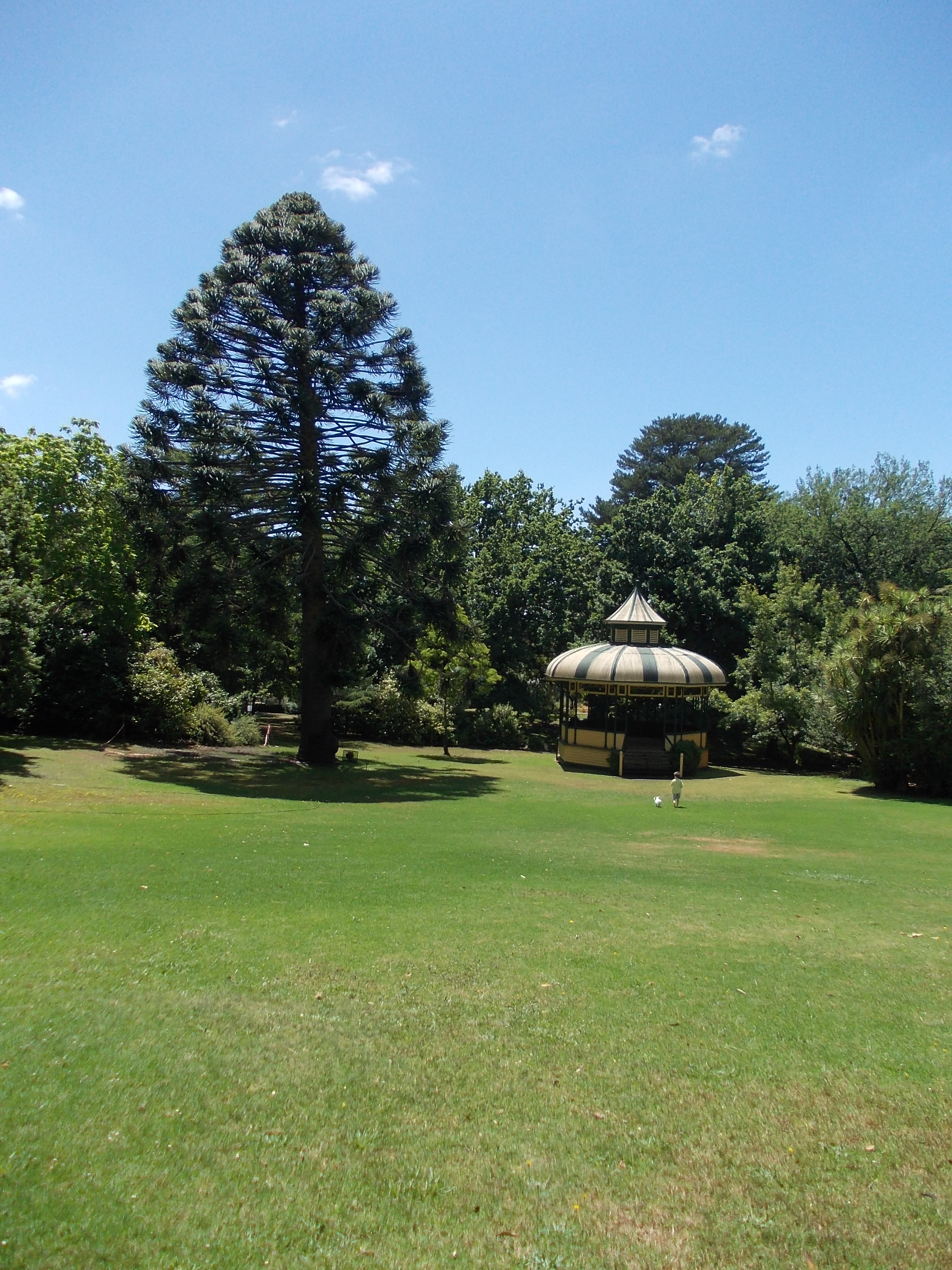
Crowds gathered in the Hamilton Botanic Gardens to listen to band recitals in the bandstand on Sunday February 25.  On the following Tuesday, children gathered in the gardens for sports.

BANDSTAND, HAMILTON BOTANIC GARDENS

Councillor Noske spoke to the gathering declaring “Hamilton was destined to become a great town” and the council’s focus was on closer settlement.  A parade was held on the Tuesday afternoon which included Thomas Cawker of Casterton driving a four-in-hand coach, old pioneers his passengers.

Back to Hamilton. (1923, February 28). The Argus (Melbourne, Vic. : 1848 – 1956), p. 14. Retrieved February 23, 2012, from http://nla.gov.au/nla.news-article1879269

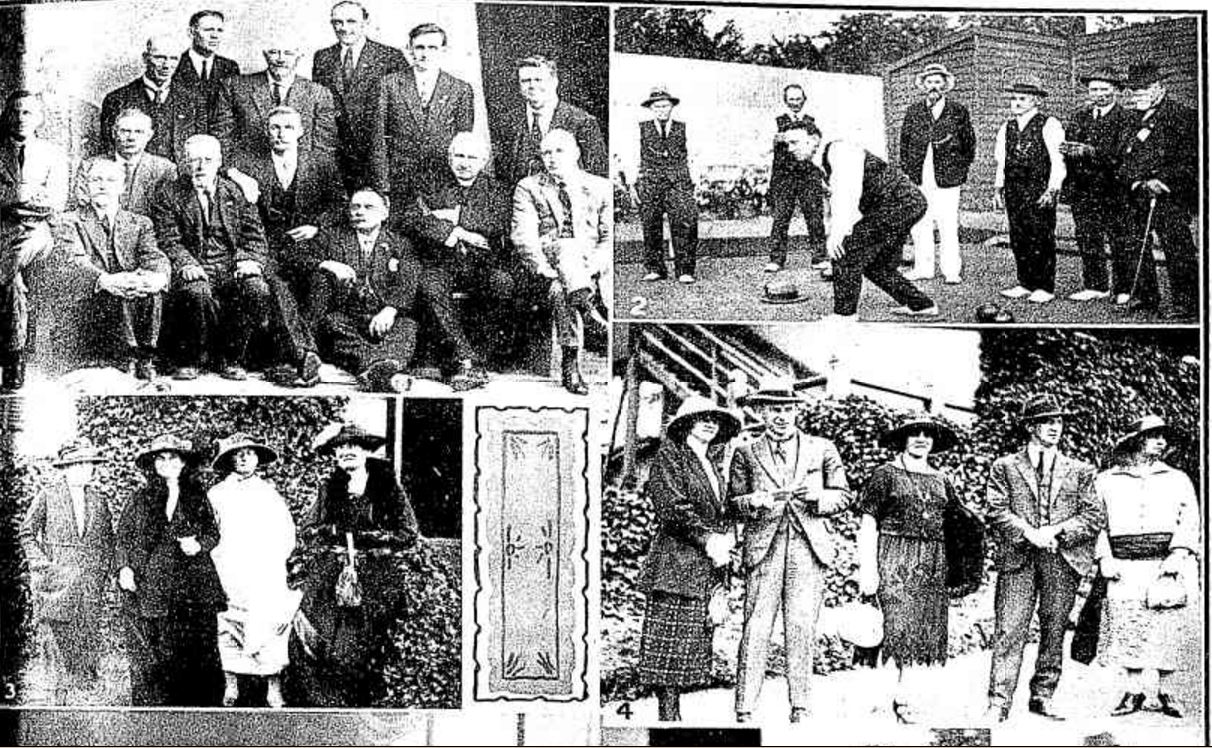
Photos from the event from Table Talk 8 March 1923

bh5

"[No heading]." Table Talk (Melbourne, Vic. : 1885 - 1939) 8 Mar 1923: 9. Web..

bh6

“[No heading].” Table Talk (Melbourne, Vic. : 1885 – 1939) 8 Mar 1923: 9. Web.<http://nla.gov.au/nla.news-page17434629&gt;.

 "[No heading]." Table Talk (Melbourne, Vic. : 1885 - 1939) 8 Mar 1923: 26. .


“[No heading].” Table Talk (Melbourne, Vic. : 1885 – 1939) 8 Mar 1923: 26. <http://nla.gov.au/nla.news-page17434648&gt;.


The “Back to Hamilton” was a roaring success, with a profit of £189/11/9.  A very healthy sum for an event which one would imagine was not for profit.  I wonder where the money ended up?

Miscellaneous. (1923, April 9). Portland Guardian (Vic. : 1876 – 1953), p. 3 Edition: EVENING.. Retrieved February 23, 2012, from http://nla.gov.au/nla.news-article64102283

It was during the following year, 1924, when a committee  formed to organize a “Back to Horsham”, gave some clue how such a big profit came about.  While a similar event in Stawell was mostly subsidized,  Hamilton visitors incurred charges for many events, including a trip to a dry Wannon Falls.

Back to Horsham. (1924, August 5). The Horsham Times (Vic. : 1882 – 1954), p. 3. Retrieved February 23, 2012, from http://nla.gov.au/nla.news-article72749147