Passing of the Pioneers

This is the fourth “Passing of the Pioneers” and includes a chess champion who lived in Merino and plenty of Irish influence.  They highlight some of the pioneers of Victoria’s Western District by way of their obituaries as published in the Portland Guardian.  If you would like to read the full obituary, just click on the pioneer’s name.

Emma WITHERIDGE: Died  4 October 1888 at Portland. This obituary demonstrates the tone of many at the time.

OBITUARY. (1888, October 5). Portland Guardian (Vic. : 1876 – 1953), p. 2 Edition: EVENING.. Retrieved October 26, 2011, from http://nla.gov.au/nla.news-article63590480

George BEVAN: Died  17 October 1888 at Portland. George owned and died at the London Hotel in Portland.  His family notice shows he was born in Somerset, England and was fifty-nine at the time of death.  George had been in Portland since the early 1860s and was a keen sportsman and former Town Councillor.

Mary ROGERS: Died October 1912 at Greenwald.  Mary Rogers was aged eighty-six at the time of her death and had lived in Victoria for sixty years.  She originally went to Tasmania from Ireland with her parents as a small child.  Mary married Francis Egan who had passed away thirty years earlier.

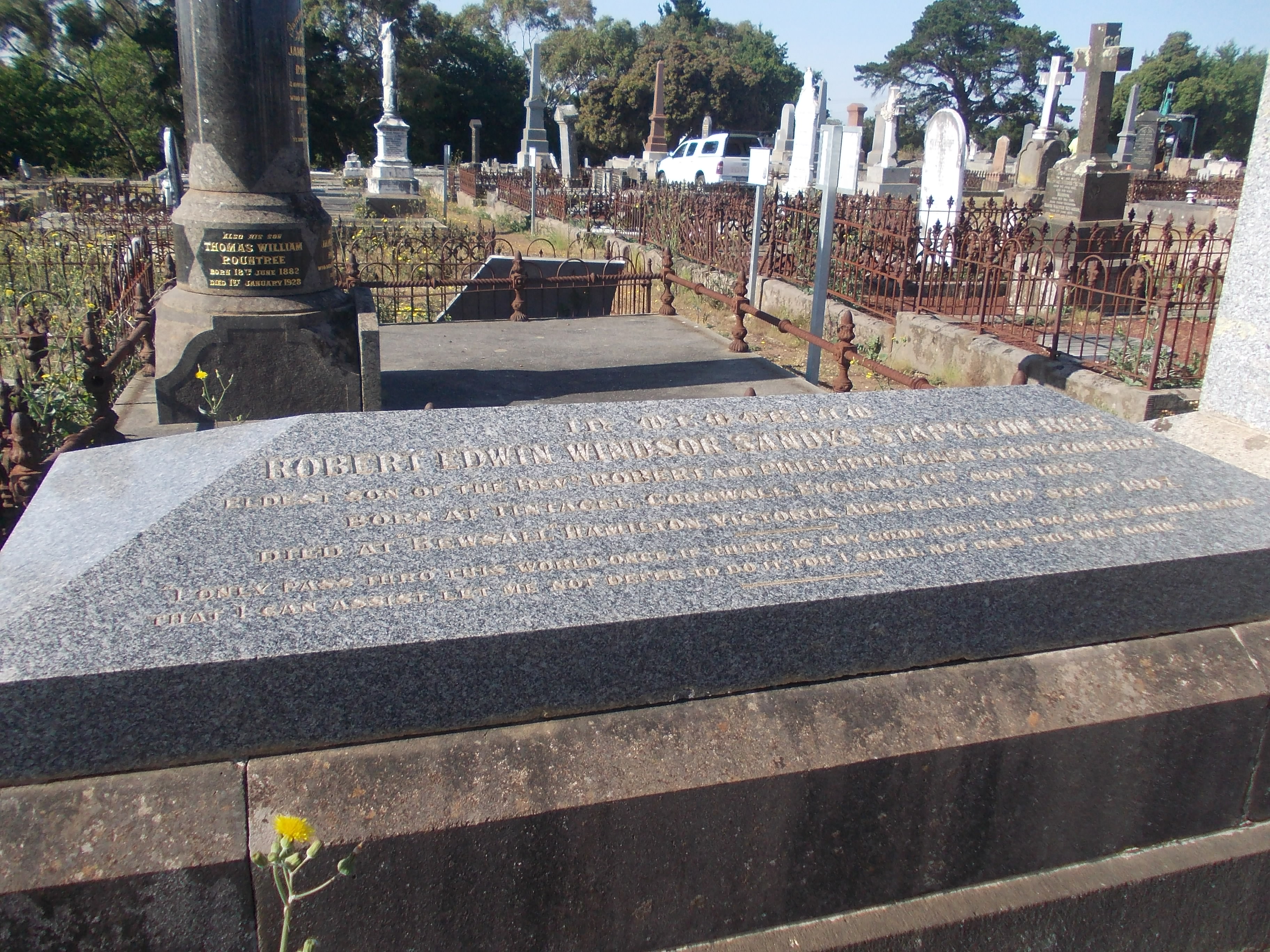
William Sudgen Price LEWIS: Died 4 October 1915 at Hamilton. William Sudgen Price Lewis was the stepson of Richard Lewis, a former owner of Rifle Downs at Digby.  Born in Tasmania in 1835, William and his brother came to live with Richard Lewis when Richard and their mother married in 1841. In adult life, William leased Hilgay station for a time, bred fine livestock and was a member of several racing clubs. He later retired to Hamilton. He was buried at Hamilton (Old) Cemetery (below).

John Hawkins ROW: Died 27 October 1926 at Portland. John Row was a Portland jeweller.
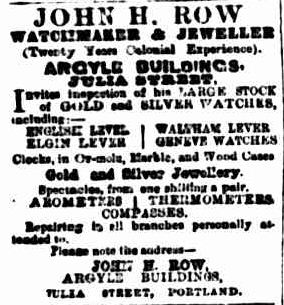
Advertising. (1879, March 27). Portland Guardian (Vic. : 1876 – 1953), p. 2 Edition: MORNINGS.. Retrieved October 27, 2011, from http://nla.gov.au/nla.news-article63341984

At the time of his death, he was the oldest member of the Portland Free Library and the bowling club.  He was also a member of the St Stephen’s Church congregation.

St Stephens Church Portland

John McDONNELL: Died 17 October 1930 at Moree. Mr McDonnell was originally from Ireland and arrived in Australia in 1863 via Liverpool. He was considered one of the oldest people in the district. He married Catherine FAHEY and they selected land at Moree in 1865.

Catherine Bridget SAMPEY: Died October 1933 at Melbourne. Catherine Sampey arrived in Melbourne from Ireland aboard the Red Jacket in 1852. She travelled on to Chetwynd with her brother James Sampey and she later married Patrick WHITE of Casterton.

Elizabeth MONOHAN: Died 12 October 1933 at Casterton. Elizabeth Monohan was 100 when she died. Arriving from Ireland aboard the Frances Henty at age twenty-one, seventy-nine years before, she was still able to converse in Welsh and Gaelic in her later years. In 1859, she married John Glover at Sandford House.

Julia Teresa DOYLE: Died October 1934 at Portland. Born in Tipperary, Ireland but remembered as “a true type of a fine old English lady”, Julia Doyle arrived in Australia as a six-year-old in the mid-1850s. She married Frances SUTTON in 1874 and together they had six daughters and two sons.

Ernest John SEALEY: Died 25 October 1935 at Casterton. In his younger years, Ernest Sealey worked as a bullock driver transporting wool. In later worked on Portland’s deep-water pier, hauling logs from the forests to the pier.

Charles PRATT: Died 26 October 1935 at Birchip.
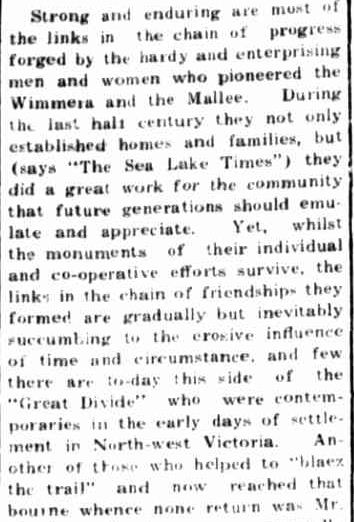
Obituary. (1935, November 4). Portland Guardian (Vic. : 1876 – 1953), p. 2 Edition: EVENING.. Retrieved October 27, 2011, from http://nla.gov.au/nla.news-article64290777

And so begins the obituary of Charles Pratt.  Charles or Charley as he was widely known, was born at Mumbannar in 1870.  In 1891, he went to Beulah in the Mallee and worked with his step-brother and later selected his own land near Watchupga.  He married Annie LAVERY in 1914 and they had three sons.

Thomas Denton CLARKE: Died 5 October 1937 at Hamilton. Thomas, born around 1847 at Liverpool, was the son of Captain Thomas H. Clarke who was a trader in Portland.  Thomas jnr was a champion chess player and a composer of chess problems.  He won many competitions for both pursuits.  Composing problems up until his death, it was considered probable, according to the obituary, that he was the world’s oldest composer.

James McCLUSKEY: Died October 1942 at Koroit. James McCluskey was born at Portland in 1857, not long after the arrival of his parents on the ship, British Empire. Soon after, the family travelled by bullock wagon to Kirkstall near Warrnambool.  In his early working life, James drove pigs to Port Fairy in order to load them on the steamer Casino to go to market in Melbourne.

Mary PRATT: Died 7 October 1942 at Greenwald. Mary, the widow of George COWLAND, was eighty-seven at the time of her death.  There were twelve children in their family.  Her obituary recalled her pioneering traits.
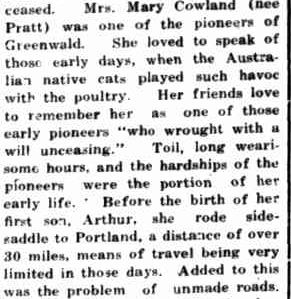
OBITUARY. (1942, October 26). Portland Guardian (Vic. : 1876 – 1953), p. 2 Edition: EVENING. Retrieved October 27, 2011, from http://nla.gov.au/nla.news-article64382483

The Day the Queen Visited Hamilton

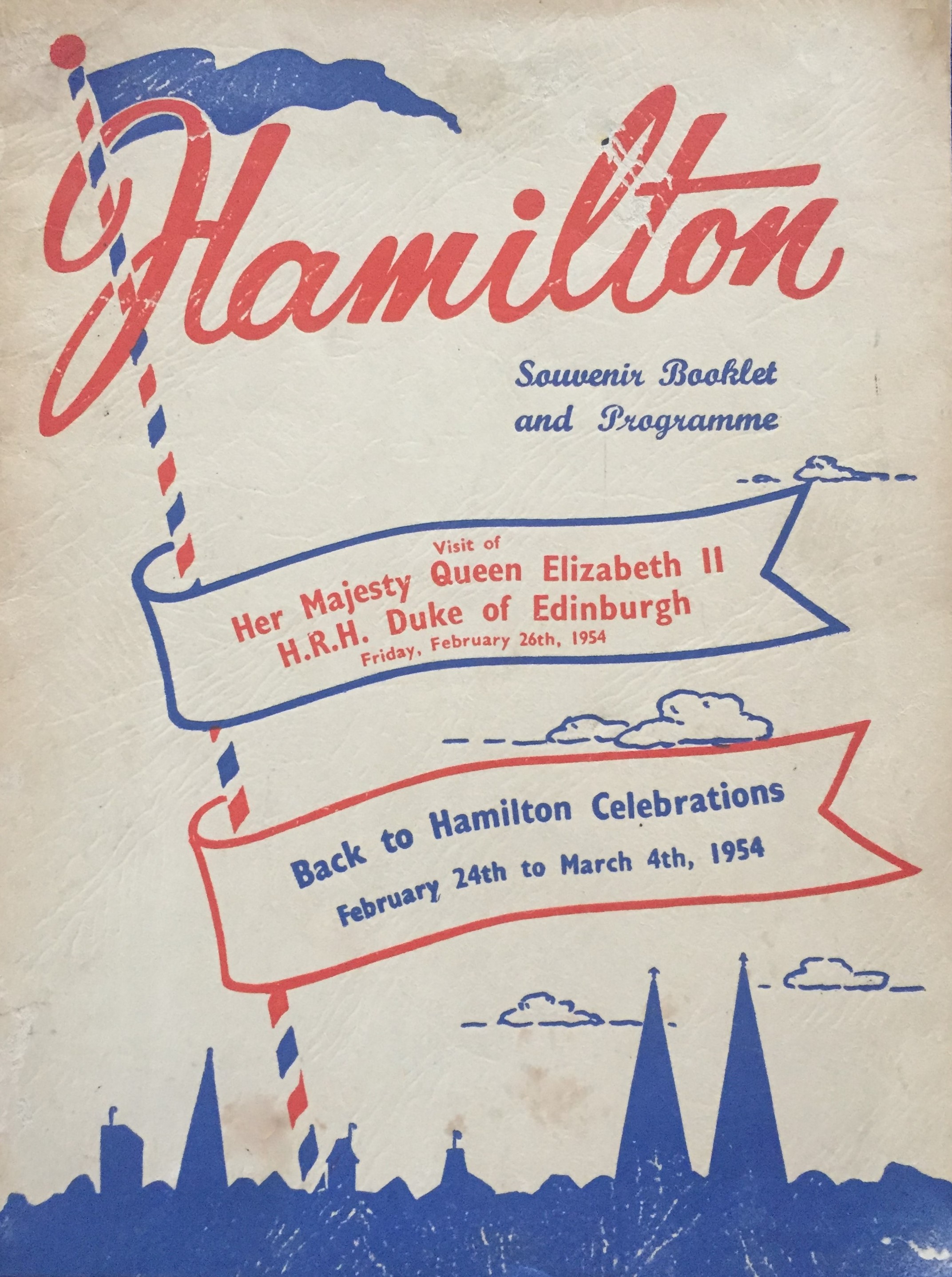
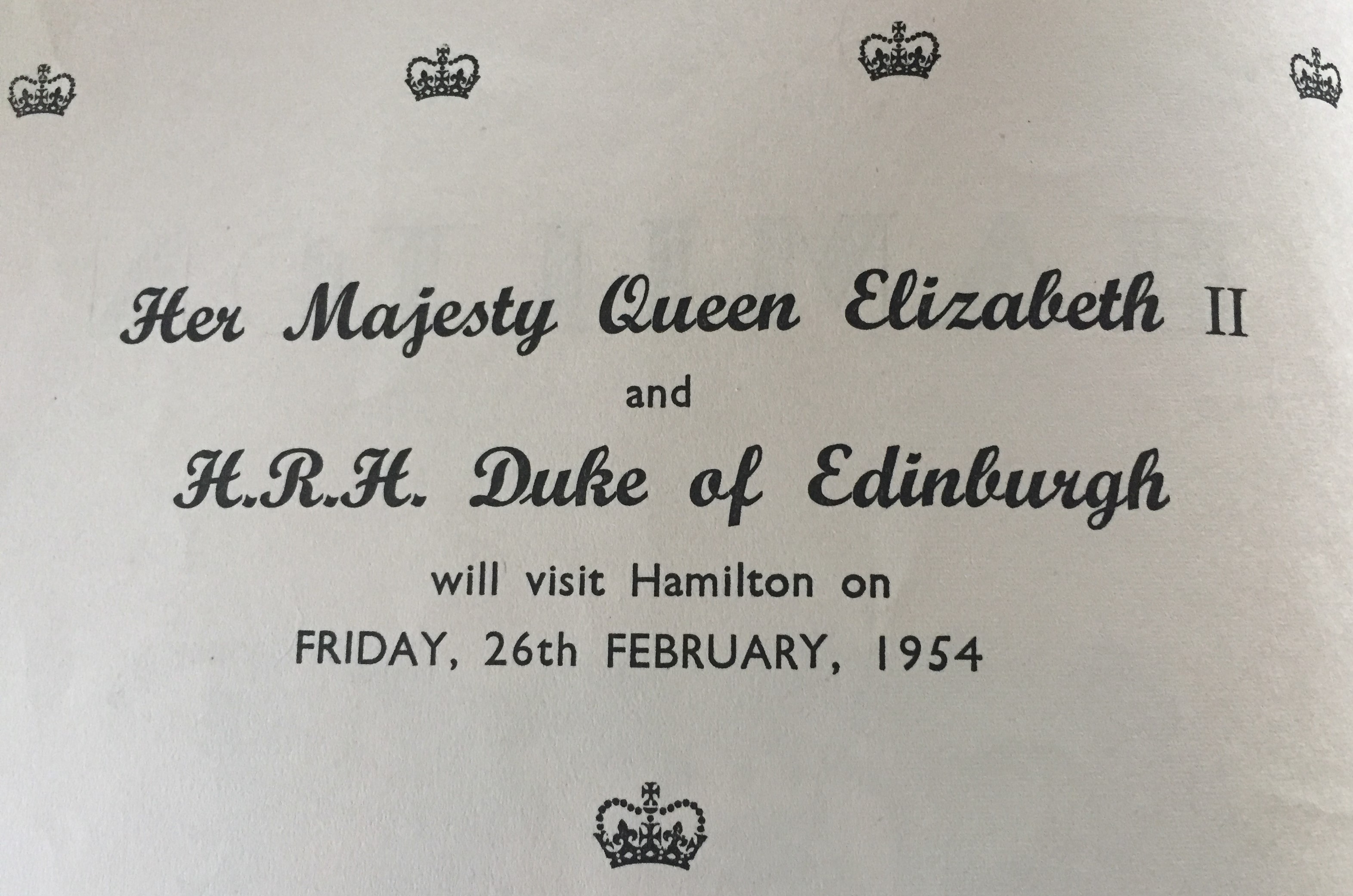
Hamilton Souviner Booklet and Program, 1954

On 26 February 1954, Hamilton was buzzing with excitement for a much-anticipated visit by Queen Elizabeth II and Prince Phillip, Duke of Edinburgh.

Mt Gambier and Hamilton were the only locations in the region chosen for a visit by the new Queen, despite much lobbying by nearby towns. The inter-town rivalry preceding the visit was immense. Headlines in the Portland Guardian at the time included “Number One Priority for Royal Visit Should Have Been Portland’s” and “No Royal Visit an Insult to Portland”

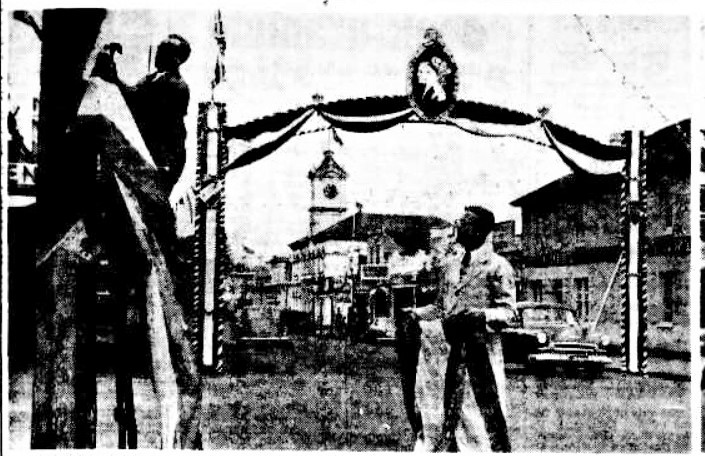
Hamilton wanted to put on a show, and preparations started long before the big day. Residents decorated their homes, some with flags on the roofs for the Queen to see as she flew into the Hamilton Aerodrome.  The council spent £5,000 on decorations, including four large arches around the town, with one on the outskirts made of locally grown hay, oats, and flax, with “Welcome” crafted from wool, for which the district was famous. Several kilometres of bunting, flags, and lights decorated the CBD.

HAMILTON READY TO GREET QUEEN (1954, February 26). The Argus,p. 15. http://nla.gov.au/nla.news-article26593166

More than 100,000 people were expected to converge on the town. Local hotels set up beds in the lounges and on balconies to accommodate the overflow of guests and accommodation houses up to 60 kilometres away reached capacity.

The Royal Visit coincided with “Back to Hamilton” celebrations, and the organising committee published a souvenir booklet.

PHOTO OF AUTHOR’S COPY.

On the big day, The Argus published a map of the best places to glimpse the Queen and Duke.

Where to see the Queen Today FIRST COUNTRY VISIT. (1954, February 26). The Argus p. 7. http://nla.gov.au/nla.news-article26593160

At Melville Oval, around 13,000 school children started assembling from 8.00am.

Along with the school children were several thousand others, many travelling long distances.

HAMILTON’S FAMILY WELCOME. (1954, February 27). The Argus, p. 15. http://nla.gov.au/nla.news-article26593294

With the Queen’s plane scheduled to arrive at the Hamilton Aerodrome, to the north of the city, at 3.35pm, the Dundas Shire President, Cr. Henry Bull, his wife, and around 3000 eager locals gathered to meet Queen Elizabeth and the Duke. Young Rosemary Oates prepared to present Her Majesty with a bouquet.

Back to Hamilton visitors saw Queen and Duke (1954, March 10). Weekly Times p. 78. http://nla.gov.au/nla.news-article224910934

The plane was five minutes late, and a gasp went up from the large crowd when part of the carpet laid on the tarmac almost blew away from the force of the plane’s propellers.

MARGARET OATEN PRESENTS QUEEN ELIZABETH WITH A BOUQUET (1954, February 27). The Argus, p. 7. http://nla.gov.au/nla.news-article26593444

The Royal party then moved by car to Melville Oval, where the schoolchildren were still patiently waiting after eight hours.

Hamilton rocked in Royal salute. (1954, February 27). The Argus p. 7. http://nla.gov.au/nla.news-article26593444

The sight of the decorated city, and an estimated 70,000 adults and children waving, saw the Queen wipe her eyes several times before the motorcade came to a halt at Melville Oval.

Hamilton welcome Queen had tears in her eyes (1954, February 27). The Argus p. 4.  http://nla.gov.au/nla.news-article26593398

After being met by Mayor Cr. Reginald White and Town Clerk Hector Donald and their wives, the royal couple drove around Melville Oval before returning to the airport for a flight to Melbourne.

The Age (Melbourne, Vic. : 1854 – 1954) 27 February 1954, p. 3. http://nla.gov.au/nla.news-article206088677

But not before eight-year-old Jennifer Biggs from Hamilton State School had the honour of presenting the Queen with a bouquet.  Jennifer is pictured below, practising her courtesy before the event while her classmates watch on.

Rag doll aids girl’s curtsy (1954, February 26). The Argus , p. 15.  http://nla.gov.au/nla.news-article26593193

“Hamilton’s Children Cheer the Queen” The Age 27 February 1954: p. 8. http://nla.gov.au/nla.news-article206088514 

Hamilton rocked in Royal salute (1954, February 27). The Argus, p. 7. http://nla.gov.au/nla.news-article26593444

On the return trip to the aerodrome, the Royal party drove past the Hamilton Hospital, where members of the nursing staff excitedly waved to the passing motorcade.

(1954, February 27). The Argus p. 7. http://nla.gov.au/nla.news-article26593444

Back at the aerodrome, around 3,000 people waited to farewell the Royal visitors.  The Argus of 27 February 1954, described how the large crowd “surged forward in a wild rush” jostling “elderly men and women and young children.”

It was a memorable day for Hamilton, one not since matched, and almost 70 years later, it remains in the memories of those who were there to experience it.

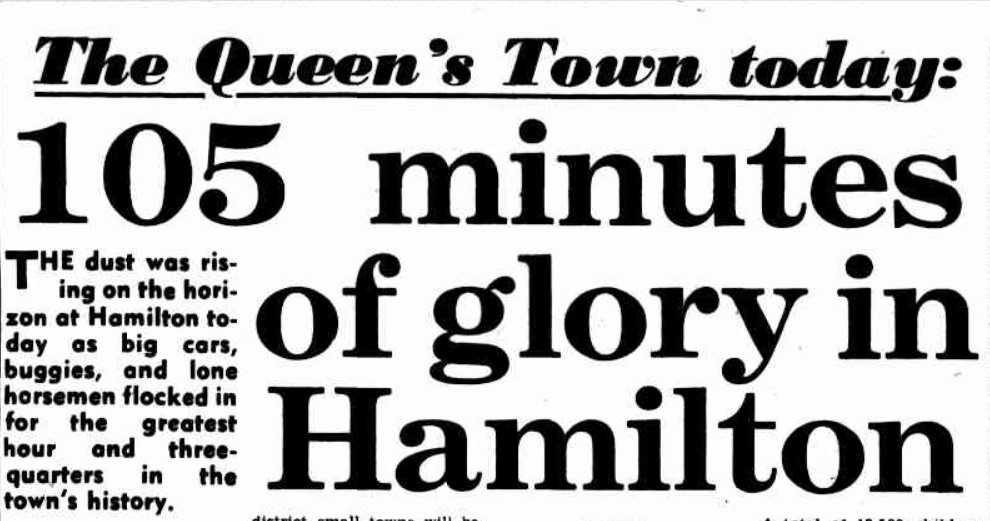
The Queen’s Town today: 105 minutes of glory in Hamilton (1954, February 26). The Argus, p. 2. http://nla.gov.au/nla.news-article26593119

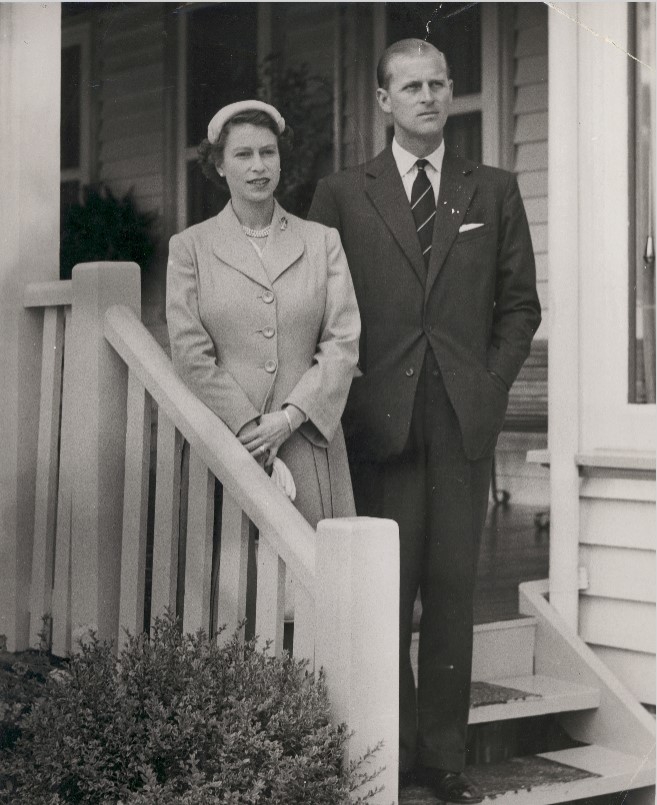
QUEEN ELIZABETH II & PRINCE PHILLIP, DUKE OF EDINBURGH DURING THEIR 1954 TOUR OF VICTORIA. Image courtesy of the State Library of Victoria http://handle.slv.vic.gov.au/10381/245876

Histories of South-West Towns

I often look at the ABC Local radio websites, but usually only a page a link has led me to.  Recently I found myself on the ABC South West Victoria website and decided to look around.  I discovered a series of radio interviews by Jeremy Lee entitled A-Z of the South West.  Recorded in 2010, the aim was to highlight the history of towns in the region.  The good news is that there are 45 towns featured, not just 26.  The towns include Macarthur, Caramut, Port Campbell, Branxholme, and Casterton.

They are great interviews with local residents and historians, some have lived in their town all their life.  Topics covered include town beginnings, past businesses, local attractions, prominent residents, and the future outlook. I enjoyed Jim Kent talking about Casterton and his own contribution to the local population, 11 children, 40 grandchildren, and 16 great-grandchildren.  There are photos of each town too.

An understanding of local history is important when researching a family. It can explain why a family chose to settle in a town.  For example, Peter Watt talks of how Cavendish was a town of workers.  Many residents, both male, and female worked for the large stations close to the town such as Mokanger and Kenilworth.  Aside from a sawmill,  a couple of shops, and a pub, there was no other employment opportunities except for the stations.  Two of my families, the Haddens and Mortimers, went to Cavendish primarily to work at Mokanger station and they remained there most of their working lives.

The various ABC websites are a great resource.  I have since looked closer at some of the other ABC local radio websites and found that you can search by topic.  Clicking on the  “Community & Society” tab brings up a list of sub-topics, including “History”.  ABC Western Victoria currently has 86 history-related stories available.  I have also subscribed to an RSS feed of stories tagged “history” so I don’t miss any.  Or take 15 months to stumble across.

To listen to the interviews follow the link:

http://www.abc.net.au/local/stories/2011/06/03/3234418.htm?site=southwestvic

Passing of the Pioneers

The September “Passing of the Pioneers” in the Portland Guardian saw several prominent Western Victorian residents pass away and two of my own relatives.

Richard LEWIS: Died September 1890 at Digby.  Richard owned some well-known stations in the Western District including Rifle Downs and Hilgay.  An excellent biography of Richard Lewis is on the Ballarat Genealogical Society website. Richard died as a result of Bright’s disease.

Samuel CROSSDied 4 September 1901 at Hamilton. Samuel was seventy-nine at the time of his death and had been in Australia since 1849 after travelling from Sussex, England. He worked in and owned, department stores including the Beehive Store in Hamilton.  In his later years, he was a librarian at the Hamilton Mechanics Institute.

Jacob THEISINGER: Died 13 September 1901 at Portland. Jacob, also a sufferer of Bright’s Disease, had been in the colony since around 1854.  He was a popular person around town and was a member of the Portland German Band.

Robert Edwin Windsor Sandys STAPYLTON-BREE: Died 17 September 1907 at Hamilton. Robert Edwin Windsor Sandys Stapylton-Bree was a Hamilton stock and station agent and well know identity not only in Hamilton but also in Portland.  He married the daughter of Stephen HENTY, Annie Maria.  His funeral was well attended with Dean Parkyn presiding over the service.  He and Archdeacon Hayman had motored the 119 mile trip from Ballarat in five hours.

Christina STEWART: Died September 1921 at Hamilton. Christina STEWART was born in Kingussie, Scotland in around 1825 and travelled with her husband, Duncan McPherson, to Australia in 1851 onboard the Hooghlly.  While Duncan went off to the goldfields, Christina waited in Melbourne until they journeyed to Portland.  For a time, she and her husband ran the Dartmoor Hotel.  She was a mother of eight children.

Elizabeth GLADSTONE: Died 18 September 1925 at Millicent, South Australia.  Elizabeth Gladstone grew up near Portland and the Guardian noted she rode eighty miles each day to school.  I am assuming this was a round trip, or it was a short school day.  Elizabeth married George Plunkett in 1862 at Penola, South Australia.

May ROBERTSON: Died September 1925 at Gringalgona.  May Robertson arrived in Sydney with her family in 1847 from Scotland.  They travelled to the Coleraine district by bullock wagon.

Margaret Emily McDONALD:  Died  5 September 1928 at Nokomai, New Zealand.  Margaret McDonald’s parents were early pioneers and she spent time around Portland and Hamilton as a child with one of her early memories being that of Adam Lindsay Gordon and his riding feats.  In 1863, Margaret married Donald Cameron in Melbourne and they moved to New Zealand and raised twelve children.

Margaret BEST: Died 7 September 1933 at Hamilton. Margaret was born in County Caven, Ireland in 1853 to Mr and Mrs William Best.  They arrived at Portland on board the General Hewitt in 1856.  After time in Portland, the Bests moved to Heywood when Margaret was nine. She married James Henry BELL and remained in the Heywood area.

Ada Catherine HAYMAN: Died September 1934 at Portland.  Ada was born in Axminster, Devon, England in about 1858.  She arrived at Portland with her parents and siblings in the 1860s.  This is an interesting family.  Ada’s father was a doctor and practiced in Harrow, Edenhope, and Ararat.  One of her brothers was a doctor, another Archdeacon Hayman presided over R. Stapylton-Bree’s funeral (above).  Another brother W.R. Hayman was one of those who organised the  Aboriginal cricketers’ tour of England in 1868.  The biography of one of the players, Johnny Mullagh, describes the part Hayman played.

Finlay McPherson PATON: Died September 1936 at Tarrayoukyan. Finlay Paton was born at Stirlingshire, Scotland and after landing at Portland, took on the job of ringing the church bell and did so for 15 years. This could have been just one of the reasons for his “magnificent physique”.  Maybe it was because he claimed that he was one of those that carted stones to build Mac’s Hotel in Portland.  Or was it lifting four-bushel bags of wheat from the ground to a wagon, with little trouble.  He really must have been a fine specimen. As were his team of horses used for his carrying business. Bred by Finlay they were the “admiration of the district”

William DIWELL: – Died September 1939 at Jeparit. William was my ggg uncle.  His obituary mentioned his work as a builder and the several buildings in Portland remaining, at the time of his death, as memorials to his work.  It does mention he was a native of Portland, however, he was born at Merino.  It correctly states his wife Frances was a native of Portland.

Thomas Haliburton LAIDLAWDied September 1941 at Hamilton. Over 500 people were reportedly at the funeral of Thomas Laidlaw, a Hamilton stock and station agent.  Thomas was the son of pioneers, Thomas and Grace Laidlaw.   The obituary offers a great description of the early days of Thomas Laidlaw senior in the colony with his four brothers.  Thomas junior, along with building his successful stock and station business was at one time a Shire of Dundas Councillor, President of the Hamilton Racing Club, and chairman of directors of the Hamilton and Western District College, today Hamilton and Alexandra College.  Laidlaw is one of the names that if I hear it, I think of Hamilton.

Henry MORTIMER: Died  6 September 1948 at Portland.  Another ggg uncle of mine, Henry was the son of James Mortimer and Rosanna Buckland.  He was born in Cavendish and was eighty at the time of his death at Portland.  He is best known on this blog as Mr Mortimer of Mr Mortimer’s Daughters.  This was an informative notice as it listed Henry’s children, grandchildren, and great-grandchildren.

In The News – September 16, 1904

An article in The Portland Guardian on September 16, 1904, made me smile.  Today, when politicians of all levels of government are questioned about the frequency of their overseas trips or their questionable expenses, the concerns of the  Guardian seem humble in comparison.  Also,  the tone of the article may have been different if an invitation had been offered to the Editor to take part in what was titled “The Riding Party”.

In an earlier edition of the Guardian, it had been reported that the local Councillors had set off on horseback and buggy that day, with the intent to inspect a road and also Grant Bay, not far south of the town.  The Guardian found out later that the real reason for the outing was to hunt rabbits.

Established August 1842. (1904, September 16). Portland Guardian (Vic. : 1876 – 1953), p. 2 Edition: EVENING. Retrieved September 15, 2011, from http://nla.gov.au/nla.news-article63689870

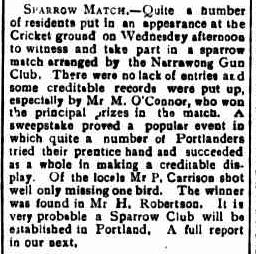
Another article that caught my eye was that of the “Sparrow Match”.  The Narrawong Gun club had organised the match at the cricket ground and there was a large attendance.

Established August 1842. (1904, September 16). Portland Guardian (Vic. : 1876 - 1953), p. 2 Edition: EVENING. Retrieved September 16, 2011, from http://nla.gov.au/nla.news-article63689870

A story on the Penshurst Gun Club by Phillip Doherty for the Mt Rouse & District Historical Society shed some light on this activity.  Sparrow catchers collected the birds for the gun clubs and on the day, they were released and shot for sport.  This was also done with starlings and pigeons.  The introduced birds had become pests and this was seen as killing two birds with one stone, so

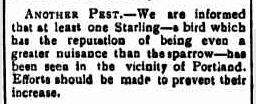
  The sighting of a starling in the Portland area was also mentioned in the Guardian of September 16.  Established August 1842. (1904, September 16). Portland Guardian (Vic. : 1876 - 1953), p. 2 Edition: EVENING. Retrieved September 16, 2011, from http://nla.gov.au/nla.news-article63689870

Passing of the Pioneers

The Portland Guardian obituaries from August recognized several residents with very early links to the Portland district. It is well worth reading their obituaries in full.

Robert HEAZLEWOOD:  Died 3 August 1892 at Portland.  Robert was one of Portland’s oldest residents at the time of his death.  He had been in Portland for around 40 years arriving from Tasmania where he had resided since age 16.  Robert ran a farrier business and was considered the best of his trade in the town.

Thomas KEAN:  Died 8 August 1892 at Portland. Thomas arrived in Melbourne in 1843 and went to Portland in 1845 to take charge of the Customs boat.  He did leave for a time when he caught “yellow fever” and joined the hunt for gold.  Unsuccessful, he returned to Portland to resume his position on the Customs boat. and was also a Councillor on a few occasions.

Frederick SAUNDERS:  Died 11 August 1914 at Narrawong.  At eighty-eight years old, Frederick Saunders had been in Australia for eighty-three years.

Francis ROBERTS:  Died 5 August 1920 at Orford. Francis was born in Tasmania and came to Victoria as a nine-year-old.  He spent time at the Firey Creek diggings and selected land at Broadwater where he farmed for the most part of his life.

Eliza Ann MALSEEDDied 13 August 1920 at Myamyn.  Eliza Malseed epitomized the pioneering women of the south-west.  She arrived in Portland from Ireland with her brothers, later marrying a cousin, James Malseed.  She and her husband, along with a small group of pioneering families, forged a life on unsettled land around Cape Bridgewater.  She was remembered as widely read and extremely charitable.  She was eighty-five when she died.

John Read HEDDITCH  Died 12 August 1927 at Cape Bridgewater.  The Portland Guardian reported that John was a descendant of the Hedditch family who arrived in Adelaide in 1837 aboard The Eden.  Also, John was apparently the first white child to be born at the Henty brothers’ Bridgewater run.  He was born in 1847.

William Henry MILLS:  Died August 1931 at Trafalgar.  William’s obituary is an interesting one, not only for its insight into early Australian history, but it demonstrates the need to check the “facts” presented.  William was born in Port Fairy in 1848 and remained there before moving to Gippsland in the late 1870s.  His father was credited as being one of the early discoverers of the south-west of Victoria, arriving in 1825, two years before the Hentys.  The obituary reports that William’s grandfather was the secretary to “Captain Blyth (sic) the then Governor of Victoria”.  Of course, the obituary writer was talking of Captain William Bligh, whose official title was Governor of New South Wales.  Captain Bligh did have a nineteen-year-old secretary by the name of  Peter Mills.

Arthur Harold SUTTON: Died August 1935 at Portland.  This is a most glowing obituary and includes a description of the funeral service.  Arthur was only fifty-three at the time of his death, which shocked Portland.  His parents were Strathdownie pioneers, where Harold was born.  He served in WW1, ran a successful wool export business, and served on the Portland Council.  Over 500 mourners were at his funeral, with over 100 cars (remember this is 1935) following the cortege.  This is an extensive obit which includes details of his children.

Michael James MINOGUE:  Died August 1935.  Michael was the youngest son of Mr and Mrs Simon Minogue, early pioneers of Portland.  A natural horseman, he at one time trained thoroughbreds.

Frederick William BILSTON:  Died August 1935 at Sandford. Frederick was the son of Thomas and Annie Bilston who arrived in Victoria in 1836. Another son, George Yarra Bilston was reportedly the first white child born in Melbourne.  A sister born in 1840, was claimed as the first white child born on the Glenelg River.  Frederick was born in Heywood in 1849 while his parents were running the Heywood hotel.  He trained horses in his early life with the likes of Adam Lindsay Gordon.  He then became a bootmaker and then a carrier.  An expert blade shearer, Frederick would ride to N.S.W to work sheds.  His obituary includes stories of the 1851 bushfires, bushranger Frank Gardiner and high-jumping.

In the News – August 8, 1919

The Minister for Home and Territories, Mr Glynn announced there would be an Australian Census in 1921.  The chief statistician Mr Knibbs had left for an international statistical conference in Europe to learn how other countries conducted a Census.  He would be looking at borrowing a Power machine to help with the counting.

Portland Guardian. (1919, August 8). Portland Guardian (Vic. : 1876 – 1953), p. 2 Edition: EVENING. Retrieved August 8, 2011, from http://nla.gov.au/nla.news-article63959361

The census was held on April 3, 1921.  Thanks to the Hollerith electric machine, an American invention, results were expected in two years!    I’m not sure if this is the Power machine Mr Knibbs was investigating, but it seems he did pick up some tips from his trip to Europe.  On April 4, 1921, The Argus published an interesting article about how the information for the census was collected.

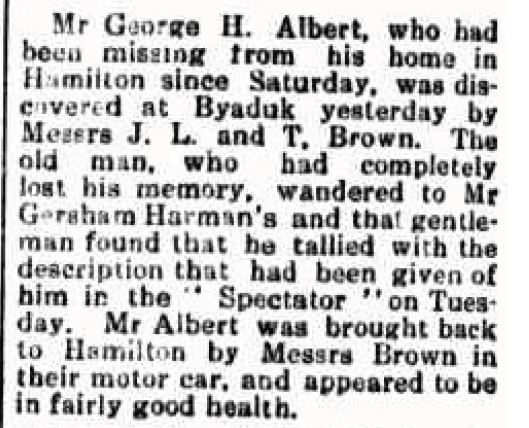
Mr George Albert of Hamilton was found after five days missing.  He was located at Byaduk on the property of Gershom Harman, grandson of Joseph Harman.

Portland Guardian. (1919, August 8). Portland Guardian (Vic. : 1876 – 1953), p. 2 Edition: EVENING. Retrieved August 8, 2011, from http://nla.gov.au/nla.news-article63959361

Jim’s Gone A-Droving

In the 1970s, I visited a Western District drovers’ camp with my father.   I remember the weathered stockmen, their battered caravan, and wiry dogs.  It was not uncommon in those days to drive up behind a mob of sheep being slowly moved along the grassy roadsides.

Then, drovers moved stock to find feed when grass was scarce, but in the early years of settlement, the only way to get stock to and from market or from the ports was to use a drover. Known for their hard-drinking and foul mouths they were often away for months at a time.

My ggg grandfather James Bishop was of those hardy breeds.  He herded cattle from Adelaide to the Western District and moved sheep for the local stations for around 30 years.

Jim was born in Dorset in about 1825.  I am still to find how he came to Australia, but I first catch up with him in this country when he married Sarah Hughes on October 26, 1852, at Adelaide.  They had one child in Adelaide, Mary Elizabeth, but she died aged two.

James and Sarah then moved to Ararat, where James tried his luck on the goldfields.  Charles was born in 1856 in Ararat, followed by my gg-grandmother Elizabeth on September 12, 1857.  Her birth certificate shows James’ occupation as a miner.  James and Sarah had one more child at Ararat, George in 1859.

Not long after, the Bishops moved back to South Australia with two children born in Mt Gambier.  Peter Fraser mentions in Early Byaduk Settlers that James Bishop went to Byaduk around 1865.  This is backed by the birth of Mary Bishop at nearby Macarthur in 1865.   In 1870, Jim selected 16 acres of land at Warrabkook between Byaduk and Macarthur.   Robert, Louisa, and Alice were born at Macarthur, and William was born at Byaduk.

CHILDREN OF JAMES BISHOP & SARAH HUGHES

Mary Elizabeth – Born: 1853 Adelaide, SA.  Died: 1855 Thebarton, SA

Charles – Born: 1856 Ararat, Victoria.  Died: 1916 Macarthur, Victoria; Married:  Sarah DANCER

Elizabeth– Born: 1857 Ararat, Victoria.  Died: 1890 Byaduk, Victoria; Married:  Reuben James HARMAN

George – Born: 1859 Ararat, Victoria.  Died: ?; Married:  Mary HUGHES

Harriet – Born: 1860 Mt Gambier, SA.  Died: 1922 Merino, Victoria; Married:  James ELSTON 1882

Ellen– Born: 1862 Mt Gambier, SA.  Died: 1931 Byaduk, Victoria; Married:  Frederick Watson HINDES 1885 Married:  Abraham CLARKE 1905

Mary– Born: 1865 Macarthur, Victoria.  Died: 1889 Byaduk, Victoria

Robert– Born: 1867 Macarthur, Victoria. Died: 1945 Port Fairy, Victoria; Married:  Edith HARMAN 1901

Louisa – Born: 1870 Macarthur, Victoria.  Died:  1915 Strathmerton, Victoria; Married:  Jonathan Thomas REEVES 1892

Alice – Born: 1872 Macarthur, Victoria.  Died: 1894 Byaduk, Victoria

William James – Born 1874 Byaduk, Victoria. Died:  ?

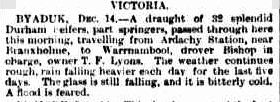
Peter Fraser tells of  Jim droving cattle overland to the Adelaide market and I have found several references to Jim’s droving in The Argus.  “Pastoral Intelligence” notes in The Argus updated readers on the weather, crops, and stock movements, among other things.  Jim is mentioned on August 4, 1890, droving fat cattle from Muntham, between Coleraine and Casterton to Warrnambool.  The same article mentions the weather as being very cold with constant heavy rain over the previous 24 hours.   Tough conditions for a drover of any age, but at 65 Jim must have found it incredibly tough.

A month after the Argus article, Jim’s eldest daughter Lizzie (Elizabeth) died of consumption (TB) aged just 33.  Only a year before, daughter Mary also died at age 24.  Of 11 children born, Jim had lost three of his daughters.  Also, his wife of 33 years, Sarah,  died in 1885 at only 51 years.  Another daughter, Alice, died before Jim’s own death.

Jim just kept droving.  In October 1892, he was moving cattle from the property of the Powers at Byaduk to Framlingham near Warrnambool this time in humid conditions.  Two months later he was moving heifers during a cold December.

PASTORAL INTELLIGENCE. (1892, December 16). The Argus (Melbourne, Vic. : 1848-1954), p. 6. Retrieved July 12, 2011, from http://nla.gov.au/nla.news-article8493210

The last article I find about Jim is on February 15, 1893.  He had taken horses from William Melville’s Weerangourt station at Byaduk through to Ballarat.

Jim died just two years later in 1895 at Hamilton, aged 70, leaving behind four sons and three daughters.


Western District Volcanoes – Are They Sleeping?

Twice in the past week, I have gone deep into volcanic Western Victoria.  I passed the Grampians and its rock formations, Harman Valley at Byaduk, Mt Napier, and Mt Elephant at Derrinallum.  Along with the dry stone walls that weave through the countryside and the rocks that still litter the landscape, the volcanic activity of the past is evident.

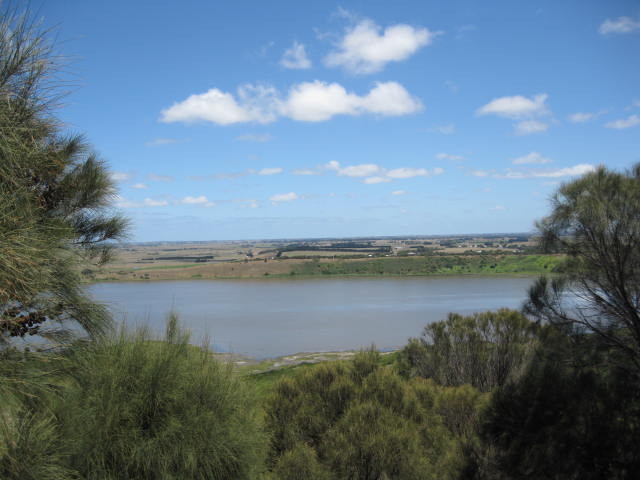
Lake Surprise, crater lake, Budj Bim (Mt Eccles, Victoria)

Since my travels, an earthquake at Korumburra in West Gippsland on Tuesday and a perfectly timed conference in Melbourne, has seen the Western District volcanoes in the news.  Questions are being asked about the likelihood of them erupting again.  Speaking at the Congress of Geodesy and Geophysics, University of Melbourne Professor Bernie Joyce reminded us that the last volcanic eruption at Mt Gambier was 5000 years ago, yet these volcanoes normally would erupt every 2000 years.  According to Professor Joyce we are overdue and contingency plans should be made in readiness for a possible eruption Back in 1902, similar issues were raised.  It was a year not dissimilar to 2010/11 with volcanic eruptions and earthquakes being reported all over the world.

NATURE’S UNREST. (1902, September 13). The Argus (Melbourne, Vic. : 1848-1954), p. 14. Retrieved July 7, 2011, from http://nla.gov.au/nla.news-article9079350

I have found newspaper reports of earthquakes at Yea, Castlemaine, Moe, and Goroke in the same year.  Also, South Australia experienced several earthquakes in the latter part of 1902.  A large earthquake in September felt over most of the state, saw chimneys brought down.  The Bathurst Free Press and Mining Journal reported with some relief that the earthquake was not felt in Mt Gamble (sic), obviously meaning Mt Gambier

The Earthquake in South Australia. (1902, September 22). Bathurst Free Press and Mining Journal (NSW : 1851-1904), p. 2. Retrieved July 7, 2011, from http://nla.gov.au/nla.news-article64341983

Just as well, as panic would have prevailed.  Earlier in July, Mt Gambier authorities had tested the temperature of the famous crater lake, Blue Lake, in light of earlier South Australian quakes

TEMPERATURE OF THE BLUE LAKE. (1902, July 9). The Register (Adelaide, SA : 1901-1929), p. 6. Retrieved July 7, 2011, from http://nla.gov.au/nla.news-article55696129

So what was the explanation to the seismic activity back in 1902?  A paper by H. I Jenson, a student at Sydney University, explained a relationship between sunspots and seismic activity.

I

INTERVIEW WITH MR. E. F. PITTMAN. (1902, September 22). The Sydney Morning Herald (NSW : 1842-1954), p. 7. Retrieved July 7, 2011, from http://nla.gov.au/nla.news-article14506300

Could the Western District volcanoes erupt again was a question being asked at the time.  Professor David from Sydney University said in 1902 that although science was not advanced enough to fully predict, he did not expect any volcanic eruptions in any part of Australia in the near future unless there was stronger earthquake activity. Professor W Howchin of Adelaide University was sure it could and cited other extinct volcanoes which had gone on to erupt. The last word goes to Professor W.G Woolnough, a noted volcano expert of the early 1900s.

LECTURE ON VOLCANOES. (1902, August 12). The Advertiser (Adelaide, SA : 1889-1931), p. 6. Retrieved July 7, 2011, from http://nla.gov.au/nla.news-article4868528

Crater lake, Tower Hill, Victoria

In the News – July 1, 1891

As Victoria’s banks closed on July 1, 1891, to celebrate 40 years of Separation, some were questioning the relevance of the holiday.

The Portland Guardian reported there was some indifference among business owners as to whether they closed or not.  Some shops did decide to open their doors.  The writer proposed this may have been some indication of how each trader felt about Separation day.

The Portland Guardian, (ESTABLISHED 1842.) With which is incorporated The Portland Mirror. (1891, July 1). Portland Guardian (Vic. : 1876-1953), p. 2 Edition: EVENING. Retrieved July 1, 2011, from http://nla.gov.au/nla.news-article65386464

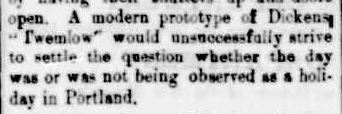
On the same day two years earlier, the Guardian had again raised the worth of the Separation Day holiday.  This time, a character of Charles Dickens, Melvin Twemlow is used to make the writer’s point.

The Portland Guardian,. (1889, July 1). Portland Guardian (Vic. : 1876-1953), p. 2 Edition: EVENING. Retrieved July 1, 2011, from http://nla.gov.au/nla.news-article63623718

Forward to 1894 and there was barely a mention of Separation day, but it did not go by without comment

Established August, 1842. The Portland Guardian, With which is incorporated The Portland Mirror. (1894, July 2). Portland Guardian (Vic. : 1876-1953), p. 2 Edition: EVENING. Retrieved July 1, 2011, from http://nla.gov.au/nla.news-article65407317