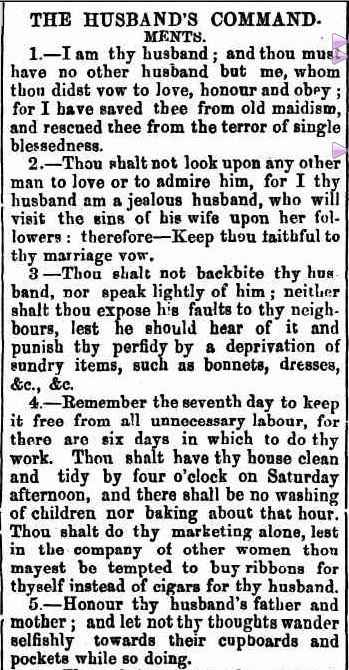
Trove Tuesday – The Husband’s Commandments

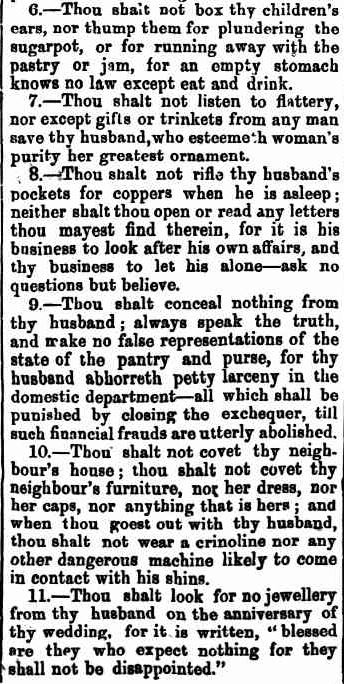
Trove Tuesday this week comes from the Bunyip of Gawler, dated May 11, 1872.

hc

THE HUSBAND'S COMMAND. (1872, May 11). Bunyip (Gawler, SA : 1863 - 1954), p. 4. Retrieved April 28, 2013, from http://nla.gov.au/nla.news-article97206557

THE HUSBAND’S COMMAND. (1872, May 11). Bunyip (Gawler, SA : 1863 – 1954), p. 4. Retrieved April 28, 2013, from http://nla.gov.au/nla.news-article97206557

Next Trove Tuesday I will share some variations of the Husband’s Commandments that ran at different times up until the 1950s.  Wives got their own back too.


Trove Tuesday – One Stop Shop

Trove really is a one stop shop for researching those that served during WW1.  Aside from a visit to the National Archives of Australia (NAA) website for service records, Trove is the place to go to find photos, books and newspaper articles.  This is even more so the case thanks to a project to digitise newspapers of the 1914-1918 period  for the lead up the 100th anniversary of WW1.

For Western Victorian researchers, newspapers that have appeared over the last 12 months, all from 1914-1918, include:

Kerang New Times

Ouyen Mail

Port Fairy Gazette

Portland Observer and Normanby Advertiser

Swan Hill Guardian and Lake Boga Advocate

St Arnaud Mercury

The Ararat Advertiser

The Ballarat Courier

The Casterton News and the Merino and Sandford Record

Warrnambool Standard

During WW1, these papers were full of war news, locals enlisting, send offs, letters homes, the work of locals to do their bit for the war effort and of course, the casualties.

Trove is a great for finding WW1 books and photos.  You can search for an individual, a battalion or a battlefield and you are bound to find something to give you a little more information about your family member’s wartime experience .  Photos held by repositories such as the Australian War Memorial are all cataloged at Trove.  One search can find so much from many places.

As it’s Trove Tuesday, I have some WW1 treasures from one of my favourite papers The Casterton News and the Merino and Sandford Record.

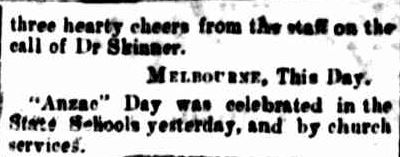
The first article, reported on the first Anzac Day on April 25, 1917 and how Casterton marked the occasion.

adad1

"Anzac Day.". (1917, April 26). The Casterton News and the Merino and Sandford Record (Vic. : 1914 - 1918), p. 3 Edition: Bi-Weekly. Retrieved April 23, 2013, from http://nla.gov.au/nla.news-article74489110

“Anzac Day.”. (1917, April 26). The Casterton News and the Merino and Sandford Record (Vic. : 1914 – 1918), p. 3 Edition: Bi-Weekly. Retrieved April 23, 2013, from http://nla.gov.au/nla.news-article74489110


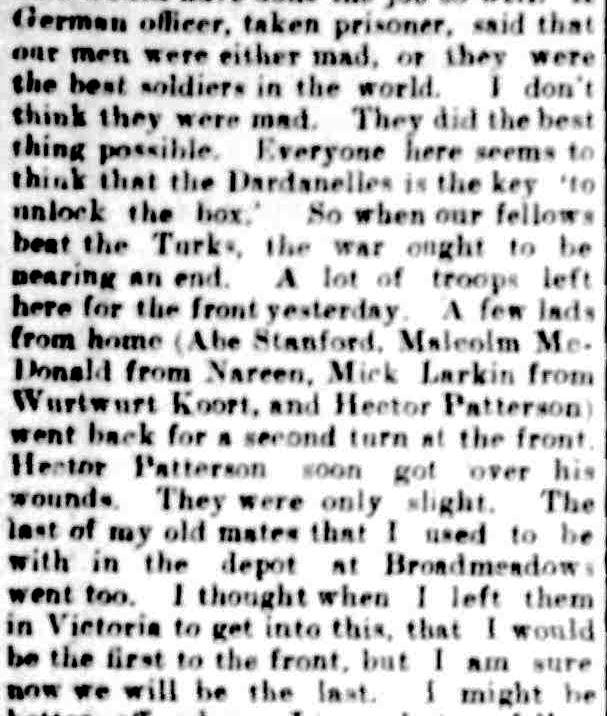
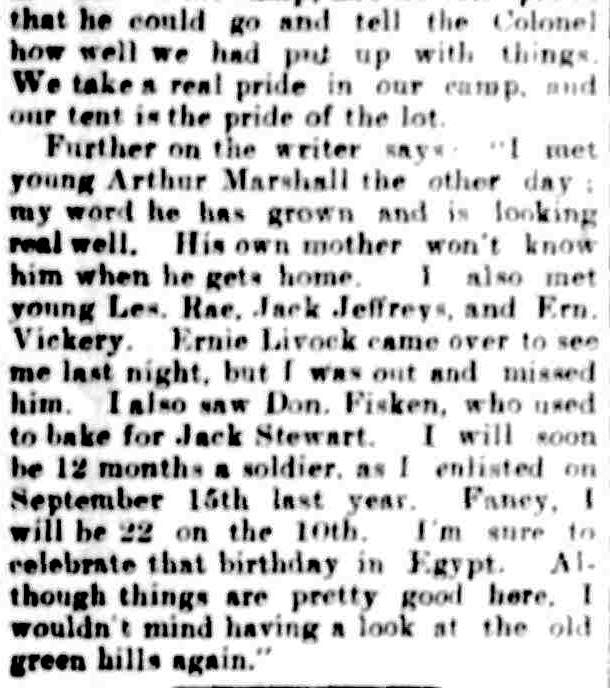
Following is a letter home by Norman Seymour to his mother in Casterton.  He wrote of his brother James, and the pride he felt that James was at “the great landing at Gallipoli”.  This is a great example of how useful these letters are.  Norman wrote of many men from the local district including Hector Patterson and his wounds.

It is a lovely letter, as many of them were, and it makes you wonder if a 21-year-old man today could write home to his mother in the same way.  I also love his closing sentence.  If you know Casterton, you will know exactly what he means.

ad3 ad4 ad5

Our Soldiers. (1915, September 16). The Casterton News and the Merino and Sandford Record (Vic. : 1914 - 1918), p. 4 Edition: Bi-Weekly. Retrieved April 23, 2013, from http://nla.gov.au/nla.news-article74766366

Our Soldiers. (1915, September 16). The Casterton News and the Merino and Sandford Record (Vic. : 1914 – 1918), p. 4 Edition: Bi-Weekly. Retrieved April 23, 2013, from http://nla.gov.au/nla.news-article74766366

I checked the NAA and brother James Seymour did come home, but only two months after the publishing of Norman’s letter.   He developed enteritis in September 1915, was hospitalised and sent home in November.

Norman Edward Seymour served with the 3rd Light Horse and did make it to Gallipoli on October 8, 1915.  In October 1917 he developed septic sores and that  led to his return home in December that year.

When I finally get my post finished for the ANZAC Day Blog Challenge,(Anzac Day 2014 the way I’m going) you will see more examples of how Trove can enhance the story of your WW1 hero.

Trove Tuesday – Beautiful Hair

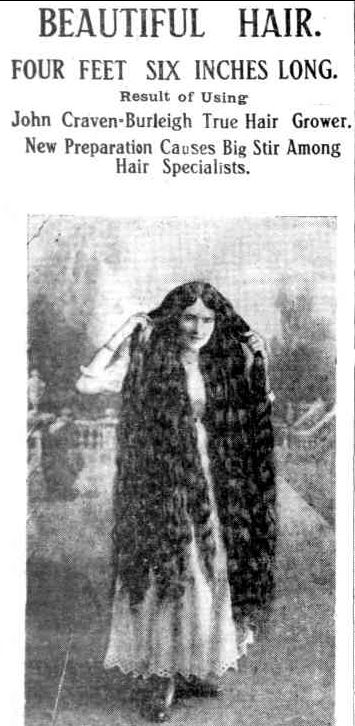
I first came across Miss May Donnan and her beautiful hair in the April 13, 1914 issue of The Ballarat Courier while I was searching for pioneer obituaries. The copy wasn’t good, so I searched Trove for her.  I found a clearer photo in The Mail of Adelaide from 1913.

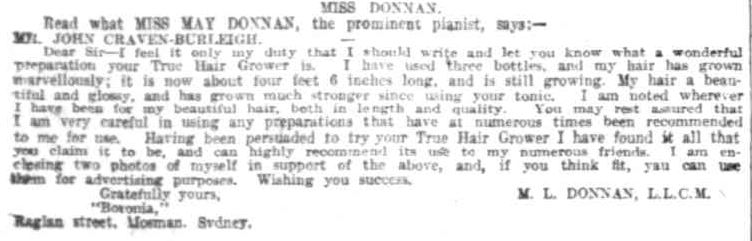
May had apparently sent away for a free sample of John Craven-Burleigh’s True Hair Grower.  What a product.  Her hair grew to a length of four feet six inches.  Although described as a prominent pianist,  after some Troving it seems May’s only claim to fame was her beautiful hair.


bhbh1

Advertising. (1913, September 13). The Mail (Adelaide, SA : 1912 - 1954), p. 3 Section: FIFTH SECTION.. Retrieved April 14, 2013, from http://nla.gov.au/nla.news-article63805694

Advertising. (1913, September 13). The Mail (Adelaide, SA : 1912 – 1954), p. 3 Section: FIFTH SECTION.. Retrieved April 14, 2013, from http://nla.gov.au/nla.news-article63805694

May was not the only girl to send in a testimonial about her beautiful hair.  There were several that did the rounds of the newspapers through the 1910s but beware some of the pictures are scary…

bh3

Advertising. (1914, July 5). Sunday Times (Perth, WA : 1902 - 1954), p. 29. Retrieved April 14, 2013, from http://nla.gov.au/nla.news-article57781617

Advertising. (1914, July 5). Sunday Times (Perth, WA : 1902 – 1954), p. 29. Retrieved April 14, 2013, from http://nla.gov.au/nla.news-article57781617


bh5

Advertising. (1915, March 21). Sunday Times (Perth, WA : 1902 – 1954), p. 25. Retrieved April 16, 2013, from http://nla.gov.au/nla.news-article58586851

Advertising. (1915, August 9). The Sydney Morning Herald (NSW : 1842 - 1954), p. 12. Retrieved April 14, 2013, from http://nla.gov.au/nla.news-article15605877

Advertising. (1915, August 9). The Sydney Morning Herald (NSW : 1842 – 1954), p. 12. Retrieved April 14, 2013, from http://nla.gov.au/nla.news-article15605877


Advertising. (1917, March 5). The Advertiser (Adelaide, SA : 1889 - 1931), p. 9. Retrieved April 14, 2013, from http://nla.gov.au/nla.news-article5567352

Advertising. (1917, March 5). The Advertiser (Adelaide, SA : 1889 – 1931), p. 9. Retrieved April 14, 2013, from http://nla.gov.au/nla.news-article5567352

John Craven-Burleigh Ltd. was an international company with bases in London, Paris, New York and Sydney.  The November 24, 1930 issue of The Argus reported that the Australian branch had gone into liquidation.  I assume the whole company went under.

Trove Tuesday – Hometown Rivals

This Trove Tuesday, we are off to my hometown Hamilton.

Take two rival football clubs, the Hamilton Football Club and the Hamilton Imperials Football Club, merge them and what do you get?  The beginning of a new chapter in the town’s sporting history when the Hamilton Kangaroos make their debut in Round 1 of the 2013 season this Saturday 13 April.  Also, the new club will be entering a different league, the Hampden League, after both were founding members of the Western Border Football League in 1964.

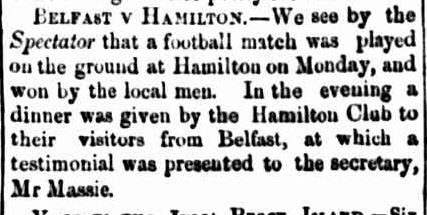
Of the two teams, the Hamilton Football Club had the longest history.  While the club may not have officially been formed at the time of this article from 1868,  it is the earliest article I can find at Trove of football played at Hamilton.

TABLE TALK. (1868, November 12). Portland Guardian and Normanby General Advertiser (Vic. : 1842 - 1876), p. 2 Edition: EVENINGS.. Retrieved April 8, 2013, from http://nla.gov.au/nla.news-article64691122

TABLE TALK. (1868, November 12). Portland Guardian and Normanby General Advertiser (Vic. : 1842 – 1876), p. 2 Edition: EVENINGS.. Retrieved April 8, 2013, from http://nla.gov.au/nla.news-article64691122

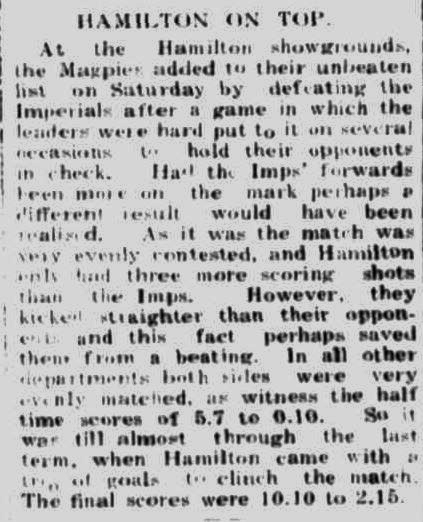
In 1948, a club formed by a breakaway group from the Hamilton Football Club made its debut in the Western District Football League.  The Hamilton Imperials Football Club was born.  In June of that year, the Magpies (Hamilton) and the Bulldogs (Imperials) met for the first time, beginning a rivalry that would endure for the next 64 years.  Hamilton easy winners.

HAMILTON ON TOP. (1948, June 10). Portland Guardian (Vic. : 1876 - 1953), p. 4 Edition: EVENING. Retrieved April 8, 2013, from http://nla.gov.au/nla.news-article64415146

HAMILTON ON TOP. (1948, June 10). Portland Guardian (Vic. : 1876 – 1953), p. 4 Edition: EVENING. Retrieved April 8, 2013, from http://nla.gov.au/nla.news-article64415146

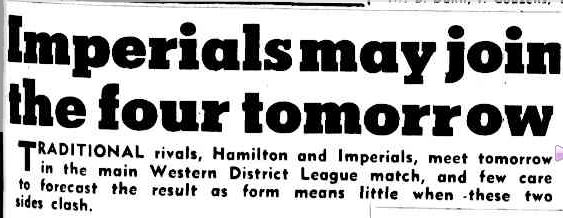
In the 1950s, they used to say that the form guide could be thrown away when Hamilton and the Imperials met.  The following headlines, all from The Argus during the 1950s, show how the rivalry had grown in just a short time.

Traditional clash in Western League HAMILTON HAS EDGE ON OLD RIVALS. (1953, July 3). The Argus (Melbourne, Vic. : 1848 - 1956), p. 10. Retrieved April 8, 2013, from http://nla.gov.au/nla.news-article23253913

Traditional clash in Western League HAMILTON HAS EDGE ON OLD RIVALS. (1953, July 3). The Argus (Melbourne, Vic. : 1848 – 1956), p. 10.  http://nla.gov.au/nla.news-article23253913

tt23

TRADITIONAL RIVALS FIGHT IT OUT. (1955, May 13). The Argus (Melbourne, Vic. : 1848 - 1956), p. 22. Retrieved April 9, 2013, from http://nla.gov.au/nla.news-article71882081

TRADITIONAL RIVALS FIGHT IT OUT. (1955, May 13). The Argus (Melbourne, Vic. : 1848 – 1956), p. 22. http://nla.gov.au/nla.news-article71882081

tt25

Imperials may jain the lour tomorrow. (1956, May 11). The Argus (Melbourne, Vic. : 1848 - 1956), p. 23. Retrieved April 9, 2013, from http://nla.gov.au/nla.news-article71802250

(1956, May 11). The Argus (Melbourne, Vic. : 1848 – 1956), p. 23. http://nla.gov.au/nla.news-article71802250

Here’s to a successful future for the Hamilton Kangaroos, but may the history of the two clubs that came before be maintained so future generations know their role, not only in Hamilton’s sporting history but its social history.

Where did my heart lie?  With the mighty Imps of course!

Trove Tuesday – Dancing Girls

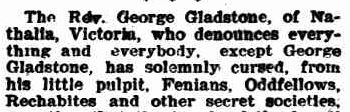
I found this article “Women at Dances” while searching for pioneer obituaries in the Portland Guardian, so I tagged it for a future Trove Tuesday post.  That day has arrived.  Today I introduce the preachings of  Reverend George Gladstone of the Holy Trinity Anglican Church, Nathalia, Victoria.
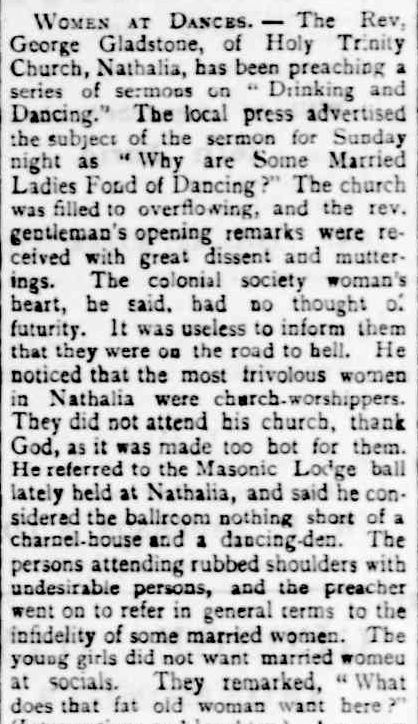
tt10

Established August 1842. (1899, June 7). Portland Guardian (Vic. : 1876 - 1953), p. 2 Edition: EVENING. Retrieved March 30, 2013, from http://nla.gov.au/nla.news-article63676343

Established August 1842. (1899, June 7). Portland Guardian (Vic. : 1876 – 1953), p. 2 Edition: EVENING. Retrieved March 30, 2013, from http://nla.gov.au/nla.news-article63676343

Surely he didn’t get  away with that. Did he?  Well, yes and no.  While the Bishop of Melbourne stood by his man, the people of Nathalia wanted to run him out of town.

That finding came from a search – George Gladstone Nathalia – at Trove.  There were pages of search results specific to the Reverend and the implications of the June 1899 sermon reported in the Portland Guardian and beyond.

I was not surprised to read headlines like this:

The Dancing Crusade. (1899, June 24). Clarence and Richmond Examiner (Grafton, NSW : 1889 - 1915), p. 7. Retrieved March 30, 2013, from http://nla.gov.au/nla.news-article61302118

The Dancing Crusade. (1899, June 24). Clarence and Richmond Examiner (Grafton, NSW : 1889 – 1915), p. 7. Retrieved March 30, 2013, from http://nla.gov.au/nla.news-article61302118

or this:

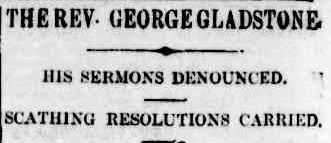
THE REV. GEORGE GLADSTONE. (1899, June 21). The Argus (Melbourne, Vic. : 1848 - 1956), p. 8. Retrieved March 30, 2013, from http://nla.gov.au/nla.news-article9516823

THE REV. GEORGE GLADSTONE. (1899, June 21). The Argus (Melbourne, Vic. : 1848 – 1956), p. 8. Retrieved March 30, 2013, from http://nla.gov.au/nla.news-article9516823

or even this:

THE EXTRAORDINARY SERMON. (1899, June 13). The Horsham Times (Vic. : 1882 - 1954), p. 3. Retrieved March 30, 2013, from http://nla.gov.au/nla.news-article7505982

THE EXTRAORDINARY SERMON. (1899, June 13). The Horsham Times (Vic. : 1882 – 1954), p. 3. Retrieved March 30, 2013, from http://nla.gov.au/nla.news-article7505982

A public meeting was held in the Nathalia hall and the following is an example of the tone of the meeting:

THE REV. GEORGE GLADSTONE. (1899, June 21). The Argus (Melbourne, Vic. : 1848 - 1956), p. 8. Retrieved April 1, 2013, from http://nla.gov.au/nla.news-article9516823

THE REV. GEORGE GLADSTONE. (1899, June 21). The Argus (Melbourne, Vic. : 1848 – 1956), p. 8. Retrieved April 1, 2013, from http://nla.gov.au/nla.news-article9516823

A cry of “Horsewhip him” rang out as Mr W. McCormick had his say, indicating the Reverend’s sermons were receiving publicity around the world.

THE REV. GEORGE GLADSTONE. (1899, June 21). The Argus (Melbourne, Vic. : 1848 - 1956), p. 8. Retrieved April 2, 2013, from http://nla.gov.au/nla.news-article9516823

THE REV. GEORGE GLADSTONE. (1899, June 21). The Argus (Melbourne, Vic. : 1848 – 1956), p. 8. Retrieved April 2, 2013, from http://nla.gov.au/nla.news-article9516823

The Reverend did not stop. He delivered a sermon at Barmah, not far from Nathalia in September 1899, and once again spoke of the evils of dances.  He also denounced the Irish, proclaiming they the were known for “drinking, dancing and dynamiting”.  George Gladstone then had to escape through a side door and run through the bush to an awaiting buggy, hence the headline:
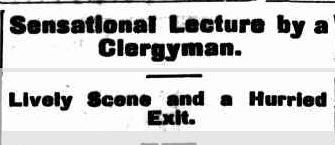
Sensational Lecture by a Clergyman. (1899, September 23). The Cumberland Argus and Fruitgrowers Advocate (Parramatta, NSW : 1888 - 1950), p. 5. Retrieved April 1, 2013, from http://nla.gov.au/nla.news-article85778569

Sensational Lecture by a Clergyman. (1899, September 23). The Cumberland Argus and Fruitgrowers Advocate (Parramatta, NSW : 1888 – 1950), p. 5. Retrieved April 1, 2013, from http://nla.gov.au/nla.news-article85778569

A year on he was not leaving anyone alone.

Current Notes. (1900, October 8). The North Queensland Register (Townsville, Qld. : 1892 - 1905), p. 3. Retrieved April 1, 2013, from http://nla.gov.au/nla.news-article82340469

Current Notes. (1900, October 8). The North Queensland Register (Townsville, Qld. : 1892 – 1905), p. 3. Retrieved April 1, 2013, from http://nla.gov.au/nla.news-article82340469

I was surprised to read that in 1907 George Gladstone was still in Nathalia and was still delivering sermons that led to riotous scenes.

In 1908, it all ended up in the courts after the Bishop of Wangaratta revoked Gladstone’s license to preach.  After failing in the courts, Gladstone attempted to set up his own religion, the Natalia Reformed Church of England.  The Victorian Government refused to proclaim the religion.  He passed away in 1916.

George Gladstone, while totally unrepentant, was probably lucky he was not preaching one hundred years later.  Imagine the social media uproar #horsewhiphim
Trove Tuesday – Daddy of Them All

If you have read my Twitter profile, you would have noticed one of my loves, other than family history, is the Carlton Football Club.  This week, as we are in the middle of Round 1 of the 2013 AFL season with Carlton playing on Thursday night, I thought Trove Tuesday should have a sporting theme .

Opening round football is not the only sport happening over the Easter weekend.  One of the great sporting events of  Western Victoria , the Stawell Gift, will attract thousands to the town for a weekend of athletics culminating in the final of the Gift on Monday.  But as I have written about the First Stawell Gift Winner before, I thought I would look at the Carlton Football Club, one of the original teams in the VFL/AFL, from a Trove perspective.

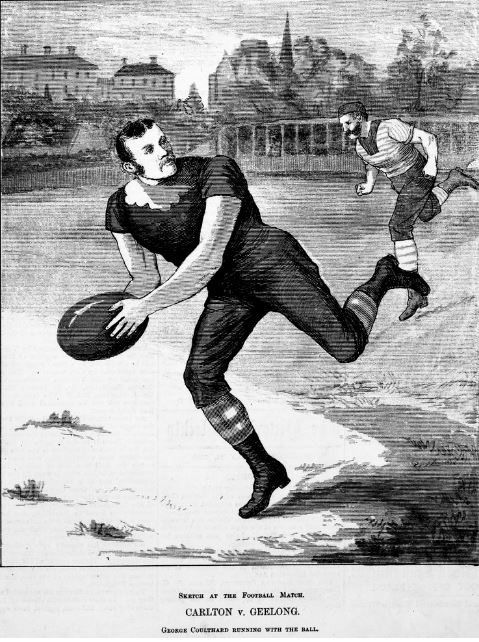
Plucking a name from the past times of the club, I found George Coulthard. He played with Carlton from 1876 to 1882 when teams took part in the Victorian Football Association (The VFL begain in 1896).  Sixty years later, commentators and former players were still naming him as one the greatest footballers ever.  In 1990, he was inducted into the Carlton Hall of Fame.
What treasures could I find about George at Trove?  From the “Picture, Photo and Object” search, I found this great engraving from 1880 .  Held at the State Library of Victoria, it shows George, with the ball,  leaving his Geelong opponent behind.  This is a great example of football attire of the time and I’m glad Carlton moved away from the white neck frill.

GEORGE COULTHARD, CARLTON FOOTBALL CLUB - Image Courtesy of the State Library of Victoria - Wood engraving published in Australian pictorial weekly, no. 7, Melbourne, July 24, 1880, held in Rare Books Collection. http://handle.slv.vic.gov.au/10381/104291

GEORGE COULTHARD, CARLTON FOOTBALL CLUB – Image Courtesy of the State Library of Victoria – Wood engraving published in Australian pictorial weekly, no. 7, Melbourne, July 24, 1880, held in Rare Books Collection. http://handle.slv.vic.gov.au/10381/104291

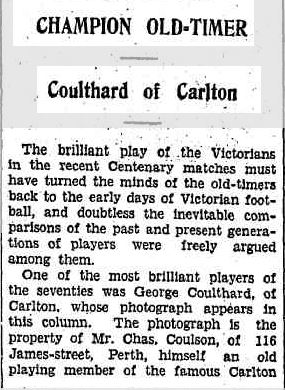
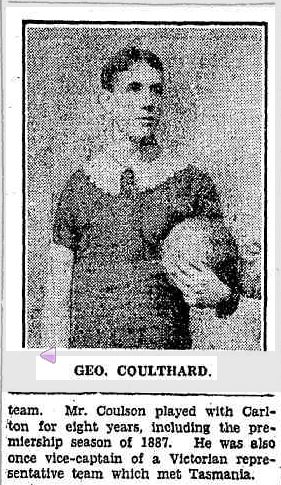
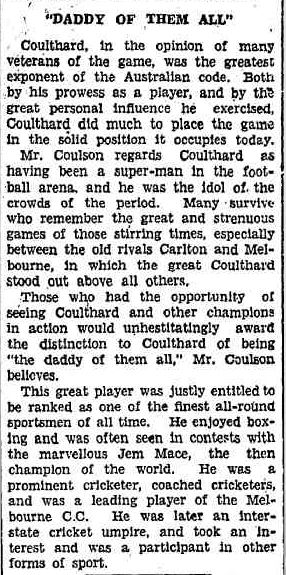
The following article from Perth’s The Daily News summarises George’s career and displays that white frilly collar again.  What was the idea behind that?  George was also a keen boxer and cricketer of some note, even playing a Test match for Australia.  I like George’s entry on the Blueseum site.  The number of games played by George was about 140, 4 state games and 2 Rugby matches.  George was a true all-rounder.

tt8

tt11

CHAMPION OLD-TIMER. (1929, July 13). The Daily News (Perth, WA : 1882 - 1950), p. 4 Edition: FINAL SPORTING EDITION. Retrieved March 26, 2013, from http://nla.gov.au/nla.news-article82981723

CHAMPION OLD-TIMER. (1929, July 13). The Daily News (Perth, WA : 1882 – 1950), p. 4 Edition: FINAL SPORTING EDITION. Retrieved March 26, 2013, from http://nla.gov.au/nla.news-article82981723

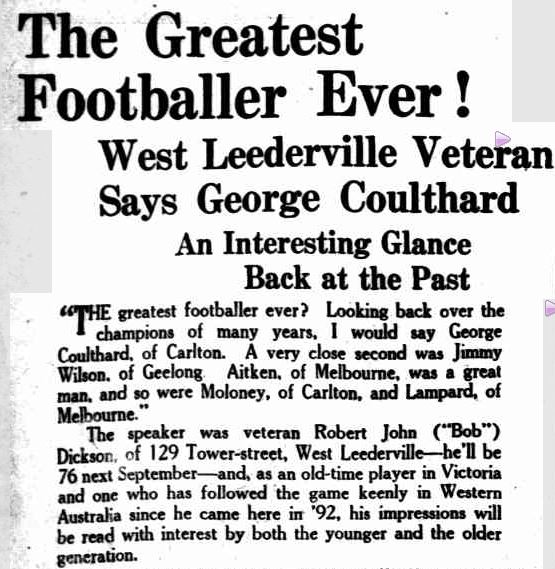
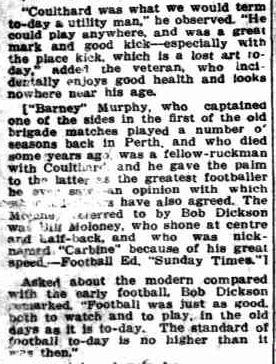
In 1937, “Bob” Dickson told the Sunday Times of Perth, George Coulthard was “the greatest footballer ever”.

gc

The Greatest Footballer Ever!. (1937, July 25). Sunday Times (Perth, WA : 1902 - 1954), p. 13 Section: First Section. Retrieved March 26, 2013, from http://nla.gov.au/nla.news-article58785233

The Greatest Footballer Ever!. (1937, July 25). Sunday Times (Perth, WA : 1902 – 1954), p. 13 Section: First Section. Retrieved March 26, 2013, from http://nla.gov.au/nla.news-article58785233

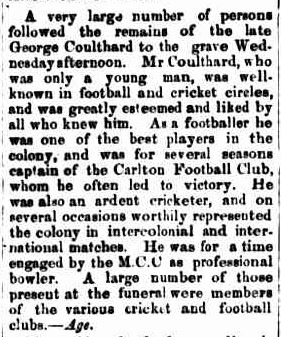
George Coulthard’s story was not all sporting glory as he was sadly cut down in his prime.  Even a great athlete could not hold off the ravages of tuberculosis.  In October 1883, aged 27, he succumbed to the disease.

THE North eastern Ensign. (1883, October 26). The North Eastern Ensign (Benalla, VIC. : 1872 - 1938), p. 2. Retrieved March 26, 2013, from http://nla.gov.au/nla.news-article70744750

THE North eastern Ensign. (1883, October 26). The North Eastern Ensign (Benalla, VIC. : 1872 – 1938), p. 2. Retrieved March 26, 2013, from http://nla.gov.au/nla.news-article70744750

Formed in 1864, the Carlton Football Club has a rich history that includes 16 premierships.  The club is proud of its history and there is a wealth of information available online via the Blueseum website and the Carlton Football Club website. There is a wonderful tribute to George Coulthard on the Blueseum site including many newspaper references.  I also found out a little more about that early guernsey  In additon, one for the original members of the Carlton Football Club was buried at the Hamilton Old Cemetery. Thomas Gorman played with the club from 1864 until 1871. You can read more about him on the link – Thomas Gorman.

Something of interest to the family historian on the Blueseum site is a call out for photos of former Carlton players.  If you find one of your family members played for Carlton anytime over the past 149 years and you have a photo, check out the website.
Trove Tuesday – Bottom Drawer

What’s in your bottom drawer?

No doubt the lovely ladies of Portland that overran Father Donoghue’s’ alter in last week’s Trove Tuesday post, Whispering Wedding Bells, would each have had a range of items in their bottom drawers ready to take them through to life as a married woman.

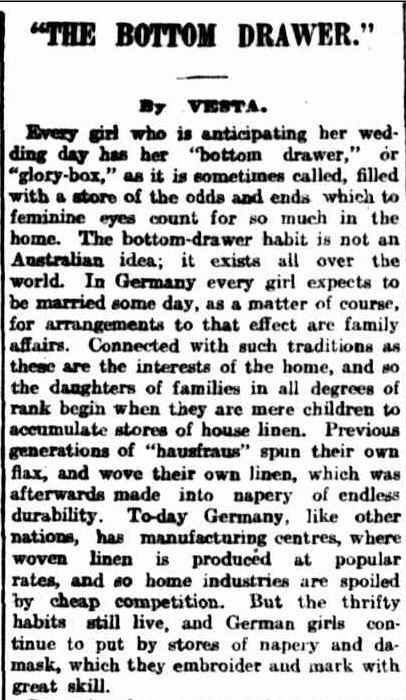
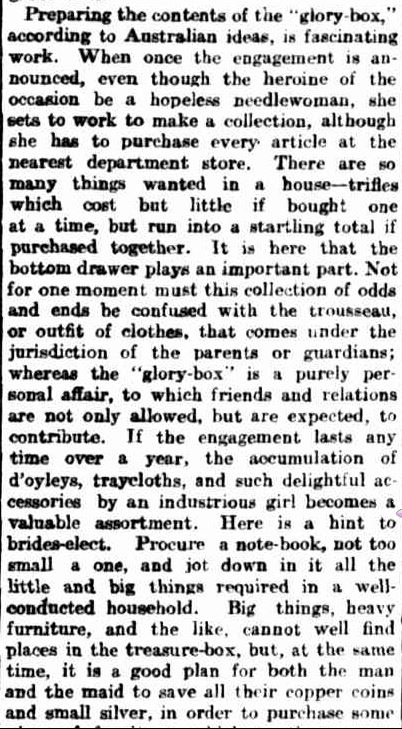
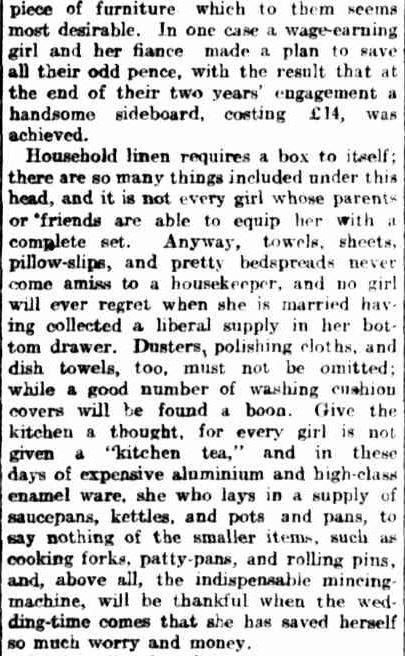
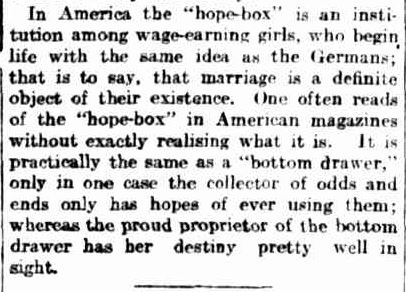
Vesta of the “Women to Women” column from the The Argus, explained on September 10, 1913 the essential items for a girl’s “bottom drawer” or “glory box”.  As you will see they must have been big drawers!

tt2 tt3 tt4

WOMEN TO WOMEN. (1913, September 10). The Argus (Melbourne, Vic. : 1848 - 1956), p. 5. Retrieved March 19, 2013, from http://nla.gov.au/nla.news-article7243175

WOMEN TO WOMEN. (1913, September 10). The Argus (Melbourne, Vic. : 1848 – 1956), p. 5. Retrieved March 19, 2013, from http://nla.gov.au/nla.news-article7243175

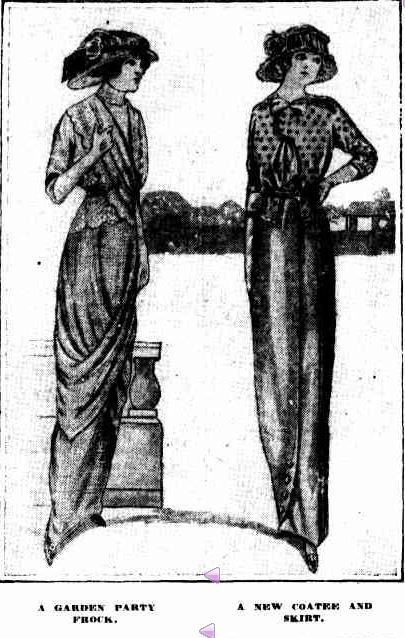
I couldn’t resist sharing these fashions from the same page:

tt6

Trove Tuesday – Whispering Wedding Bells

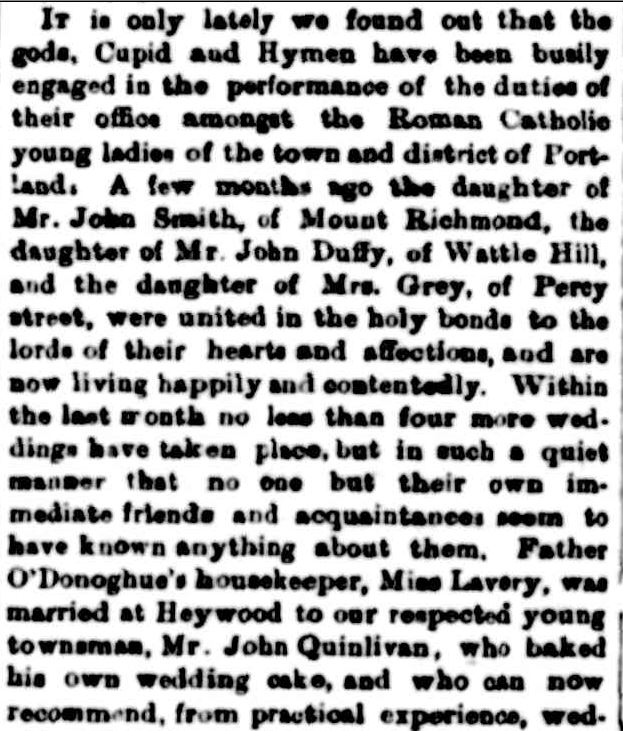
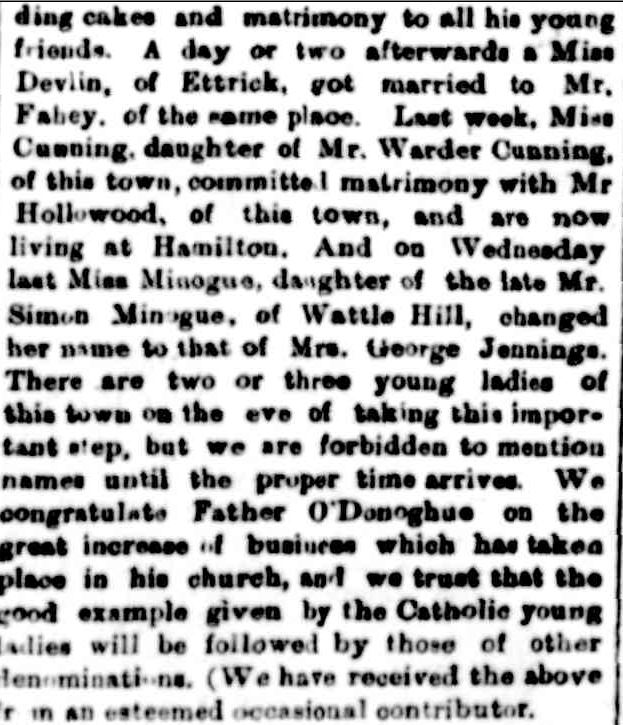
An interesting piece for Trove Tuesday this week.  From February 4, 1882, The Portland Guardian reported on some hush-hush weddings in the district with the information provided by an “esteemed occasional contributor”.  The weddings were happening but the wedding bells were not ringing.  Not only that, one groom baked his own wedding cake.

An article such as this is most useful to the researcher.  It has names, place names, marriages and religious denomination

weddings1

weddings2

The Guardian. (1882, February 4). Portland Guardian (Vic. : 1876 – 1953), p. 2 Edition: MORNING.. Retrieved March 11, 2013, from http://nla.gov.au/nla.news-article63403448

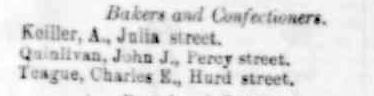
I think Father O’Donoghue might have been ready for a lie down.  All those weddings and he was doing his own housework after his housekeeper, Miss Lavery was also “united in the holy bond”.  In case you were wondering, Miss Lavery’s new husband, John Quinlivan, did not bake the wedding cake just because he fancied himself as a cook… he was a  baker.

PORTLAND PROFESSIONAL AND BUSINESS DIRECTORY. (1890, January 17). Portland Guardian (Vic. : 1876 - 1953), p. 4 Edition: EVENING. Retrieved March 11, 2013, from http://nla.gov.au/nla.news-article63626245

PORTLAND PROFESSIONAL AND BUSINESS DIRECTORY. (1890, January 17). Portland Guardian (Vic. : 1876 – 1953), p. 4 Edition: EVENING. Retrieved March 11, 2013, from http://nla.gov.au/nla.news-article63626245