H is for…

If ever there was a time to enter the Gould Genealogy Family History Through the  Alphabet challenge, that time would be now.  “H” has arrived.

When my descendants look back at my HISTORY, they will see the letter “H” recurring.

The marriage of Sarah Elizabeth HARMAN and Thomas HADDEN in 1904 brought together two of my “H”‘s.  They settled in HAMILTON and had a daughter, my nana Linda HENRIETTA HADDEN.

Thomas HADDEN & Sarah HARMAN

Sarah HARMAN was not the only one in her family to keep her initials after she married.  Her sister Ellen married a HANKS and she became Ellen HANKS of HARRIET Street HORSHAM.

HADDEN and HARMAN are two of the four main family names that make up the maternal side of my family.

HAMILTON too, features in my HISTORY.  Nana was born there and I was too.

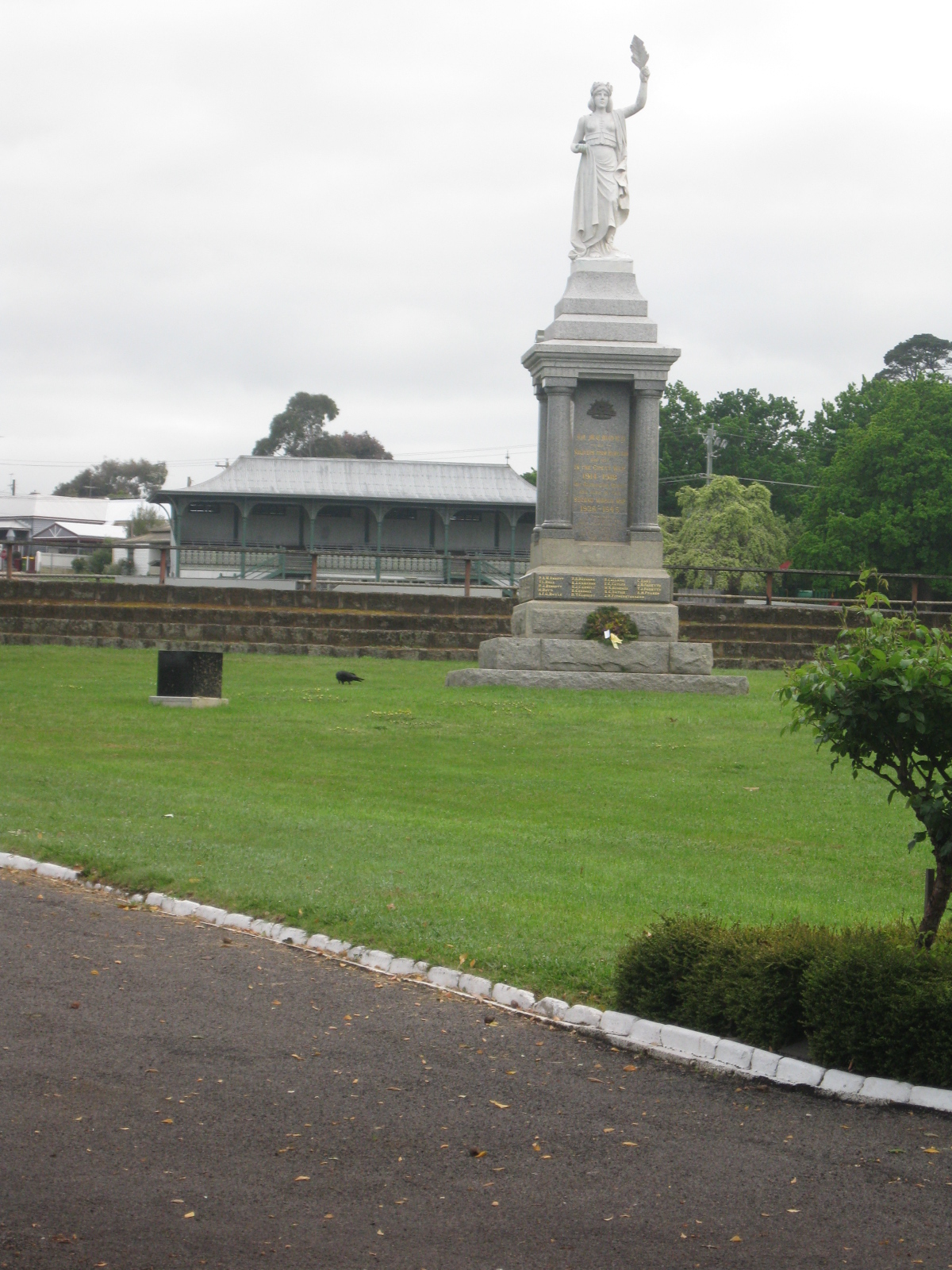
Looking across Melville Oval, HAMILTON

I lived in HAMILTON for 18 years, the town that was formally called the Grange.  If that name had remained, my entry in this challenge may have been “G” for Grange, Gamble and the Grampians.

Nana’s middle name was HENRIETTA  which I used to find quite amusing.   Later I learnt that her name came from her great-aunt HENRIETTA HARMAN, an HONOURABLE lady but one, it would seem, with a lonely HEART.

Linda HENRIETTA HADDEN (left) & her younger sister, Enda

Another “H” which will go down as part of my HISTORY is HALLS GAP in the HEART of the Grampians.  Many HOLIDAYS were spent there and, at times, it has been a place I have called HOME.

HALLS GAP in the HEART of the Grampians

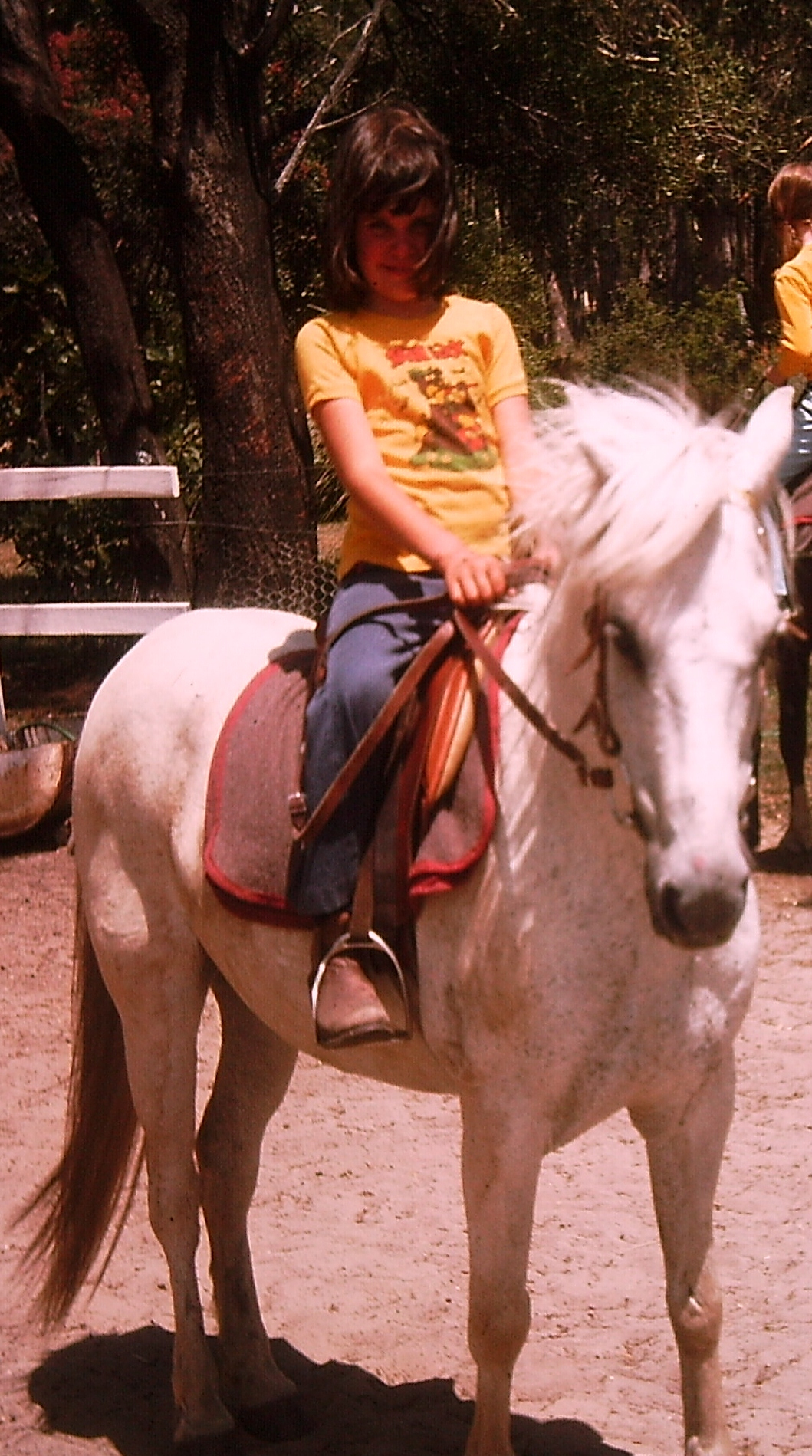
May my HISTORY also show that I liked HORSES.  It was HORSES in HAMILTON, HORSES in HALLS GAP and HORSES on HOLIDAYS in HALLS GAP, HORSES everywhere.

Finally, my HOBBIES include the HISTORY of  HADDEN, HALLS GAP, HAMILTON, HARMAN and, of course, HORSES.

HORSES in HALLS GAP

So, when I get over my obvious preference for the letters “M” and “R”, I can safely say “H” is one of my favourite letters as so much close to my HEART starts with “H”

***Apologies to the HAZELDINE, HICKLETON, HODGINS,  HOLMES, HUNT and HURRELL families to whom I also have links.

Hobbies, Passions and Devotions

The activities of my ancestors outside of their usual occupation is always of interest to me.  Their sports, pastimes, hobbies, and social activities often help define them as people and sometimes those activities are present in later generations.  Also, it can lead to further information from club records and results in newspapers.

In some cases, much spare time was devoted to the church, maybe on the committee such as William Hadden or as a lay preacher like James Harman.  James was also able to find time for his other passion, ploughing competitions, not to mention various committees, such as the local school.

Richard Diwell had an interest in the Hamilton Horticulture Society but also indulged in photography. The photo in the post about Elizabeth Ann Jelly was one of Richard’s using a camera with a timer, a new development in photography at the turn of the century.

My grandfather, Bill Gamble, grandson of Richard Diwell, had many interests, particularly before he married.  He played cornet with the Hamilton Brass band and was a committee member of the Hamilton Rifle Club and a state representative shooter.

He also loved fishing, motorcycles, and like his grandfather before him, photography.  As a result, we now have hundreds of photographs of motorbikes and fishing trips.  He even developed his own photographs.  His passions of photography and motorcycles were passed on to his son Peter.

Many of the Holmes and Diwell families were members of Brass Bands at Casterton and Hamilton.  Alfred Winslow Harman was a rifle shooter and I recently told you about Nina Harman, wiling away the hours completing tapestry carpets.

I recently found an activity that previously hadn’t been present in my family, greyhound breeding.

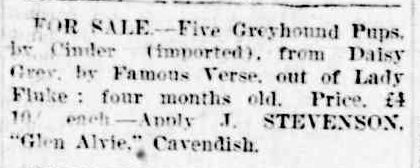
James Stevenson was the grandson of James Mortimer and Rosanna Buckland. He worked as a manager at Hyde Park a squatting run north of Cavendish until it was split up in 1926 for the Soldier Settlement scheme.  After this James moved to “Glen Alvie” at Cavendish where he described himself as a grazier.

In 1927, he advertised five well-bred greyhound pups for sale.  At £4 each, he stood to earn £20 if he successfully sold them.  A seemingly profitable hobby indeed.

Advertising. (1927, February 25). The Horsham Times (Vic. : 1882 – 1954), p. 5. Retrieved June 15, 2012, from http://nla.gov.au/nla.news-article73082854

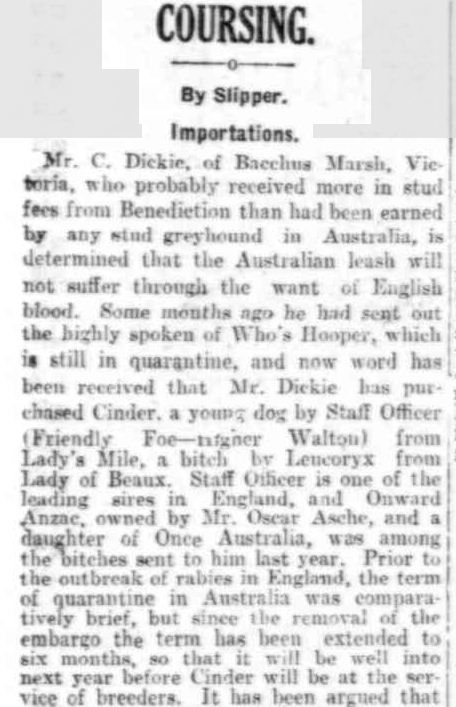
James would have needed a good return on his pups as the sire’s stud fees would have been pricey given Cinder was imported by the successful breeder, Mr. Dickie of Bacchus Marsh.  The article from the time of Cinder’s arrival in Australia in 1923, reports the dog remained in quarantine for six months.  Because of a rabies outbreak in England, there was an extension to the time spent in quarantine only a short time before his arrival.

In 1927, the time of James’ advertisement, greyhound racing using a “mechanical hare” began for the first time at the Epping course in New South Wales.  It took longer for other states to adopt the “tin hare” where they continued with the traditional field coursing.

SPORTS AND PASTIMES. (1923, September 7). The Register (Adelaide, SA : 1901 – 1929), p. 6. Retrieved June 19, 2012, from http://nla.gov.au/nla.news-article65041056


WHAT DID YOUR ANCESTORS DO IN THEIR SPARE TIME?

Inside History Magazine

Every two months I’m reminded that I must take out a subscription to Inside History magazine.  As my genealogy friends tweet with delight that the postie has arrived with another fabulous issue, I must wait until it arrives at my local newsagent.

Issue 10 has been no different.  As Inside History gave us a sneak peek of another wonderful cover, I once again kicked myself for not subscribing.

Inside History Issue 10 Cover

Worse still, I find myself with more of an anxious wait this time around.  “Western District Families” is one of the Top 50 “must follow” genealogy blogs included in  Jill Ball’s article”Entering the Blogosphere”.

Jill’s blog Geniaus is a favourite and one of the first genealogy blogs I read, so to be included among Jill’s own favorites is a thrill. Thank you, Jill!

I was also happy to see some of my other favs get a mention too, including two with Western Victorian content, Tracking Down the Family and Carol’s Headstone Photographs

So as I wait until Issue 10 hits the newsstand,  I might do something about ensuring Issue 11 hits my letterbox!

It’s My 1st Blogiversary!

Happy 1st Blogiversary Western District Families.  I thought we would never make it, but 84 posts and 12 months later, here we are.

What a fun year it has been.  It really was worth procrastinating about whether to blog or not to blog.  Over time I have made some great online friends, met some previously unknown family members, and found out so much more about my Western District family.  Western District Families even got a Google+ page!

I hope some of you have also found out something about your Western District family, where they lived, and the things they did through posts such as In the News and the Pioneer Christmas series.  Maybe you have found an obituary of an ancestor at Passing of the Pioneers.

I have found that the act of writing out my family history has been so useful for my research. It has helped me sort out what information I have but more importantly, what I don’t have.  Also, lining up the lives and events of siblings, in the case of the Harmans for example, has given me a better understanding of the dynamics of the family (can you tell I was a Social Sciences student?).

So what have been the most popular of the past 84 posts?

1.  The Fastest Ship in the World

2. A Tragic Night – January 24, 1882

3. Histories of  South-West Towns

4. Witness for the Prosecution

5. Only Seven More Sleeps…

Which posts have been my favourite to share?  Well it was hard to narrow them down to just five but here they are:

1 Elizabeth Ann Jelly

2. All Quiet By the Wannon

3. Halls Gap’s Cherub

4. From Stone Country to High Country

5. A Tragic Night – January 24, 1882

An Honourable Mention must go to  What the Dickens? and the follow-up post Another ‘What the Dickens” Moment.  They were both interesting and fun to write.

Over the past year, I have had made contact with Gamble and Jelly cousins and members of the Condon, Adams, and Oakley families.

I  also heard from Rosemary of Tulsa, Oklahoma. Her great grandparents were married in the original St Stephens Church in Portland.

Plenty is planned for the next 12 months.  I thought I would run out of things to write about. Instead, I am finding it difficult to keep up with all the subject ideas I have. There will be more Passing of the Pioneers and later in the year, I will look at Christmas in the early part of the 20th century.  Of course, I will have more stories about my family.  I’ve barely touched on some of the stories I had planned when I started the blog as I keep finding more great stories in the meantime.

A big thank you must go to my fellow Australian geneabloggers.  Your support and encouragement have been fantastic and you have all inspired me to keep going.   What I have learnt from each of you has been invaluable.  It was great to meet some of you at the Unlock the Past Victorian Expo at Geelong last year.  Also to the 29 followers of Western District Families, thank you for following and for your great comments.

I must also make a special mention of my maternal grandmother, Linda Gamble (nee Hadden).  Nana did not get to see my blog.  She passed away six days before I published my first post.  It was Nana that got me to this point.  Her love of the past and her family inspired me almost 20 years ago to start researching our family tree simply to find out more about them for her.  What a wonderful family she gave me.

Nana & me

The 2012 ANZAC Day Blog Challenge

My third post for Western District Families was in April last year for the 2011 ANZAC Day Blog Challenge.  My contribution was the story of Arthur Leonard Holmes of Casterton, gassed in France in 1918.

Recently, while researching the Holmes family at  Trove for another reason, I found a couple more items about “Lennie” and his sad death.  I have since updated his post.

Well, it is April again and with ANZAC Day drawing closer it is time to start thinking about the 2012 ANZAC Day Blog Challenge.

Created by the  Auckland City Libraries, the Anzac Day Blog Challenge gives us a chance to share stories of our family members who served during wartime and remember their contribution to our life in both Australia and New Zealand today.

The criteria, from the Auckland City Libraries website, is as follows:

Do you have a story to share about an ANZAC? We’d like to hear about not only their sacrifice, but the way it shaped their family history. Maybe you want to blog from the perspective of those that were left behind?

To participate:

  • Write a blog post about an Australian or New Zealander serviceman or woman’s family, and the impact war had on their family history
  • Post a comment with the URL to your blog on the comments section of this page. Or if you don’t have a blog then email us your story at kintalk@aucklandcouncil.govt.nz
  • Publish your post by 25 April 2012.

After ANZAC Day, all submissions will be listed in a summary posting on Auckland Libraries’ Kintalk blog.

Time to get started, but who am I going to write about??

_____________________________________________

Well, I made my decision and I wrote about the McClintock brothers.  Read their story here – “The McClintock Brothers


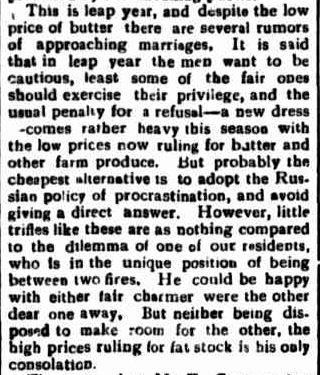
A Leap Year Dilemma

I thought I would share this snippet from the Portland Guardian of 24 February 24 1904.  The single men of Bridgewater had a lot to think about while milking the cows during the leap year of 1904.

Bridgewater. (1904, February 24). Portland Guardian (Vic. : 1876 – 1953), p. 3 Edition: EVENING. Retrieved February 29, 2012, from http://nla.gov.au/nla.news-article63687492

I Hear There is Good Fishing at Portland

We are off to Portland for a couple of days.  As Victoria’s first permanent settlement, it is dripping with history.  What a good idea my suggestion of great fishing was when we were deciding where to go.  I can do some history stuff (I’m hoping to get a lot of photos) and they can fish.  There are also several activities of a historical nature we can all take part in.  My small research assistant will be learning about Victoria’s history and he won’t even know it!

On offer is the Historic Buildings Walk with 48 buildings marked on a convenient map.   The Old Portland cemetery will be a must with the oldest recognisable grave dating back to 1848.  There is a self-guided tour brochure highlighting some of the more significant graves.  We will visit the Portland Maritime Discovery Centre and I am sure my small research assistant will enjoy it.  There is the ribcage of a sperm whale which is large enough to sit inside.

I am particularly looking forward to seeing the Immigration Wall.  This is a great initiative.  Descendants of immigrants who first set foot in Australia at Portland are able to buy a plaque for the wall.  One day I hope that James and Susan Harman and William and Margaret Diwell will have their own plaque.

We also plan to visit nearby Cape Bridgewater settled by a hardy band of pioneers.  From my Passing of the Pioneers posts, I have learnt much about those that settled the area and would like to see something of the land that lay before them.  A number of pioneers from the Cape Bridgewater area are already listed on the Passing of the Pioneers list.  Graves of pioneers with names such as Kittson, White, Hedditch and Malseed can all be found at the Cape Bridgewater cemetery. There are also many natural attractions nearby such as a petrified forest and Shelly Beach.

Back in Portland we can Walk in the Footsteps of Mary McKillop, visit the second oldest Botanic gardens in Victoria, and take a ride in a cable tram along the bay.  If I can squeeze it, I would like to visit History House, home of the Portland Family History group.  Not only are there research facilities available, but there is also a social history museum on site.

I hope the fishing is good, because with so much to do we may have to go back again.

Third Annual Great Genealogy Poetry Challenge

Genealogist Bill West has changed the title of his Great American Genealogy Poetry & Song Challenge to the Great Genealogy Poetry Challenge, giving those us from other countries to take part.  Thanks to Jill Ball for bringing this Challenge to my attention.

These are the guidelines I followed:

1. Find a poem by a local poet, famous or obscure, from the region one of your ancestors lived in. It can be about a historical event, a legend, a person, or even about a place (like a river)or a local animal. It can even be a poem you or one of your ancestors have written!  Or if you prefer, post the lyrics of a song or a link to a video of someone performing the song.

2. Post the poem or song to your blog (remembering to cite the source where you found it.)

3.Tell us how the subject of the poem or song relates to your ancestor’s home or life.

When I think of poetry and the Western District the name that comes to my mind is that of Adam Lindsay Gordon, poet, policeman, steeplechase jockey and daredevil.  However, many of Gordon’s poems could easily have been set in England.  The most obvious poem with a Western District theme is The Fields of Coleraine, which describes steeplechasing at the Coleraine racecourse, however, it doesn’t really give a feel for life in the area at the time.

I then came across a C.J. Dennis’ poem “When the Sun’s behind the Hill” from his book Blackblock Ballads and Later Verses, published 1918 when Dennis was living in Victoria.  The poem is about a  farming family and as many of my ancestors were farmers, right across Victoria, I thought it was appropriate.  While it is not as light and humorous as some of C.J. Dennis’ works, it is a lovely poem that describes the winding down of both the farm and the farmer at the end of a day.  It also reminds us a farmer’s day begins with the rising sun and ends “when the sun’s behind the hill…”

When the Sun’s Behind the Hill

There’s a soft and peaceful feeling
Comes across the farming hand
As the shadows go a-stealing
Slow along the new-turned land.
The lazy curling smoke above the thatch is showing blue.
And the weary old plough horses wander home’ard two ‘n’ two,
With their chains a-clinkin’, clankin’, when their daily toil is through,
And the sun’s behind the hill.

Then it’s slowly homeward plodding
As the night begins to creep,
And the barley grass is nodding
To the daisies, all asleep,
The crows are flying heavily, and cawing overhead;
The sleepy milking cows are lowing sof’ly in the shed,
And above them, in the rafters, all the fowls have gone to bed,
When the sun’s behind the hill.

Then it’s “Harry, feed old Roaney!”
And it’s “Bill, put up the rail!”
And it’s “Tom, turn out the pony!”
“Mary, hurry with that pail!”
And the kiddies run to meet us, and are begging for a ride
On the broad old “Prince” and “Darky” they can hardly sit astride;
And mother, she is bustling with the supper things inside,
When the sun’s behind the hill.

Then it’s sitting down and yarning
When we’ve had our bite and sup,
And the mother takes her darning,
While our Mary tidies up.
And Bess tells how the baldy cow got tangled in the wire;
And Katie keeps the baby-boy from tumbling in the fire;
And the baccy smoke goes curling as I suck my soothing briar,
When the sun’s behind the hill.

Then we talk about the season,
And of how it’s turning out,
And we try to guess the reason
For the long-continued drought.

Oh, a farmer’s life ain’t roses and his work is never done:
And a job’s no sooner over than another is begun.
For he’s toiling late and early from the rising of the sun
Till he sinks behind the hill.

But it grows, that peaceful feeling
While I’m sitting smoking there,
And the kiddies all are kneeling
To repeat their ev’ning prayer;
For it seems, somehow, to lighten all the care that must be bore
When the things of life are worrying, and times are troubling sore;
And I pray that God will keep them when my own long-day is o’er,
And the sun’s behind the hill.

C.J.Dennis

from

Backblocks, Ballads and Later Verses, 1918

Surname Saturday Meme: Names, Places and Most Wanted Faces

Following the lead of U.S. genealogist Thomas MacEntee and in turn Australian genealogist Jill Ball, I decided to take part in this meme.  It interested me more than others I had seen, because not only would I get my names “out there”, I also got the chance to do a stocktake.  What an interesting exercise it was.  With some names, I did not have to look up the details as I knew them so well, others I had to refer back to my tree, and for one name, I had basically nothing.

It’s easy to develop favourite families, with some just oozing information making them more compelling to research.  The Harmans are an example of that.  The Riddiford line was probably my least favourite and despite it being my family name, I tended to pass it by. When I did start seriously researching them, I found loads of information.  This avoidance was probably due to them being 20th-century immigrants and my history interests lie in 19th century Australia.  I had no choice but to delve into 18th and 19th century English history and I have really enjoyed it and learnt a lot and I continue to do so.  I am glad I got over my previous mindset.

I also have more Irish links than I normally given myself credit for and I can now clearly see the branches I have been neglecting.

I have included the surnames of my great great grandparents, but I have taken the places and dates back a little further.  If not, I would have had entries with just a single place in Australia with no indication of where the family originated from.

To take part, just do the following at your own blog, then post a  link in the comments at Thomas’ blog post

1. List your surnames in alphabetical order as follows:

[SURNAME]: Country, (State or County, Town), date range;

2. At the end, list your Most Wanted Ancestor with details about them.

MY NAMES, PLACES AND MOST WANTED FACES:

BISHOP:  England (Dorset, Weymouth) 1825-1850; Australia (South Australia, Adelaide) 1850-1854;  Australia (Victoria, Byaduk)1854-1950

COMBRIDGE:  England (Huntingdonshire) 1833-1855;  Australia (Victoria, Geelong 1855-1935);  Australia (Victoria, Grantville) 1900-1950

DIWELL:  England (Sussex) 1825-1852;  Australia (Victoria, Casterton) 1852-1893;  Australia (Victoria, Hamilton) 1893-1940

GAMBLE:  England 1808-1840;  Australia (Victoria, Geelong) 1840-1850;  Australia (Victoria, Colac), 1850-present

HADDEN:  Scotland (East Lothian) 1823-1852;  Australia (Victoria, Geelong) 1852-1865;  Australia (Victoria, Cavendish) 1865-1975;  Australia (Victoria, Hamilton) 1900-present

HARMAN:  England (Cambridgeshire, Melbourn) 1800-1854;  Australia (New South Wales) 1852-1857;  Australia (Victoria, Port Fairy) 1852-1863;  Australia (Victoria, Byaduk) 1863-present

HODGINS:  Ireland (Fermanagh) 1816-1853;  Australia (Victoria, Colac) 1853-1940

HUNT:  England (Middlesex, Poplar) 1834-1854;  Australia (Victoria, Geelong) 1854-1865; Australia (Victoria, Collingwood) 1867- ;  Australia (Victoria, West Gippsland) 1880-1936

JELLY:  Ireland (Down, Drumgooland) 1815-1845;  England (Lancashire, Manchester) 1845-1854;  Australia (Victoria, Casterton) 1854-1900

KIRKIN:  England (London, Lambeth) 1859-1940;

MORTIMER:  England (Berkshire, White Waltham) 1823-1852;  Australia (Victoria, Cavendish) 1865-1930

PIDDINGTON:  England (Buckinghamshire, Cuddington) 1700s-1880

RIDDIFORD:  England (Gloucestershire, Thornbury) 1600s-present; England (Buckinghamshire, Cuddington) 1846-present;  England (London, Lambeth) 1896-1913; Australia (Victoria, Ballarat) 1913-present

WEBB:  England (Surrey, Clapham) 1845-1878; England (London, Lambeth) 1878-1900

WHITE:  England (Kent, Broadstairs) 1857-1876;  Australia (Victoria, Grantville) 1876-1950

WYATT:  ???

MOST WANTED ANCESTOR:

When I started this I thought my most wanted ancestor would be gg-grandmother Mary Jane HODGINS.  She was born in Ireland around 1849, immigrated with her parents West HODGINS  and Martha BRACKIN in 1853 aboard the Marion Moore. She married Matthew GAMBLE in 1871 at Colac.  That is all I know except for the accident which saw Mary Jane lose the top of her finger, as mentioned in the post Misadventures, Deaths and Near Misses.

However, when I looked at the completed list it seemed clear it had to be Jane WYATT, another gg grandmother and second wife of Herbert John COMBRIDGE.

I had previously found a birth for a Jane Wyatt born 1882, St Arnaud but this did not really add up, mainly because my Jane Wyatt married Herbert Combridge in 1895 in Gippsland.  If I searched the Australian Death Index 1787-1985, I find the death of Jane COMBRIDGE in 1909 at Grantville but with no approximate birth year or parents.

As I was writing this post, I decided to have a look around for Jane again.  I checked for people researching Combridges at Ancestry.com and found a reference to Jane’s birth in 1873.  I searched again with this birth date and that threw up something interesting.  There is a Jane Wyatt listed on the Victorian Index to the Children’s Register of State Wards, 1850-1893.  Her birth date is given as 1873, but no birthplace.  This could be my Jane and it could explain the lack of parent names and birth year on the Death index.

So, thanks to this exercise, I may have come a step closer to finding Jane Wyatt, but if she was a ward of the state, I may not be able to find anything else about her.  So if anyone has information on Mary Jane HODGINS and her family, I would love to hear from you!

All Quiet By The Wannon

I first heard of the Mortimers when I asked Nana her grandparents’ names so I could start a family tree.  Her grandmother was Mary Mortimer from Cavendish, Victoria on the banks of the Wannon River.  Mortimer was not a name I was familiar with while growing up in Hamilton or a name mentioned with regard to relatives, but I soon found Mary’s birth at Mt William, her parents James and Rosanna.  I also managed to find her siblings, but not without some searching as it seems that with each birth registered, the spelling of the Mortimers’ names changed particularly Rosanna’s.

I was trying to form a picture of them, but like the family, Mary married into, the Haddens, they were not ones to get in the newspaper, commit crimes, buy land, or all those other ways that can help tell a story.  Some of my other ancestors, such as the Harmans, seem to get a mention everywhere.  Both the Mortimers and the Haddens were labourers, station hands and the like and they worked hard and more to the point, they kept to themselves, a trait that continued through the generations.

WANNON RIVER

WANNON RIVER

James Mortimer married Rosanna Buckland in 1844 in Cookham, Berkshire.  They immigrated on the “Bombay” which arrived in Port Phillip in December 1852.  They had four children aged one to eight.  In total, 24 passengers died on the voyage, typhoid the most common cause.   The ship was quarantined on arrival.

VICTORIA. (1852, December 24). South Australian Register (Adelaide, SA : 1839 – 1900), p. 4. Retrieved September 25, 2011, from http://nla.gov.au/nla.news-article38459768

Mary was born at Mt William station in 1853, and the remaining children were born at Cavendish.   James worked at Mokanger Station near Cavendish and was a ploughman when Mary married William Hadden.   Mary also worked at Mokanger as a servant and William Hadden worked as a station hand as did his father, CharlesMokanger station was one of many runs owned by the Chirnside brothers, Andrew and Thomas.

The next reference I found of  James Mortimer was his death on November 3, 1895.  An application for probate was made by Cavendish store owner, Robert Young.  James’ occupation at the time of his death was a carrier and his total assets were to the value of £86.

I don’t know if Rosanna was dead or alive at this point.  I have never been able to find a record of her death which has proved a little frustrating.  Even trying all variations of her name, and there were many, I have come up with nothing.

Some variations found so far:

Rosannah BUCKLANDEngland Births & Christenings, 1538-1975

Rosanna BUCKLAND – England/Wales Marriage Record 1844, Cookham, Berkshire, England

Roseanna MORTIMER – 1851 Census, White Waltham, Berkshire, England

Rosannah BUCKLEN – birth record of Harriet, 1862 Cavendish, Victoria.  Family name listed as Mortimore

Rosanna BUCKLIN – birth record of Henry, 1868 Cavendish, Victoria.  Family name listed as Mortimore

Rossana BUCKLIN – marriage certificate of Mary Mortimer and William Hadden 1870 Cavendish, Victoria.

Extract from Marriage Certificate of William Hadden & Mary Mortimer, Victoria 1870

Rosannah BUCKLAND – death record of Annie Mortimer, 1879

At the entrance of the Cavendish Old Cemetery, a plaque lists the names of those buried without a headstone.  Five Mortimer names are listed:

MORTIMER – 1895

MORTIMER, Baby of Mr H Mortimer – 1891

MORTIMER, W –  1889

Mrs MORTIMER  – 1898

Mrs MORTIMER –  1899

“Mortimer 1895” would be James.  Could Rosanna be one of the Mrs Mortimers?  If so, it would have to be “Mrs Mortimer 1899” as “Mrs Mortimer 1898” would most likely be Caroline wife of Stephen Mortimer, Rosanna, and James’ son.  Caroline died in 1898.

Just when I thought this was as exciting as the Mortimers were going to get, I found two newspaper articles.  The Portland Guardian & Normanby General Advertiser reported on July 22, 1862, that John Mahoney had faced the Hamilton Police Court charged with firing a gun at bullock driver, James Mortimer with the intent to do grievous bodily harm.  On October 2, 1862, Mahoney’s trial was heard by His Honour Mr Justice Williams.

The court heard James Mortimer was a bullock driver for the Chirnsides.  Heading to a sawmill near Hamilton, he was passing through a public section of the Mt Sturgeon station when confronted by Mahoney.  Using what the prosecution described as “very colonial epithets”,  Mahoney accused James of removing a part of the fence.  James told him he was a fool, but Mahoney said he would make him fix the fence.  James’ reply was “…it would take a better man than you to do that”.  It was then that Mahoney produced a pistol and shot at James, missing him.  Mahoney was found not guilty.

These two articles have given me a better idea of James’ character and helped confirm his work for the Chirnsides.  Given his location at the time of the incident, and his intended destination,  he could not have come from Cavendish, but probably one of the Chirnsides’ other runs, Mt William Station.  Mary Mortimer’s birth certificate gives her birthplace as Mt William, so this must mean the Mt William station.  Therefore James was there from 1852 to 1862.  Interestingly, the year of the Mahoney incident is the same year in which the Mortimers appear in Cavendish.  Maybe James decided to move across to the Chirnsides’ Mokanger station near Cavendish to avoid further run-ins with John Mahoney.  We will never know.  He would not have told anyone.