Western Victoria Remembers

A little while ago I came across a great video on YouTube that I have been saving for a suitable time to share.  This week I found another with a similar theme.  As this is ANZAC Day, I thought it was the perfect time to share the videos.  Each is about small Western Victorian towns remembering those who served in World War 1. One is the story of the restoration and revitalisation of the old and the other, the unveiling of the new.

Beau Nieuwveld’s video was impressive, not only because of the story it told but it was great to see a teenage boy with an interest in his town’s history.  Not only that, his video was the overall winner of the 2009 10MMM Youth Film Festival held in Hamilton.

Beau’s town is Dartmoor in the south-west of Victoria.  Faced with the dilemma of many other towns, the trees in the Avenue of Honour were deteriorating.  How could the integrity of the Avenue be maintained while ensuring the safety of the residents?

The result is fantastic.  Family members of the soldiers with memorial trees were happy and the town now has a great tourist attraction!  For more information about the Dartmoor Avenue of Honour, check out the Glenelg & Wannon Settlers website  http://www.swvic.org/dartmoor/avenue.htm

On October 31, 2009, the people of Rupanyup in the Wimmera, celebrated the unveiling of a new memorial to remember local men who served with the 4th Light Horse at Beersheba on October 31, 1917.  One of those, Colonel James Lawson is given special recognition on the memorial.

I love this video because of the community spirit it depicts.  Rupanyup is a town of under 800 people and I think they were all there on the day.  I am assuming, but can’t be sure,  that those depicting the Light Horse soldiers were members of the Creswick Light Horse Troop,  a fantastic group of people keeping the memory of the Light Horse alive.

To see the horses at the ceremony is moving as one remembers the heroics of not only the soldiers but also the horses.  The bond between man and horse was deep.

LEST WE FORGET

The McClintock Brothers

This is the second year I have participated in the ANZAC Day Blog Challenge.  It is a privilege to share the stories of my family members who went to war.  The stories of the men and women who served their country in each of the wars should never be forgotten.

Reading the World War 1 service records of my 1st cousins 3x removed,  brothers, John, James and Albert McClintock one thing was obvious.  The great adventure of war soon became a nightmare for the McClintock family of Grassdale near Digby.

Head of the family, John McClintock was born in Ireland in 1842. He arrived in Victoria in 1865 aboard the Vanguard. Somehow he ended up in the Digby area and in 1878 he married Sarah Ann Diwell, my ggg aunt and daughter of William Diwell and Margaret Turner.  The following year, daughter Margaret Ann was born and in 1880, son David was born.  Life seemed good for the McClintock family.

In 1882, the first tragedy befell them.  Sarah passed away at just thirty-one.  John was left with two children aged just three and four. Help was close at hand.  In 1883, John married Sarah’s younger sister, Margaret Ann Diwell.  At twenty-six and fifteen years John’s junior, Margaret went from aunt to mother to Margaret and David. In 1885, the first of eleven children were born to John and Margaret McClintock.  A son, William Diwell McClintock died as an infant in 1887 but by 1902, when the last child Flora was born, Margaret and John had a family of six girls and six boys.

In 1913, a seemingly harmless activity of chasing a fox ended in another tragedy for the McClintocks.  Eighteen-year-old Robert died from heart strain and tetanus as a result of his fox chasing.

Next was the outbreak of war in 1914 which paved the way for the greatest tragedy faced by the family.  Three of the five McClintock boys, John, James and Albert, enlisted.  Of the remaining two boys, David was too old and Thomas was too young.

JAMES RICHARD McCLINTOCK

James was the first of the McClintock boys to enlist.  In Melbourne on 7 October 1915, the twenty-four-year-old signed his attestation papers and effectively signed his life away.

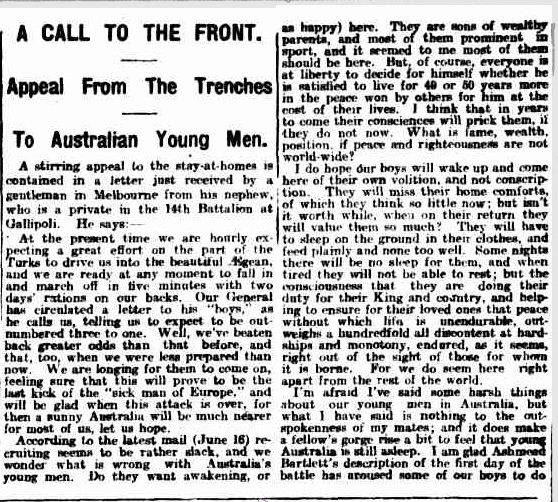
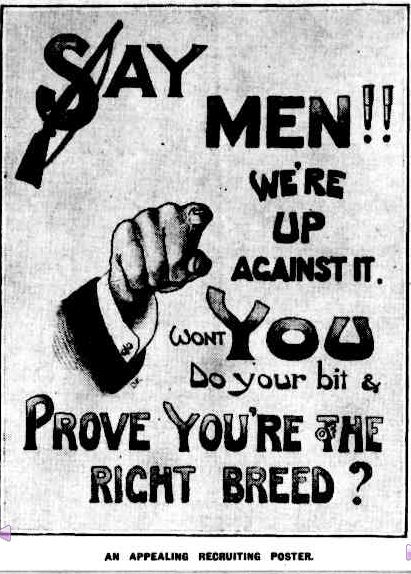
At the time,  those of eligible age were bombarded with propaganda designed to drive recruitment.   The horrors of war had already been felt at home with the Gallipoli landing earlier in the year. The recruitment campaign went to a new level.  War was no longer the big adventure it was made out to be.  Rather men were urged to fight in honour of their fallen countrymen who had died for them. Recruitment posters were everywhere and articles such as this from The Argus of 16 September 1915, must have gone a long way to persuading James to enlist the following month.

A CALL TO THE FRONT. (1915, September 16). The Argus (Melbourne, Vic. : 1848 – 1956), p. 5. Retrieved April 20, 2012, from http://nla.gov.au/nla.news-article1560597

On 27 January 1916, James was given a send-off by the Digby community.

A Digby Recruit. (1916, January 27). The Casterton News and the Merino and Sandford Record (Vic. : 1914 – 1918), p. 3 Edition: Bi-Weekly. Retrieved April 19, 2012, from http://nla.gov.au/nla.news-article74484539

24th Battalion 10 Reinforcements. Australian War Memorial http://cas.awm.gov.au/item/DAX1243

James sailed on 7 March 1916 aboard the HMAT Wiltshire with the 24th Battalion 10th Reinforcement.  He arrived in England on 26 July 1916, and later France at Sausage Valley south of Pozieres on 5 August 1916.  The 24th Battalion had been in France since March after arriving from Egypt.  Previous to that the battalion had been at the Gallipoli landing in 1915.

On the day of his arrival, the 24th had seen action with casualties.  They moved on from their position, making their way around the Somme before reaching Mouquet Farm on 23 August.  The battalion settled in, digging trenches while they could.  The noise of shelling was all around them.

THE FIGHT AT MOQUET FARM. (1916, August 31). Townsville Daily Bulletin (Qld. : 1885 – 1954), p. 4. Retrieved April 21, 2012, from http://nla.gov.au/nla.news-article58914119

The following day, the battle intensified. The 24th Battalion received an estimated fifty casualties.  James McClintock was one of those

CASUALTIES IN FRANCE. (1916, October 3). The Argus (Melbourne, Vic. : 1848 – 1956), p. 7. Retrieved April 20, 2012, from http://nla.gov.au/nla.news-article1626549

Details surrounding his death were sketchy, so much so, his father employed the services of Hamilton solicitors, Westacott and Lord.  On his behalf, they requested details of the death from the defence department to finalise necessary paperwork.  As of November 1916, the final report on James’ death had not been received.  It was clear his remains had not been found.  He now lies below the former battlefields of the Somme with no known grave.

James is remembered at the Villers-Brettoneaux Military Cemetery.   The cemetery has the remains of soldiers brought from various burial grounds and battlefields when it was created after Armistice. It also has memorials for those missing and with no known grave.  James is one of 10,885 listed with such a fate.

Anxiety at home must have increased after news of the death of James.  It was too late to talk John and Albert out of going to war. They had already arrived in England preparing to also travel to the battlefields of the Somme.  At least John and Margaret would have been comforted that twenty-six-year-old John would be there to look after his younger brother.

ALBERT EDWARD McCLINTOCK & JOHN McCLINTOCK

John and Albert McClintock shared their World War 1 journey.  They would have been spurred on by the enlistment of James and maybe envy that he was setting sail on 7 March 1916.  The recruitment drive was in full swing and what man would not have felt that he was less of a man if he did not enlist?

No title. (1916, March 1). The Argus (Melbourne, Vic. : 1848 – 1956), p. 7. Retrieved April 20, 2012, from http://nla.gov.au/nla.news-article2092485

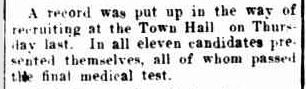
Albert enlisted six days before his brother John.  At nineteen, he filled in his enlistment papers at Hamilton on 25 February 1916.

STREET APPEAL AT HAMILTON. (1916, February 26). The Ballarat Courier (Vic. : 1914 – 1918), p. 4 Edition: DAILY. Retrieved April 20, 2012, from http://nla.gov.au/nla.news-article74502118

On 2 March, John enlisted at Ararat.

The Ararat Advertiser. (1916, March 4). The Ararat Advertiser (Vic. : 1914 – 1918), p. 2. Retrieved April 20, 2012, from http://nla.gov.au/nla.news-article75028814

John was married and living at Wickliffe with his wife Selina Miller Ford.  They had married a year earlier.  At the time of John’s enlistment, it is unlikely that the couple knew they were expecting their first child, due in December.  Maybe John knew by 4 July, when he and Albert boarded the HMAT Berrima and sailed for war with the 29th Battalion 7th Reinforcements.

John and Albert disembarked in England on 23 August 1916.  During December, back home, John’s wife Selina gave birth to their son, John James, his second name a tribute to his fallen uncle.

After time in England,  Albert and John arrived in Etaples, France on 4 February 1917.  On 9 February, they marched out into the field.  The 29th Battalion unit diary notes their location on February 9 as Trones Wood near Guillemont and only ten kilometres from Mouquet Farm.

The battalion was not involved in any major battles at the time. It was at the Battle of Fromelles in 1916 and later in 1917 were a part of the Battle of Polygon Wood, but John and Albert had arrived between campaigns.  During February 1917, members of the battalion were laying cable in the area around Trones Wood.

What exactly happened, three days later on the 12th, is not clear, however, the outcome saw both McClintock boys fighting for their lives with gunshot wounds to their faces.  John’s service record notes the injury was accidental.  He also had shoulder injuries and a fractured left arm.  Albert lost his right eye and had an injured left arm and a fractured right leg.   They were relocated over the next twenty-four hours to the 1st New Zealand Stationary Hospital at Amiens.

On 17 February,  John and Albert’s war-time “adventure” together would end.  Albert was transferred from Amiens to the 13th General Hospital at Boulogne, leaving John fighting for his life at Amiens.

On 1 March 1917, John McClintock passed away from his wounds.  He was buried at the St Pierre Cemetery at Amiens.  Both boys said goodbye to France on the same day, as it was that day that Albert sailed for England.  After only twenty days in the country, and no active fighting, one had lost his life and the other had suffered life changing wounds.

AUSTRALIAN CASUALTIES. (1917, March 16). The Argus (Melbourne, Vic. : 1848 – 1956), p. 10. Retrieved April 19, 2012, from http://nla.gov.au/nla.news-article1604104

On 28 February 1918, over twelve months after the incident,  Albert was discharged from Harefield House Hospital, north of London,  the No.1 Australian Auxiliary Hospital.  He remained in England until May when he returned to Australia.

Digby. (1918, July 25). The Casterton News and the Merino and Sandford Record (Vic. : 1914 – 1918), p. 3 Edition: Bi-Weekly.. Retrieved April 19, 2012, from http://nla.gov.au/nla.news-article74221588

So Albert was home and the war had ended.  Life was expected to go on.  On the outside that is what it did.  There would have been some brave faces at the welcome at Digby.

Albert married Doris Hancock around 1920 and they raised a family of seven.  He died in Digby in 1970 aged seventy-four.

John’s wife Selina never remarried and remained in Wickliffe most of her life, finally passing away in Adelaide in 1960.  John jr enlisted in WW2 but was discharged early. For Selina, there was a constant reminder of John’s sacrifice on the Wickliffe War Memorial.

Parents John and Margaret McClintock did not live long past the war.  The loss of one son would have been enough for any parents to bear, but two would be heart-wrenching.  Another tragedy bestowed them with daughter Flora passing away in 1921 aged just nineteen. John passed away in 1923 aged eighty and Margaret in 1932 aged seventy-four.

On the inside, those people could never have been the same as they were before the war.  In Albert’s case, the loss of an eye and memories of his short time as a soldier would have lived with him forever.  For the others, the deep loss each suffered must have been immense.

This story interested me in a number of ways.  In particular the timing and the locations of the McClintock brothers while in France.  They were each there for such a short time and in similar towns and villages.

Maybe, in those last days before the departure of James, the brothers talked about meeting up somewhere, sometime during their war adventure. They were very close. James was killed only six months before John and Albert arrived in the same area of France he had fallen.  They marched the same roads.  Maybe at some time they did in some way pass each other by.  As John and Albert marched to Trones Wood they could well have passed the final resting place of their brother James.

Today, John and James lay around forty kilometres away from each other in France. Albert is buried at Digby, thousands of kilometres away from his brothers, but I am sure he left a part of his heart in France the day in left in 1917.

LEST WE FORGET

REFERENCES:

24th Battalion Unit Diary

29th Battalion Unit Diary

Australian War Memorial

Australians on the Western Front 1914-1918

Commonwealth War Graves Commission

The AIF Project

The National Archives of Australia

The War Graves Photographic Project

It’s My 1st Blogiversary!

Happy 1st Blogiversary Western District Families.  I thought we would never make it, but 84 posts and 12 months later, here we are.

What a fun year it has been.  It really was worth procrastinating about whether to blog or not to blog.  Over time I have made some great online friends, met some previously unknown family members, and found out so much more about my Western District family.  Western District Families even got a Google+ page!

I hope some of you have also found out something about your Western District family, where they lived, and the things they did through posts such as In the News and the Pioneer Christmas series.  Maybe you have found an obituary of an ancestor at Passing of the Pioneers.

I have found that the act of writing out my family history has been so useful for my research. It has helped me sort out what information I have but more importantly, what I don’t have.  Also, lining up the lives and events of siblings, in the case of the Harmans for example, has given me a better understanding of the dynamics of the family (can you tell I was a Social Sciences student?).

So what have been the most popular of the past 84 posts?

1.  The Fastest Ship in the World

2. A Tragic Night – January 24, 1882

3. Histories of  South-West Towns

4. Witness for the Prosecution

5. Only Seven More Sleeps…

Which posts have been my favourite to share?  Well it was hard to narrow them down to just five but here they are:

1 Elizabeth Ann Jelly

2. All Quiet By the Wannon

3. Halls Gap’s Cherub

4. From Stone Country to High Country

5. A Tragic Night – January 24, 1882

An Honourable Mention must go to  What the Dickens? and the follow-up post Another ‘What the Dickens” Moment.  They were both interesting and fun to write.

Over the past year, I have had made contact with Gamble and Jelly cousins and members of the Condon, Adams, and Oakley families.

I  also heard from Rosemary of Tulsa, Oklahoma. Her great grandparents were married in the original St Stephens Church in Portland.

Plenty is planned for the next 12 months.  I thought I would run out of things to write about. Instead, I am finding it difficult to keep up with all the subject ideas I have. There will be more Passing of the Pioneers and later in the year, I will look at Christmas in the early part of the 20th century.  Of course, I will have more stories about my family.  I’ve barely touched on some of the stories I had planned when I started the blog as I keep finding more great stories in the meantime.

A big thank you must go to my fellow Australian geneabloggers.  Your support and encouragement have been fantastic and you have all inspired me to keep going.   What I have learnt from each of you has been invaluable.  It was great to meet some of you at the Unlock the Past Victorian Expo at Geelong last year.  Also to the 29 followers of Western District Families, thank you for following and for your great comments.

I must also make a special mention of my maternal grandmother, Linda Gamble (nee Hadden).  Nana did not get to see my blog.  She passed away six days before I published my first post.  It was Nana that got me to this point.  Her love of the past and her family inspired me almost 20 years ago to start researching our family tree simply to find out more about them for her.  What a wonderful family she gave me.

Nana & me

Easter Touring in the Western District

Easter, with its four day holiday, has long been a popular time for people to get away in the car and travel to a holiday destination.  I spent around twenty Easters working in Halls Gap, always overflowing with visitors there for the mountains and the ever popular Stawell Gift.  Just tonight, there as been a steady flow of cars passing my house, as people head off for the long weekend.

The early 20th century was no different.  The arrival of the car gave people new freedom.  Not restricted to railway routes, they could take off in any direction. 

THE NEWTON FAMILY. Photographer: Wilf Henty. Image courtesy of the State Library of Victoria http://handle.slv.vic.gov.au/10381/38667

The RACV began producing tour maps and providing driving tips.  In 1912, The Argus proclaimed the educational and health benefits of touring in a car.  Autumn, it suggested, was the appropriate season to travel.

EASTER OUTINGS. CHARM OF AUTUMN TOURING. (1912, April 3). The Argus (Melbourne, Vic. : 1848 – 1956), p. 10. Retrieved April 5, 2012, from http://nla.gov.au/nla.news-article11665234

It may have been 1912, but the roads of the Western District were considered some of the best in the state.  Anyone who has driven the roads of the Western District in recent years will probably say that is no longer the case.   

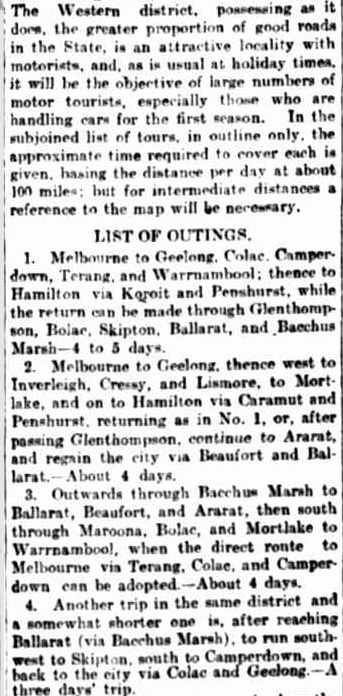
Four Western District touring routes were suggested by The Argus. They were similar to those travelled today, only the estimated travel times have changed.

EASTER OUTINGS. CHARM OF AUTUMN TOURING. (1912, April 3). The Argus (Melbourne, Vic. : 1848 – 1956), p. 10. Retrieved April 5, 2012, from http://nla.gov.au/nla.news-article11665234

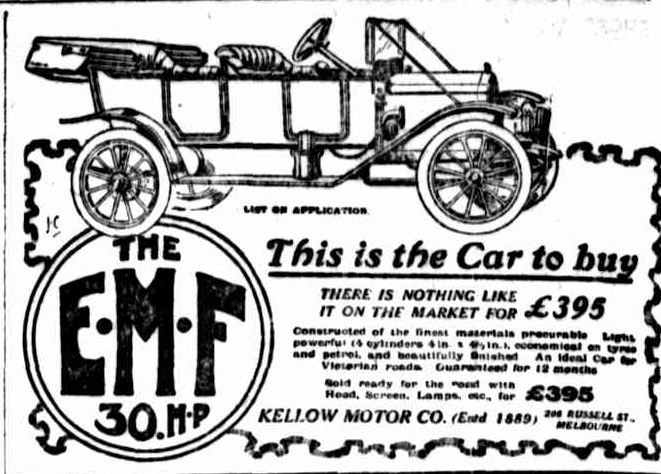
What might those able to afford a motor car driving through the Western District?  Maybe an E.M.F 30hp.

(1912, April 3). The Argus (Melbourne, Vic. : 1848 – 1956), p. 10. Retrieved April 5, 2012, from http://nla.gov.au/nla.news-page381590

The 2012 ANZAC Day Blog Challenge

My third post for Western District Families was in April last year for the 2011 ANZAC Day Blog Challenge.  My contribution was the story of Arthur Leonard Holmes of Casterton, gassed in France in 1918.

Recently, while researching the Holmes family at  Trove for another reason, I found a couple more items about “Lennie” and his sad death.  I have since updated his post.

Well, it is April again and with ANZAC Day drawing closer it is time to start thinking about the 2012 ANZAC Day Blog Challenge.

Created by the  Auckland City Libraries, the Anzac Day Blog Challenge gives us a chance to share stories of our family members who served during wartime and remember their contribution to our life in both Australia and New Zealand today.

The criteria, from the Auckland City Libraries website, is as follows:

Do you have a story to share about an ANZAC? We’d like to hear about not only their sacrifice, but the way it shaped their family history. Maybe you want to blog from the perspective of those that were left behind?

To participate:

  • Write a blog post about an Australian or New Zealander serviceman or woman’s family, and the impact war had on their family history
  • Post a comment with the URL to your blog on the comments section of this page. Or if you don’t have a blog then email us your story at kintalk@aucklandcouncil.govt.nz
  • Publish your post by 25 April 2012.

After ANZAC Day, all submissions will be listed in a summary posting on Auckland Libraries’ Kintalk blog.

Time to get started, but who am I going to write about??

_____________________________________________

Well, I made my decision and I wrote about the McClintock brothers.  Read their story here – “The McClintock Brothers


The Sultan of Shelly Beach

This was going to be a post about our visit to Shelly Beach in January, a trip to rekindle childhood memories of visits there.  Along with photos and an article which described the beauty of the beach,  I had it covered. However, as is usually the case, I could not settle at that.  I had to search Trove for more information on Shelly Beach and what I found has given the post a twist as I introduce you to a wonderful character who had a link to Shelly Beach in the 1930s.

Firstly, here is part of the article “Beautiful Shelly Beach” that was going to feature.

Beautiful Shelly Beach. (1939, March 30). Portland Guardian (Vic. : 1876 – 1953), p. 3 Edition: EVENING.. Retrieved March 26, 2012, from http://nla.gov.au/nla.news-article64392283

When I returned to Trove, I was keen to find a photo of Shelly Beach.   What I found was beyond my expectations.

No title. (1933, June 24). The Argus (Melbourne, Vic. : 1848 – 1956), p. 5. Retrieved March 26, 2012, from http://nla.gov.au/nla.news-article4744401

The caption reads:  “These camels are employed in removing grit from Shelly Beach, near Portland.  Each carries two bags each weighing 2cwt. each and makes 15 trips daily over the sandhills.   The owner is over 70 years old and has four wives”.

Well, I couldn’t leave it there.  Back to the Portland Guardian, I went to search “camels Shelly Beach”.  From that, I discovered a lot more about the mysterious man with the camels.  Jumping ahead two years from the original picture I found the following “Letter to the Editor” from the man himself:

Camels at Portland. (1935, January 24). Portland Guardian (Vic. : 1876 – 1953), p. 1 Edition: EVENING.. Retrieved March 26, 2012, from http://nla.gov.au/nla.news-article64287962

From one letter, so much is learnt.   Sultan Aziz, it seems, was giving rides to tourists on the North beach at Portland during the summer and carting shell grit at Shelly Beach during the winter.  He was working for Mr Vivian Jennings, a local carrier.  Why were the camels being used to cart the shell grit?  The next article explains:

CARTING SHELL GRIT. (1933, May 16). The Horsham Times (Vic. : 1882 – 1954), p. 5. Retrieved March 26, 2012, from http://nla.gov.au/nla.news-article72660392

Sultan Aziz appears to have been in Portland from at least 1933, but he did travel around the south-west and into South Australia.  In 1934, he and his camels were the star attraction of the Mt. Gambier Tourist Promotion Association parade on 21 February 1934.  Sultan Aziz arrived the day before after travelling along the coast from Portland.

T.P.A. CARNIVAL. (1934, February 20). Border Watch (Mount Gambier, SA : 1861 – 1954), p. 1. Retrieved March 26, 2012, from http://nla.gov.au/nla.news-article77960150

From this, we now know that the Sultan had a son, Abdul.

Mt. Gambier embraced Aziz, if the front page of the Border Watch on 22 February 1934, was any indication.  My favourite photo was that of the mayor, dressed in cameleers robes, riding one of  Sultan Aziz’s camels.

MAYOR LEADS CARNIVAL PROCESSION ASTRIDE CAMEL. (1934, February 22). Border Watch (Mount Gambier, SA : 1861 – 1954), p. 1. Retrieved March 26, 2012, from http://nla.gov.au/nla.news-article77960232

There were five photos on the front page that day, all of which included the camels! Sultan Aziz spent at least a month in South Australia selling camel rides at the Mt. Gambier Showgrounds.   It was not a profitable exercise as discussed at a meeting of the Mt. Gambier A & H Society in March 1934.

MOUNT GAMBIER A. & H. SOCIETY. (1934, March 3). Border Watch (Mount Gambier, SA : 1861 – 1954), p. 3. Retrieved March 26, 2012, from http://nla.gov.au/nla.news-article77960562

On his way back to Portland, Aziz called in at Allendale East, south of  Mt. Gambier.  The camels were once again a source of excitement.

REPORTS FROM RURAL CENTRES. (1934, March 20). The Advertiser (Adelaide, SA : 1931 – 1954), p. 19. Retrieved March 26, 2012, from http://nla.gov.au/nla.news-article47544800

In October 1934, the Sultan applied to the Portland Council to have his camels on the South Beach over the summer, however, the council decided he should stay on the North Beach.

Borough Council. (1934, October 4). Portland Guardian (Vic. : 1876 – 1953), p. 3 Edition: EVENING.. Retrieved March 27, 2012, from http://nla.gov.au/nla.news-article64286951

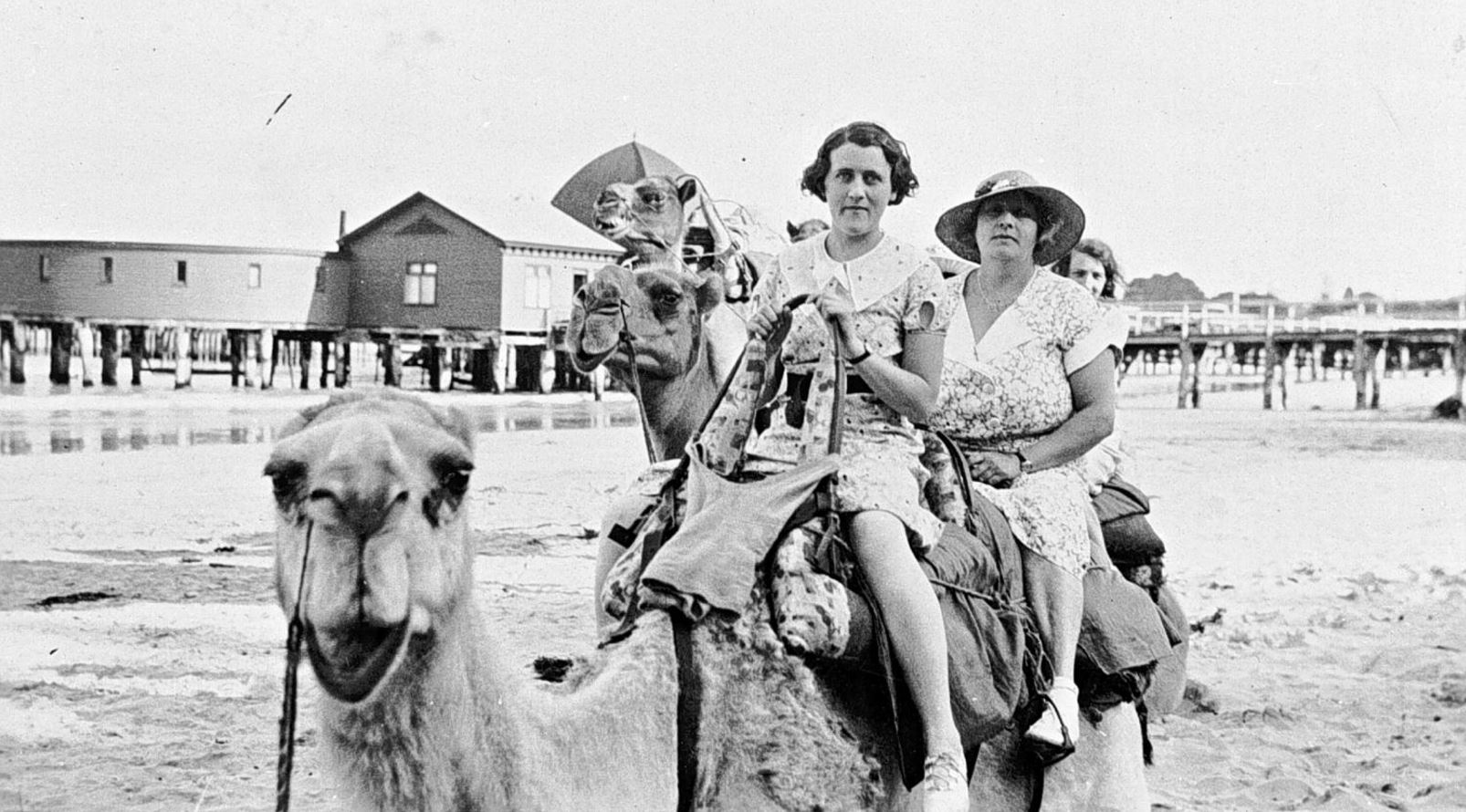
The following photo was taken during summer 1935 at Portland.  The former Portland Baths are in the background.  Enjoying the novelty of a camel ride are Eileen Hickmer, Gladys Read and Jean Ainsworth.

SULTAN AZIZ’S CAMELS ON PORTLAND BEACH IN 1935. Image courtesy of the Museums Victoria Collections https://collections.museumvictoria.com.au/items/773643

This takes us to the time of the “Letter to the Editor” of January 1935.  The Sultan only stayed in Portland another six months, leaving just as another southern winter hit.  He returned home to Broken Hill.  It may well have been a combination of cold weather and the discontent over his camels he spoke of in his letter.  His trip to Portland made news in Broken Hill’s Barrier Miner.

Long Trek On Camels. (1935, October 5). Barrier Miner (Broken Hill, NSW : 1888 – 1954), p. 7 Edition: SPORTS EDITION. Retrieved March 27, 2012, from http://nla.gov.au/nla.news-article46707350

An interesting part of this story is Sultan Aziz’s age.  The photo I found from 1933, gives his age as over 70.  Eight years later in 1941, he was claiming he was 112 which would have made him 104 when the photo on Shelly Beach was taken! I don’t know about that.

“God Is Good” Says Sultan Aziz. (1941, May 16). Barrier Miner (Broken Hill, NSW : 1888 – 1954), p. 1 Edition: HOME EDITION. Retrieved March 27, 2012, from http://nla.gov.au/nla.news-article48407504

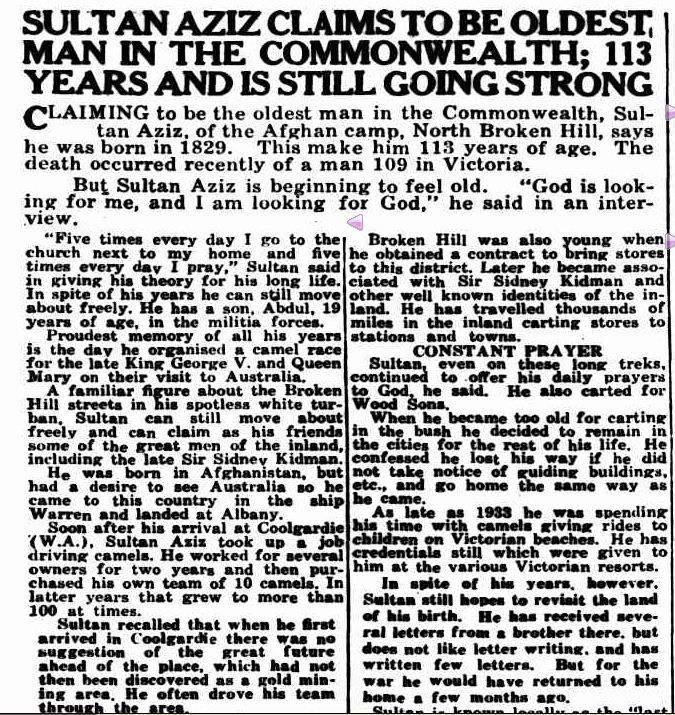
A year later he was back in the news, claiming he, at 113 was the oldest person in the Commonwealth.

SULTAN AZIZ CLAIMS TO BE OLDEST MAN IN THE COMMONWEALTH; 113 YEARS AND IS STILL GOING STRONG. (1942, August 13). Barrier Miner (Broken Hill, NSW : 1888 – 1954), p. 3. Retrieved March 27, 2012, from http://nla.gov.au/nla.news-article48401748

Sadly, age did catch up with Sultan Aziz.  He passed away in 1950.  His age was given as 105.

AFGHAN DIES AT 105. (1950, August 16). Barrier Miner (Broken Hill, NSW : 1888 – 1954), p. 12. Retrieved March 27, 2012, from http://nla.gov.au/nla.news-article49578554

Summarising Sultan Aziz’s life in Australia through the newspaper articles,  I found he was born in Afghanistan and arrived in Albany, Western Australia via India,  around 1885.  His memories from that time included organising a camel race for His Royal Highness, The Duke of York and Cornwall who would, in 1910, become King George V.

An article from the Northern Times, Carnarvon, Western Australia on March 23, 1912, saw Aziz still in W.A. However, he was selling his camels and then sailing for South Australia to take camels back overland to Carnarvon.  I don’t think he made it all the way back as he ends up in Broken Hill with a carting contract around that time. Many other cameleers from Afghanistan were camped at Broken Hill.  He carted goods into central Australia with his camels, working for Sir Sidney Kidman.  At one time he claims to have owned up to 200 camels.  In the 65 years he was in Australia, he must have racked up some miles on his camels.  The trip from Broken Hill to Portland alone was over 900 kilometres.

He had a least one son, Abdul Aziz, who accompanied his father on his trip to Victoria.  Abdul attended school while in Portland and went on to serve in WW2.

In his later years, Sultan Aziz was the caretaker of the mosque in Broken Hill and tended his fowls.

Of course, this is mostly information provided by Sultan Aziz himself and is still to be supported by other sources.

I also did a search for marriages for Sultan Aziz, because I had to know if he did have up to four wives.  However, I did not find a harem, rather a marriage in 1923 to Bigham Kahn at Broken Hill.  This could be Abdul Aziz’s mother.  It is possible that Sultan Aziz had wives he left in Afganistan, which was not unusual for the cameleers.

It really is a great story of another colourful character to find his way into the Western District of Victoria.  I wonder if any of my relatives saw their first camel or paid a penny for a ride on the North Portland Beach.

Further Reading:

If you would like to learn more about the cameleers who helped explorers and pastoralists venture into inland Australia, the website Australia’s Muslim Cameleers is worth a visit.  There is so much information about the Muslim cameleers, including biographies. Yes, Sultan Aziz’s biography is among them.  One interesting fact is that at least 2000 cameleers arrived in Australia during the fifty years from 1870 to 1920 and 20,000 camels!  Most Australians would know Central Australia today has a lot of camels but would have no idea how and why they are there.

There is also a book by Phillip Jones and Anna Kenny, Australia’s Muslim Cameleers.  It includes a biographical listing of over 1200 cameleers.

The Age, on January 3, 2012, published an article entitled Afghans, cameleers and the massacre of Broken Hill.  It includes photos of cameleers and a mining registration form belonging to Sultan Aziz.  This was from 1939 and according to his own calculations at the time, he would have been around 110!  There is a photo, so see what you think.

I also located the WW2 service record of Abdul Aziz.  This was sad to read.  Abdul, born in 1923, enlisted in the Australian Military Service in 1942, aged 18 and later the A.I.F. in 1944.  He was sent to Bougainville in 1945 and after only four months, he received life-threatening wounds to his leg, thanks to a shell.  He returned to Australia.

Further on in the service record,  I found a letter from 1958 of Thora Aziz’s application to buy a home with help from Legacy.  Her husband Abdul had died in 1951.  He would have been only 28.  Such a short life for the son of a centenarian.

Passing of the Pioneers

I enjoy finding stories of pioneer women, as they give me some idea of the lives lived by my own pioneering female ancestors.  March Passing of the Pioneers introduces a plucky pioneer, Elizabeth Cole.  Elizabeth and another pioneer, Annie Alexander both made their mark in roles not traditionally considered the domain of women. Among the passing gentleman, I enjoyed the story of John McClounan, a well-travelled pioneer.

Mr John Lang CURRIE: Died 12 March 1898 at St Kilda.  John Currie was born in Selkirkshire, Scotland in 1818.  He arrived in Victoria in 1841 to join his cousins who had taken up land near Melbourne and then later at Buninyong.  

JOHN LANG CURRIE 1872. Image courtesy of the State Library of Victoria http://handle.slv.vic.gov.au/10381/18219

JOHN LANG CURRIE 1872. Image courtesy of the State Library of Victoria http://handle.slv.vic.gov.au/10381/18219

 In 1844, John purchased Larra Estate (below) near Derrinallum with Thomas Anderson.  In 1850, he brought out Anderson’s share in the property and purchased the Mount Elephant run and two years later married Louisa Johnston.

"LARRA" c1859. Photographer John Lang Currie. Image no. H2013.345/42 http://handle.slv.vic.gov.au/10381/320299

“LARRA” c1859. Photographer John Lang Currie. Image no. H2013.345/42 http://handle.slv.vic.gov.au/10381/320299

In 1886, John bought Tintanga and Gala estates near Lismore along with having interests in properties in New South Wales and Queensland. He bred merino sheep known for the high quality of their wool.  John died at his town residence Eildon in Grey Street, St Kilda.  

EILDON, ST KILDA. Image courtesy of the State Library of Victoria http://handle.slv.vic.gov.au/10381/151371

EILDON, ST KILDA. Image courtesy of the State Library of Victoria http://handle.slv.vic.gov.au/10381/151371

Not surprisingly, John Currie left a large estate and news of its value made news across Australia. John’s son Henry Alan Currie inherited Mount Elephant station.

"A Wealthy Pastoralist's Will." Riverine Herald (Echuca, Vic. : Moama, NSW : 1869 - 1954) 21 July 1898: .

“A Wealthy Pastoralist’s Will.” Riverine Herald (Echuca, Vic. : Moama, NSW : 1869 – 1954) 21 July 1898: <http://nla.gov.au/nla.news-article114964506&gt;.

For more information, John Lang Currie’s biography is on the Australian Directory of Biography site.

John McCLOUNAN: Died 2 March 1902 at Green Lake. John McClounan was born in Scotland in 1832 but left when he was twenty-one.  But not straight to Australia.  He first travelled to America where he spent seven years and then on to New Zealand for around six years.  He and his brother, his travelling companion, then moved to the goldfields of N.S.W. and then to Victoria and Deep Lead near Stawell.  They gave up on mining and moved to Green Lake to farm.  It was on this property John died, forty years later.  He was unmarried.

Isabella SPALDING:  Died March 1907 at Warrnambool. Isabella Spalding was “another pioneer “Mother of Israel”” lost to the Western District.  Aged ninety-one, her husband, James Davidson had died forty-six years before and according to the obituary, she “trained up five sons and four daughters to man and womanhood”

John Henry OLIVER:  Died 23 March 1909 at Horsham. John Oliver was the brother-in-law of Jonathon and Reuben Harman. The obituary states John arrived in Melbourne with his family in 1848. It was in fact 1849 aboard the Courier.  John had spent time around Byaduk where his family settled, however, he bought land at Sailors Home near Dimboola in the early 1870s.  After a stroke, John did return to Byaduk trying to regain his health, but he eventually returned to the Wimmera to live out his last months.

William Snaith WARD: Died 14 March 1913 at Ballarat. On arrival at Geelong in 1857, William Ward headed straight for the goldfields of Ballarat. He mined the “Hit and Miss” shaft at Creswick before taking time off mining to run the coach on the Ballarat-Buninyong Road. The lure of gold was too great and he headed to the goldfields of N.S.W. and one time drilled for coal in Gippsland.

Margaret CAMPBELL: Died 10 March 1914 at Casterton. Margaret arrived at Portland with her parents in 1855 after sailing aboard the Athletae.  She married Donald Ross in 1857 when she was around twenty-six.  They moved to Hamilton, then Sandford before settling in Casterton on the corner of Jackson and Clarkes Street in the house both Margaret and Donald died about fifty years later.

James FERGUSON: Died March 1914 at Beulah. Scottish-born James was one of the early settlers at Beulah and was known around the town as “The Laird”. He was one of the first representatives of the newly formed Karkarooc Shire in 1896.  In 1908, he travelled to England and visited the place of his birth in Scotland.

Dugald MAIN:  Died 9 March 1916 at Ballarat. Dugald arrived in Geelong aboard the Star of the East in 1854 and then settled in Ballarat.  He was a builder by trade and sat on the committee of the Ballarat Orphan Asylum.

Alexander McKAY:  March 1919 at Carlton. Alexander, formerly of Mortlake, was a Scot through and through and was a keen participant in Highland games throughout the district. He was an excellent player of the pipes and excelled at the heavy lifting events of the games, such as the caber toss.

Edmond DWYER:  Died 14 March 1930 at Condah. Edmond at ninety-two was the last of the pioneers to arrive on General Hewitt in 1856. He initially went in search of gold near Beaufort at the Fiery Creek diggings, before turning to road contracting at Portland. He worked the road from Portland to Hamilton for many years.

Mary McDONALD:  Died 4 March 1932 at Hotspur. Mary McDonald was a very old pioneer when she passed away in 1932.  She was born in the Isle of Skye in 1838 and was a teenager when she arrived at Portland with her parents in 1853 aboard New Zealand.  She married Archibald McLean in 1862 and they settled at Hotspur and raised eight children.

Mary Jane JONES:  Died March 1932 at Portland. Mary Jane Jones was born in Portland in 1859.  She first married a Mr Jennings and they had two sons before she married Alfred Fredericks.  They had a further six children.

Martha RIGBY:  Died 11 March 1934 at Hamilton. Born in Lancashire, Martha Jackson arrived at Portland with her parents, John and Sarah Rigby, in 1859. They settled at Heywood where she married John Jackson.  They later moved to Hamilton.  Martha left a large family of ten children, thirty-two grandchildren, and seven great-grandchildren (this was reported as seven great-great-grandchildren, so they either forgot the great-grandchildren or it was meant to read great-grandchildren).

GRAVE OF MARTHA JACKSON, HAMILTON (OLD) CEMETERY

Emma HOLMES: Died March 1935 at Drik Drik.  Emma was a knitter.  She knitted during the Great War for the troops and later for the Methodist Babies Home at South Yarra.  Emma arrived at Portland as a seven-year-old in 1852.  She married William Mullins and they settled at Drik Drik, with Emma considered to be the first white woman to settle there.  Surely a tough time for a new bride.

Annie Gray ALEXANDER: Died 14  March 1937 at Toorak.  Annie Alexander was born near Beechworth around 1861.  She married Henry William Witton in the early 1880s.  They took up residence at Dimboola in the 1890s.  After Henry’s death, Annie did something a little different to some of the pioneer women I have written of before. She published the Dimboola Banner newspaper until 1918.

Maria Jane TAYLOR:  Died 20 March 1939 at Portland. Maria Taylor was an active member of the Myamyn community even up until months before her death at aged ninety.  She was born at South Portland and later married John Treloar at Myamyn where they lived out their lives.  Maria had a large family of thirteen, eight of whom were still living at the time of her death.

Elizabeth COLE: Died March 1942 at Bostocks Creek. What a great pioneer Elizabeth Cole was. Born at Poplar, London in 1845, she came to Australia with her parents in the early 1850s.  She married Alexander Dalziel at Lethbridge in 1862.  At the time of her death, Elizabeth and Alexander had 120 descendants including sixty-five great-grandchildren.  What got me about Elizabeth was that she had been a bullock driver and one with great skill.  She also had memories of Eureka, could recall Lethbridge as a canvas town and the slab huts of Port Fairy and considered kangaroo a delicacy.  In her later years, she enjoyed listening to that modern contraption, the wireless.

PIONEER DIES IN 97th YEAR. (1942, March 17). Camperdown Chronicle (Vic. : 1877 – 1954), p. 3. Retrieved March 23, 2012, from http://nla.gov.au/nla.news-article26091631

Mary MURRAY:  Died 17 March 1944 at Hamilton. Mary’s father was an overseer for Edward Henty at Muntham where she was born.  At the time, she was the first white child born at Muntham.  At some time, she married Mr. Hallam and had many great pioneering stories.

Jean EDGAR:  Died March 1947 at Harrow. Jean was another wonderful pioneer who had been in Victoria for ninety years.  She arrived aboard the Severn which carried another great pioneer, the thoroughbred King Alfred, one of Australia’s early champion sires.

OBITUARY. (1947, March 13). Portland Guardian (Vic. : 1876 – 1953), p. 4 Edition: EVENING. Retrieved March 23, 2012, from http://nla.gov.au/nla.news-article64410609

In 1874 she married into the pioneering Minogue family at Harrow where she lived for the rest of her life.

Alfred Winslow Harman – Stepping out of the Shadows

Imagine the family tree of the Harmans of Byaduk, with its long branches sweeping far and wide, lush and prosperous.  That is except for one.  Near the top of the tree sits a small, stunted branch, a mere twig.  It is the branch of Alfred Winslow Harman.

To me, Alfred Harman is like a shadowy figure standing at the rear of the imaginary Harman family photo.   I know little of him and there are no living descendants.

Born in Melbourn, Cambridgeshire in 1852, Alfred was a baby when he sailed to Australia with his parents Joseph and Sarah, sister Sarah and brother Walter.  He was too young to remember life in England, the arduous journey and the early settlement of the family.

Alfred was seven years younger than Walter Harman, his immediate older sibling, and 22 years younger than his oldest brother James.  He probably had more in common with the elder children of his brothers than his brothers themselves.  For example, James Harman’s son Reuben James Harman, my gg-grandfather was only two years younger than his Uncle Alfred.

In his 20s, Alfred headed north to the Wimmera.  It was there that he met Alice Jane Miller, daughter of Scots Joseph Bass Miller and Rose Jane Church of Warracknabeal, formerly of South Australia.  Alfred and Alice married in 1878 and their only son was born in 1879 at Murtoa.

Let’s stop right there…

If I keep going on like this, the post will be over in another paragraph.  All I have to say further is that Alfred went to Western Australia, suffered a loss, returned home and passed away! There must be more to add to this branch to give it some life.

For the purpose of this post, I decided to search for Alfred again at Trove.  With newly digitised papers added regularly, it is worth checking back.  This time I directed my search to the surname “Harman” and the places I knew Alfred lived.  Starting with “Harman Murtoa”, as I gathered leads I moved to “Harman Rupanyup” and then “Harman Hopetoun”.  I searched the decades, the 1870s, 1880s and 1890s.

I then turned my attention to Western Australia, where I knew Alfred had lived.  I tried “Harman Gwalia”, “Harman Perth”, “Harman Malcolm Street”, “Harman The Crescent” between the years 1900-1930.

Thanks to a  number of other leads on Alfred and his wife Alice, the story of Alfred Winslow Harman is looking better.

Let’s pick up the story again in 1878 with Alfred’s marriage to Alice.

Alice Jane Miller was born at Pancharpoo, South Australia in 1859.  The Millers moved to Warracknabeal after 1868.  Alice’s father, Joseph Bass Miller, was an upstanding citizen and the local Justice of the Peace. I have found that while Joseph spelt his name as Miller, some of his children spelt it Millar. In case you are wondering further on in the post.

After Alfred and Alice married in 1878, they soon started their family.  Herbert Winslow Harman was born at Murtoa in 1879.  I am not sure if they were living there or at Rupanyup as newspaper articles found refer to them at both places.  There are only 16 kilometres between the two towns.

The first newspaper reference I have for the Harmans is from 1883 in a Horsham Times report of the Rupanyup and Dunmunkle Society Show. Alice won Best Ironed Gent’s Shirt and Collar.

Subsequent articles show Alfred had something of a talent for rifle shooting.  Alfred entered many competitions and was a member of the Rupanyup Company of Rangers.  In 1886, he and four teammates secured the coveted Sargood Shield, so prized a banquet was held in their honour.

COMPLIMENTARY BANQUET TO THE WINNERS OF THE SARGOOD SHIELD. (1886, December 24). The Horsham Times (Vic. : 1882 – 1954), p. 3. Retrieved March 13, 2012, from http://nla.gov.au/nla.news-article72957471

The team went on to repeat their success in the following two years, as remembered at a dinner at Horsham in 1913.  Samuel Miller, Alice’s brother, also a member of the famous Rupanyup team, was present on the night

The Rifle. (1913, March 7). The Horsham Times (Vic. : 1882 – 1954), p. 5. Retrieved March 13, 2012, from http://nla.gov.au/nla.news-article73134863

.In 1890, the team competed at Mount Gambier, the hometown of the Miller boys.  It was there they suffered one of their few defeats.

RIFLE MATCH. (1890, August 30). Border Watch (Mount Gambier, SA : 1861 – 1954), p. 2. Retrieved March 13, 2012, from http://nla.gov.au/nla.news-article77491178

By 1897, Alfred Harman was shooting with the Hopetoun club, over 100 kilometres north of Rupanyup.  The Hopetoun Rifle club was more than happy with their new acquisition,

RIFLE SHOOTING. (1897, February 9). The Horsham Times (Vic. : 1882 – 1954), p. 2. Retrieved March 13, 2012, from http://nla.gov.au/nla.news-article73118794

Alfred and his family could not have stayed at Hopetoun long, as I found him on the 1903  Electoral Roll at Gwalia, Western Australia. Gwalia was a gold mining town situated over 800 kilometres east of Perth and north of Kalgoorlie.  Gold was first mined there in 1897, so the town was in its beginnings when Alfred was there.

Today, Gwalia is described as a ghost town but has been preserved so the town’s history is not lost.  The Gwalia & Hoover House Historic Precinct website has some great photos of some of the buildings in the town.

How the Harmans came to be in Western Australia, especially in the middle of nowhere at Gwalia, I can only guess.  Two of Alice’s brothers, Joseph and Josiah Miller also turned up in Western Australia, so there may have been some motivation there.

In both 1903 and 1906 on the Gwalia Electoral Roll, Alfred listed his occupation as an agent, however in 1906, he is also on the electoral roll for Midland Junction, Perth (commercial traveller) and Francis Street, Perth (traveller).  Who knows where he and Alice were actually living at the time?  Especially Alice, as she was on the 1903 Electoral Roll at Warracknabeal, the hometown of her parents.  Did Alfred go ahead or did Alice just fail to change her details?

When Alfred and Alice went to the West, their son Herbert, the aged around twenty,also went along. After only a few years, Herbert was working as the manager of the Canada Cycle and Motor Company at Kalgoorlie.  In November 1904, tragedy struck when Herbert (Bert) was stricken with typhoid fever.  He passed away in the Perth Hospital on November 20.  Alfred and Alice had lost their only child.

Family Notices. (1904, November 29). Kalgoorlie Western Argus (WA : 1896 – 1916), p. 16. Retrieved March 14, 2012, from http://nla.gov.au/nla.news-article32744043

I noted Warracknabeal was given as the home of Alfred and Alice. As mentioned, Alice’s address was Warracknabeal in 1903, but did Alfred also live there at some time?.

The death of Bert also hit the Miller side of the family hard.

Family Notices. (1904, November 22). The West Australian (Perth, WA : 1879 – 1954), p. 1. Retrieved March 14, 2012, from http://nla.gov.au/nla.news-article25367642

Joseph Bass Miller Jnr, Alice’s brother was a Health Inspector in Perth. The funeral left his home at The Crescent, Midland Junction.  This is just one of the addresses Alfred is listed at on the 1906 Electoral Roll.

The funeral of Bert was large, with many members of the Miller family in attendance.

NEWS AND NOTES. (1904, November 24). The West Australian (Perth, WA : 1879 – 1954), p. 4. Retrieved March 14, 2012, from http://nla.gov.au/nla.news-article25367801

What interested me in this report was the coffin…” a massive polished jarrah casket, mounted with silver-plated handles and plates”.  Either Alfred’s job as a travelling salesman was doing well or the Miller family chipped in.  Bert himself had done alright for a 25-year-old, with an estate to the value of £212.00.

NEWS AND NOTES. (1905, January 13). The West Australian (Perth, WA : 1879 – 1954), p. 4. Retrieved March 14, 2012, from http://nla.gov.au/nla.news-article25371654

In 1905, Alice’s mother Rose Church passed away at Warracknabeal and her then 81-year-old father moved to Perth.  He passed away in 1908.

Family Notices. (1908, August 22). Western Mail (Perth, WA : 1885 – 1954), p. 31. Retrieved March 15, 2012, from http://nla.gov.au/nla.news-article37577065

If I ever wanted to find out where Alfred was living, Electoral Rolls were not going to help. From 1910 to 1916, Alfred was listed at 71 Malcolm Street, West Perth.  That is the only period where Alfred did not have multiple entries.  In 1910, Alfred was a collector and in 1916, he was a clerk.  In thirteen years, he has been an agent, commercial traveller, traveller, an agent again, collector, and clerk.

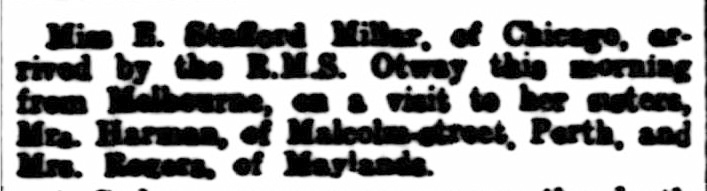
After the 1903 Electoral Roll,  Alice did not show up again until 1916, living at 71 Malcolm Street, West Perth with Alfred. However, from my search at Trove of “Harman Malcolm Street”, I know Alice was at 71 Malcolm Street in 1914.  How?  Thanks to this interesting snippet from The Western Australian.

PERSONAL. (1914, October 7). The West Australian (Perth, WA : 1879 – 1954), p. 6. Retrieved March 14, 2012, from http://nla.gov.au/nla.news-article28570146

It is a little difficult to read, but what is that about Miss E. Stafford Millar, of Chicago visiting her sister Mrs Harman, of Malcolm Street, Perth?  I checked back on the Miller family tree and Elinor Stafford Millar was the sister of Alice.  But what about Chicago?  Any excuse to get sidetracked, I turned to Trove again.  A search on Elinor revealed all.  Who needs Google?

PERSONAL. (1914, September 22). The West Australian (Perth, WA : 1879 – 1954), p. 8. Retrieved March 14, 2012, from http://nla.gov.au/nla.news-article28568583

In fact, I found so many articles on Elinor, I have decided she deserves her own post in the future.  She was after all, born at Mount Gambier, almost Western Victoria!  I found she was an amazing woman, well-travelled and known in the U.S. as the “Australian Evangelist”

I had seen a photo of Elinor on the family tree of Rachel Boatwright at Ancestry.com.au (one of Rachel’s photos of Alice’s brother William Miller is on  January Passing of the Pioneers). I was taken in by the difference between her photo and those of her siblings.  Now I know she led a very different life at the Moody Bible Institute in Chicago.   I found another photo of her in The Advertiser, Adelaide from 1937.

South Australian-Born Woman Evangelist. (1937, December 11). The Advertiser (Adelaide, SA : 1931 – 1954), p. 16. Retrieved March 14, 2012, from http://nla.gov.au/nla.news-article36394976

Back to Alfred…his next Electoral Roll appearance was in 1925 at 105 Stirling Street, North Perth.  But wait, he is also listed at Dumbleyung in Western Australia’s wheat belt, a long way from Perth.  At his Perth address, he was a clerk, while at Dumbleyung he was retired.  No mention of Alice at either address.  That was because, in 1924, she was on the electoral at 593 Burke Road, Camberwell, Victoria!

Further investigation found that this was the address of Alice’s brother Alexander.  She is also listed at 27 Aroona Road,  Elsternwick on the  Electoral Roll from the same year.  I don’t know whose house that was!  I sometimes wish the Electoral Rolls were like a census, listed by household and not surname.  It would make it so much easier to find out who was living with who.

Alice appears on the Electoral Roll again in 1931, this time at 15 Torrington Street, Canterbury. But where was Alfred?  He was listed over at 50 Downshire Road, Elsternwick of course!.  Why does that address sound familiar?  It just happened to be the address of Alfred’s niece, Susan Oakley, daughter of Alfred’s sister Sarah Harman.  And that is where it all ended for Alfred, at 50 Downshire Road, Elsternwick on March 22, 1933.  He was buried at the Box Hill Cemetery.

Family Notices. (1933, March 24). The Argus (Melbourne, Vic. : 1848 – 1956), p. 1. Retrieved March 14, 2012, from http://nla.gov.au/nla.news-article4725647

The link to Susan Oakley explains why Susan and her husband Robert Cruikshank are mentioned in the family notice.  There was only 13 years’ difference in age between uncle and niece and Susan was living in the Wimmera, including Rupanyup,  at the same time as Alfred, which may explain their close relationship.  I like to find these links as it gives me some idea of the family dynamic.

So what became of Alice?  According to the Electoral Roll of 1936, she had moved to the house next door at 17 Torrington Street, Canterbury.  She passed away on May 21, 1940, and was buried with Alfred at the Box Hill Cemetery.

Family Notices. (1940, May 23). The Argus (Melbourne, Vic. : 1848 – 1956), p. 4. Retrieved March 14, 2012, from http://nla.gov.au/nla.news-article12463508

Thanks to Trove and the digitised newspapers, I was able to take the information I had from Electoral Rolls and obituaries to discover so much more about Alfred’s life. I also found a lot more about the Millers/Millars and that helped work out who was where and when.

However, questions still stand, such as exactly where did Alfred and Alice live and what was with all the Electoral Roll entries?  I also want to know what Alfred was selling, especially during his time in Gwalia.  I will keep checking the newspapers.

Alfred’s branch is now looking a little healthier.  It will never grow but I think I can see some blossom now.

St. Patrick’s Day in Western Victoria

There is plenty of Irish blood flowing through the veins of the people of the Western District, particularly the south-west.  Port Fairy (formally Belfast), Koroit, and Killarney, in particular, saw the settlement of large Irish families.

The earliest Western District St. Patrick’s Day reference I found was from the Portland Guardian and Normanby General Advertiser, from March 4, 1843.  Enthusiastic preparations were underway for a dinner on March 17th.

LOCAL INTELLIGENCE. (1843, March 4). Portland Guardian and Normanby General Advertiser (Vic. : 1842 – 1876), p. 3. Retrieved March 16, 2012, from http://nla.gov.au/nla.news-article71569103

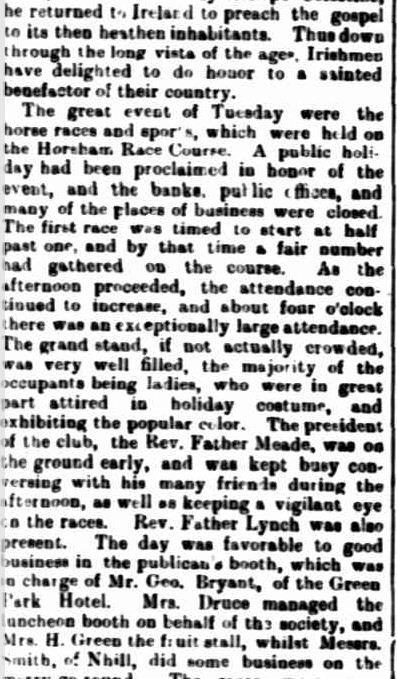
St Patrick’s Day was for a time, a public holiday and races were popular, both the horse and human kind.

HAMILTON. (1858, March 19). Portland Guardian and Normanby General Advertiser (Vic. : 1842 – 1876), p. 2 Edition: EVENINGS.. Retrieved March 16, 2012, from http://nla.gov.au/nla.news-article64570752

In 1869 at Portland, the Rechabite Society fete for the Band of Hope children was a feature of the day.

ST. PATRICK’S DAY. (1869, March 18). Portland Guardian and Normanby General Advertiser (Vic. : 1842 – 1876), p. 2 Edition: EVENINGS. Retrieved March 16, 2012, from http://nla.gov.au/nla.news-article64691997

The Horsham Times of March 20, 1903, explains the reason behind the wearing of a green ribbon on St. Patrick’s Day and the story of St Patrick. The people of Horsham went to the races on March 17, 1903.

ST. PATRICK’S DAY. (1903, March 20). The Horsham Times (Vic. : 1882 – 1954), p. 3. Retrieved March 16, 2012, from http://nla.gov.au/nla.news-article72838336

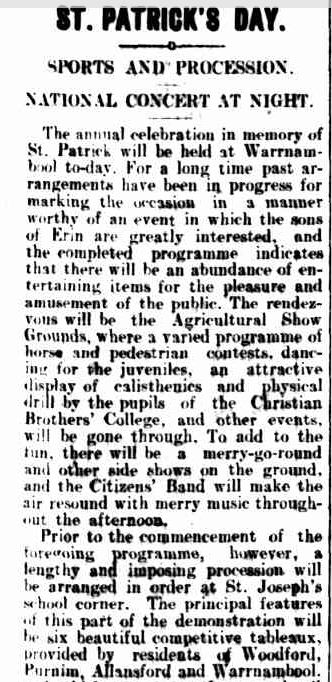
At Warrnambool, in 1914, plans were underway for the annual St. Patrick’s Day celebration, which included a parade in the afternoon and a concert in the evening.

ST. PATRICK’S DAY. (1914, March 14). Warrnambool Standard (Vic. : 1914 – 1918), p. 3 Edition: DAILY.. Retrieved March 16, 2012, from http://nla.gov.au/nla.news-article73467140

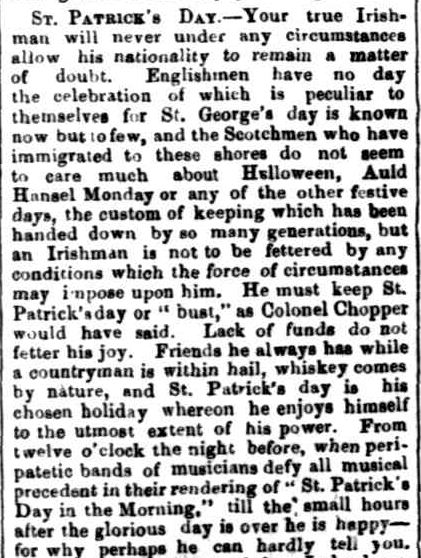
Finally, a reporter for the Star in Ballarat in 1858, observed that while the English barely remembered St. George’s day and the Scots were not interested in Halloween, the Irish would never let St Patrick’s Day be forgotten.  The Irish miners would be pleased St. Patrick’s Day is still celebrated today, minus the public holiday.

Local and General News. (1858, March 18). The Star (Ballarat, Vic. : 1855 – 1864), p. 3. Retrieved March 17, 2012, from http://nla.gov.au/nla.news-article66047115
MLA citation

Another “What the Dickens?” Moment

To mark the 200th birthday of Charles Dickens, I posted about Alfred Tennyson Dickens who lived in my hometown of Hamilton.  Entitled “What the Dickens?“, the post describes my amazement that a son of Charles Dickens could have lived in Hamilton.  Alfred left the town due to the accidental death of his wife Jessie.

Yesterday I was in Hamilton for several reasons, one of which was to visit the Hamilton Old Cemetery in search of the grave of Jessie Dickens, and as a result, I had another “What the Dickens?” moment.

My visits to Hamilton are infrequent day trips, so I try to cram in as much as possible. Visits to the cemetery are quick, usually to search for a specific grave or graves. Yesterday was no different, except I had absolutely no idea where in the cemetery Jesse was buried.  With Mum, we headed to the oldest and biggest graves.

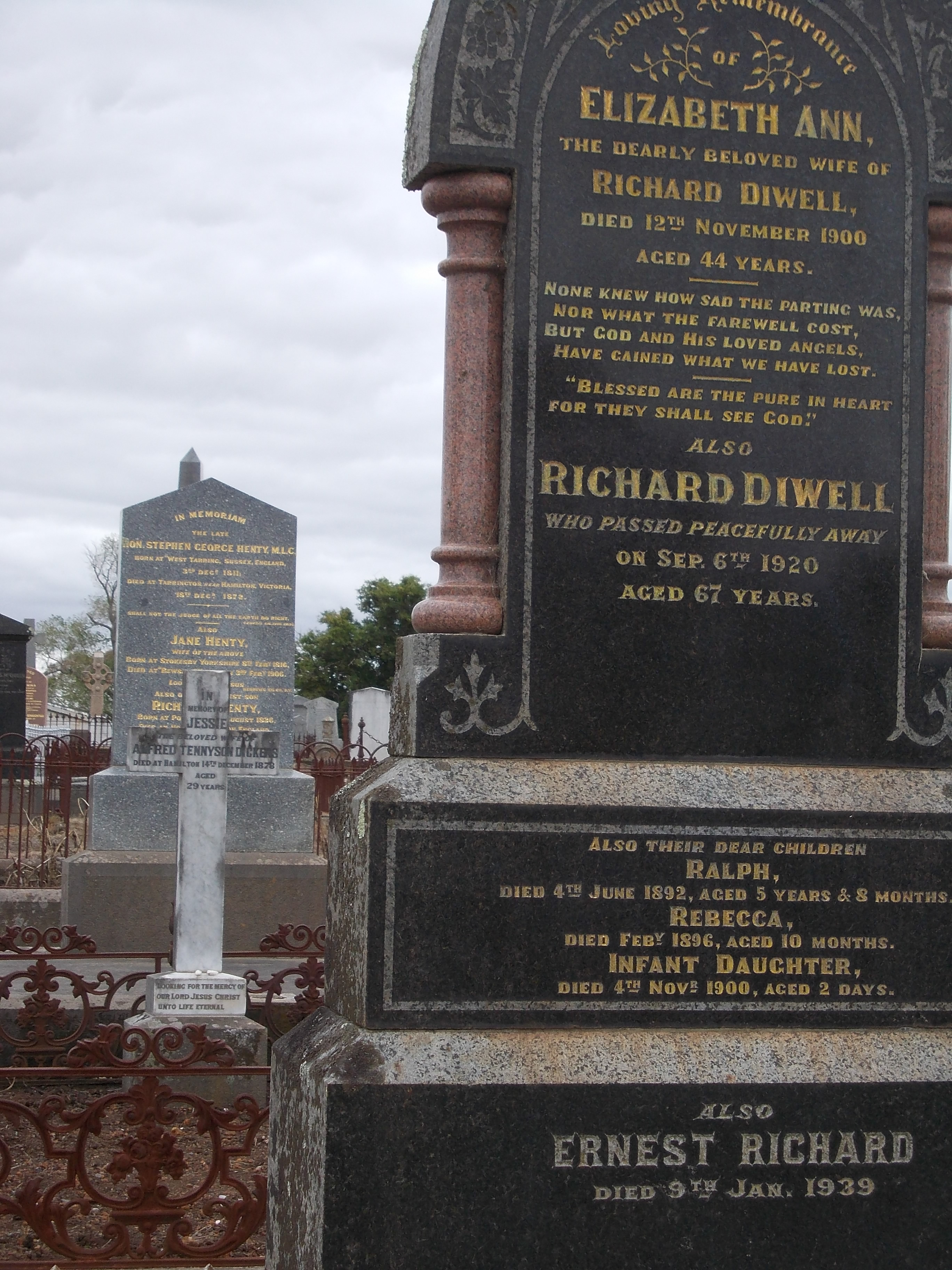
We found the grave quicker than expected.  It turns out the grave of Jessie Dickens is immediately behind my gg grandparents Richard Diwell and Elizabeth Jelly who I have posted about before.  We couldn’t believe we had previously visited the Diwell plot before, unaware the grave of the daughter-in-law of Charles Dickens was right behind. As we were earlier unaware of the Dickens link to Hamilton, we had not made the connection.

What I couldn’t believe was that I had missed the grave immediately behind Jessie’s. It was that of Stephen George Henty, one of the Henty brothers, Victoria’s first settlers.  Stephen, thought to be the most influential of the brothers, was the first to settle inland from Portland, at Muntham, Merino Downs, and Sandford stations.

DIWELL, DICKENS & HENTY GRAVES


Both the Diwell and Dickens headstones were chosen by heartbroken husbands, shattered by their wives’ premature deaths. Jessie was only 29, thrown from a horse-drawn carriage on Portland Road in 1878 and Elizabeth died at 44 due to complications of childbirth in 1900. I have updated the “What the Dickens?” post with a photo of Jessie’s grave.

When I came home, I checked the photos I already had of the Diwell grave, and sure enough, you can see the two other graves in the background.  One of these photos appears on the post “Elizabeth Ann Jelly“.

The thing that struck me was that within a distance of about 6 metres lay the remains of 10 people.  Great Victorian pioneers, Stephen George Henty and wife Jane and their son, Richmond; the wife of the son of one of the greatest novelists of all time and my gg grandparents, Richard and Elizabeth Diwell and four of their children, Ralph, Rebecca, Ernest, and an unnamed baby.  Wow!