Watching the Queen’s Diamond Jubilee river pageant, made me think of how much Nana would have enjoyed it. She loved everything royal, and while she was not always a regular reader of the Australian Women’s Weekly like Grandma Riddiford was, you could always count on her buying issues with the British royal family on the cover. Not to mention the special publications for events such as the marriage of Charles and Diana and the birth of their sons.
It also reminded me of an article I found at Trove of another Harman descendent and her link to the Australian Women’s Weekly and how she found royalty inspiring.
Nina Harman was born in 1895 at Barnawartha, Victoria, daughter of Walter Graham Harman and Ann Gray, and granddaughter of George Hall Harman and Rebecca Graham. In 1921, Nina married engineer, Jonathan Welsh. During the 1940s and 50s the couple was living at Wattle Vale, near Nagambie.
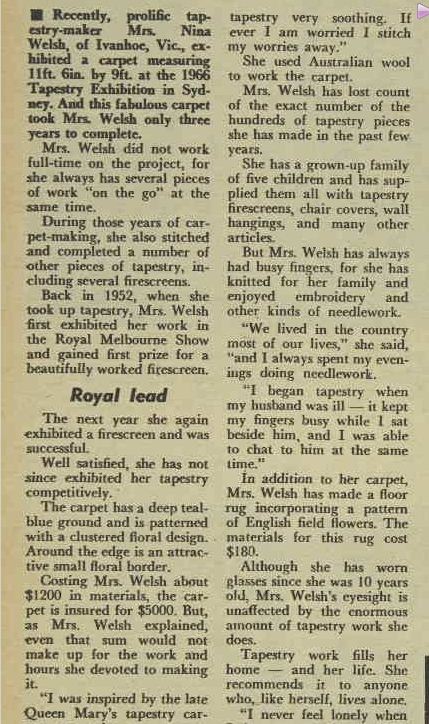
Nina took up tapestry around 1952 when Jonathan became ill as she found it “soothing”. They later moved to Ivanhoe, Victoria and Jonathan passed away in 1961. Her carpet, pictured in the “Weekly” on July 6, 1966, helped her overcome the loneliness brought about by the death of her husband.
What amazes me is that the carpet cost $1200 in materials and was insured for $5000. How much would that be today?
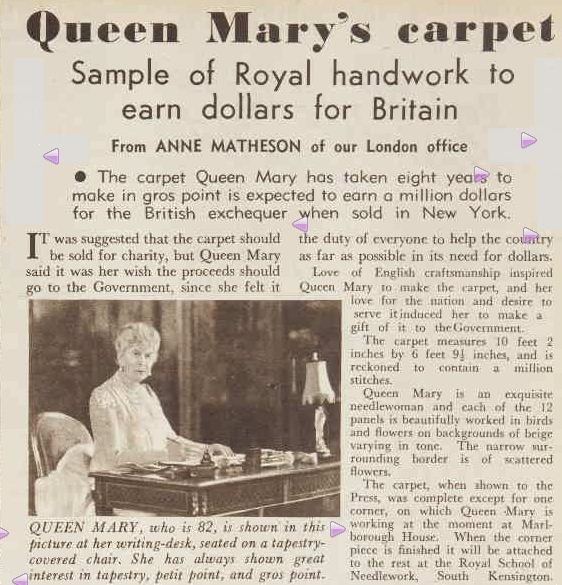
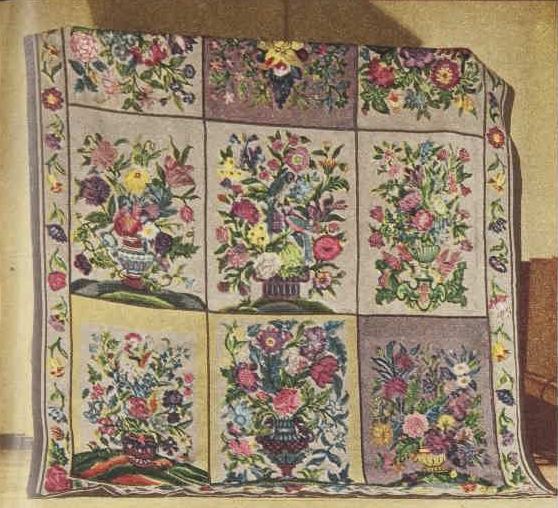
Queen Mary’s own tapestry carpet inspired Nina. The Queen completed the carpet in 1950 at which time she donated it to the British Government to sell and retain the funds. Queen Mary worked tirelessly on the carpet despite pain from sciatica.
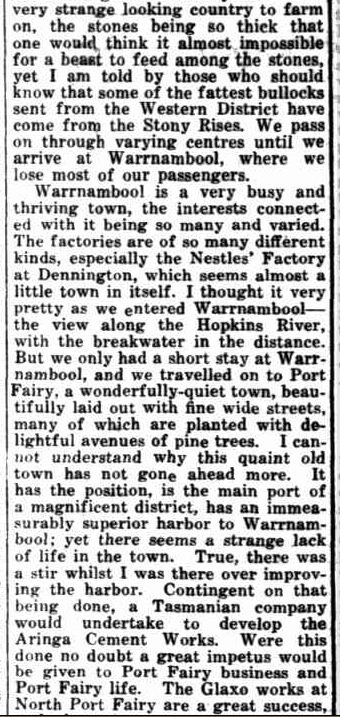
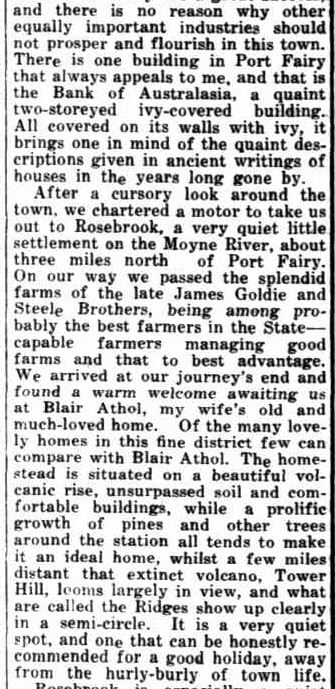
For those of you who have not visited the south-west of Victoria, the following article gives a wonderful description from Camperdown through to Port Fairy. Published on June 1, 1928 in the Hurstbridge Advertiser, the correspondent, “Mernda” journeys by bus to Port Fairy. There are descriptions of some of the towns and their industries as well as the volcanic countryside.
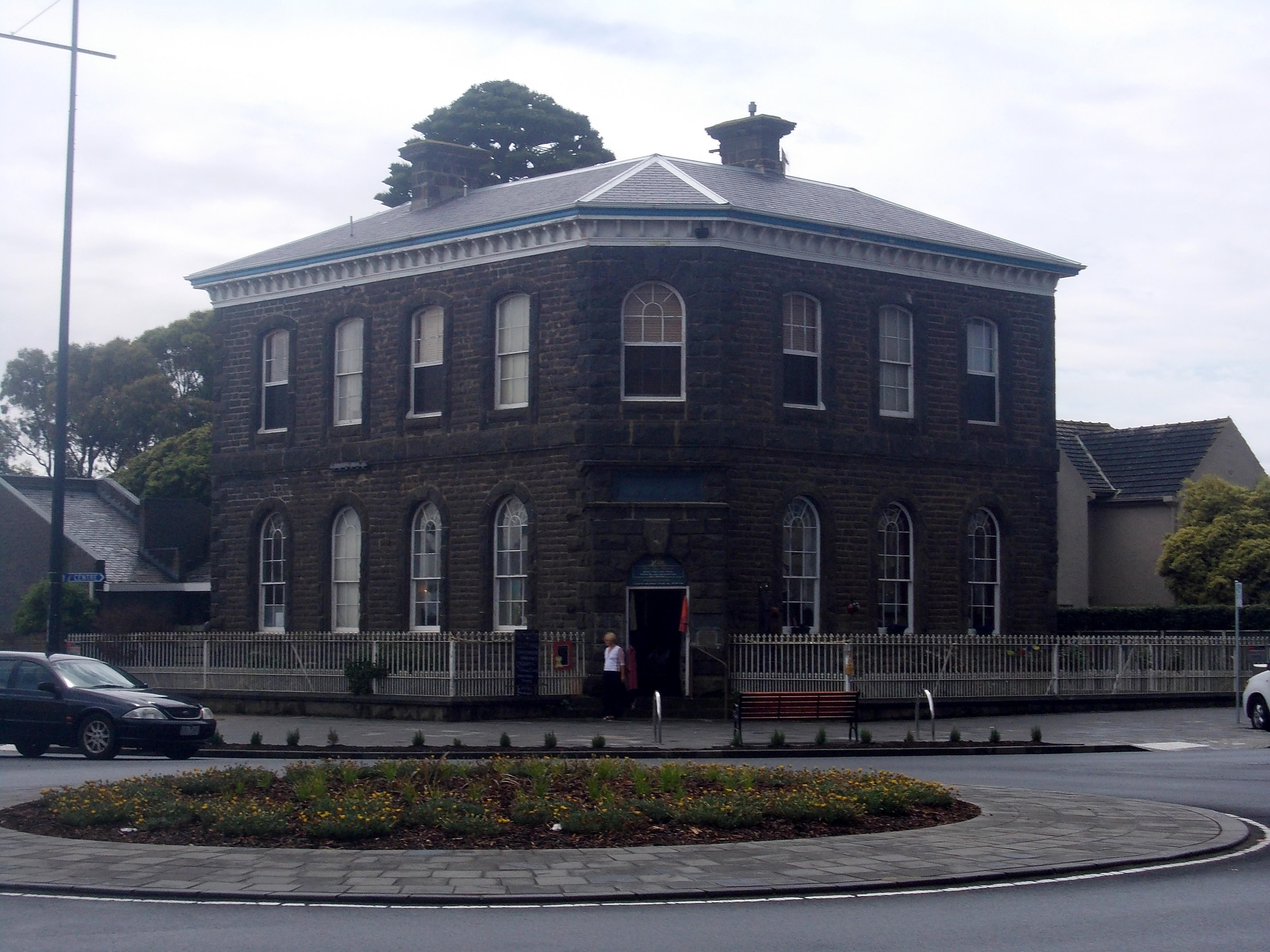
The former Bank of Australasia (below) was a highlight for “Mernda” in Port Fairy.
Of interest is the Glaxo works in Port Fairy, considered by “Mernda” as a “great success”. Glaxo produced high quantities of milk powder, from milk sourced from the local area. In the 1940s, the company name changed to Glaxo Laboratories and still exists today in Port Fairy as GlaxoSmithKline.
MY TRIP TO THE WESTERN DISTRICT. (1928, June 1). Advertiser (Hurstbridge, Vic. : 1922 – 1939), p. 4 Edition: AFTERNOON.. Retrieved May 31, 2012, from http://nla.gov.au/nla.news-article57757397
This is the third draft of this post, and it is definitely the final one. Researching this subject has taken me through several twists and turns. I’ve gone from happy dancing around the room to slumped over the keyboard with frustration to happy dancing around the room again.
In my post “Left Behind,” I alluded to a discovery that linked Mary Ann Harman to Australia. It was the Passenger Lists that led me to my subject, and those same passenger lists have contributed to my despair, leaving me desperately searching for answers.
So far, I have bookmarked almost 100 newspaper articles, watched film archive footage, listened to sound archive footage, read musical scores, and entered a lost world of entertainment, vaudeville. I have gone from the stages of the Bristol Hippodrome to the Melbourne Tivoli, from the BBC to the ABC.
I could not share this story until I knew the truth.
So without further ado, let me introduce you to the star of the show –
!!!!!!!!!RUPERT HAZELL!!!!!!!!!!!!!
!!!!!!!!!RUPERT HAZELL!!!!!!!!!!!!!
Rupert Alexander Hazell was born in West Ham, London in 1887. He was the son of Charles George Hazell and Harriett Sarah Loats, daughter of Mary Ann Harman, and granddaughter of Byaduk pioneers, Joseph and Sarah Harman. Charles Hazell worked on the wharves, and Rupert followed him there to work, first for the Royal Naval Stores and then the Port Authority.
But Rupert’s heart was not in it. He was funny, a born comedian. Despite passing the examinations to enter the Civil Service and delighting his parents, he wanted to share his humour. With that and his musical talent, he said goodbye to the Civil Service.
In 1913, he formed his first partnership, marrying Florence Adele McKnight at Kingston, Surrey. Adele worked as a saleswoman for a costumer and it’s possible that she met Rupert there. Years later, it was revealed Rupert had a great interest in ladies’ stage costumes.
The following year, their son was born and christened with the same name as his father, Rupert Alexander.
Rupert was already treading the boards when he enlisted for WW1 in 1916, listing his occupation as an entertainer. He was an acting sergeant in an English hospital, one that saw ANZAC troops as patients.
It was writing songs for Music Hall star George Robey that saw his career take off. From there, he impressed Wal Pink and vaudeville director Albert De Courville.
Radio came to England in 1920 with Dame Nellie Melba making one of the first broadcasts on Marconi’s test station, 2MT in Essex. Rupert, too, was one of those early broadcasters, being one of the first comedians signed by the Marconi Company. The Marconi Company evolved into the BBC in 1922, with whom Rupert broadcast for at least the next two decades.
In 1922, Rupert travelled to New York for the Broadway show, Pins and Needles, co-written by De Courville and Pink, with lyrics co-written by Rupert. He also appeared in the show for the month of February.
The 1923 Royal Command Performance was Rupert’s next big appearance, before King George V and Queen Mary. After this event, advertising for his shows promoted him as “The Man who Made the King Laugh”.
In 1925, Rupert Hazell hit Australian shores for a tour of the Tivoli circuit. With soprano, Miss Elsie Day (her stage name), they toured Sydney and Melbourne with both critical and popular acclaim.
The visit turned into a four-year stay, with Hazell not returning to London until 1929. During that time, he became a radio star with the ABC with stints in all the Australian capital cities and New Zealand.
Accompanied by Elsie Day, their vaudeville act comprised Rupert’s jokes and Elsie’s songs. Taking on a clown-like appearance, Rupert had wild hair and a funny little hat, while Elsie always dressed in her famous crinoline dresses. Rupert greeted audiences with the familiar opening:
“Hello People. Everybody happy?”
This advertisement for the Tivoli, Melbourne, has Rupert and Elsie on the bill with their show “Harmonylarity”
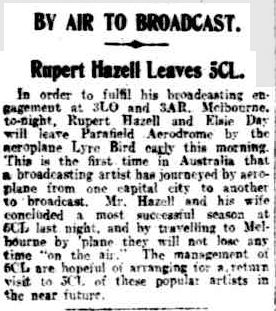
By 1928, Rupert Hazell was well known around Australia thanks to radio broadcasts, vaudeville shows, and speaking engagements with groups such as Rotary. According to The Register (S.A), Rupert and Elsie were the first performers to fly between venues.
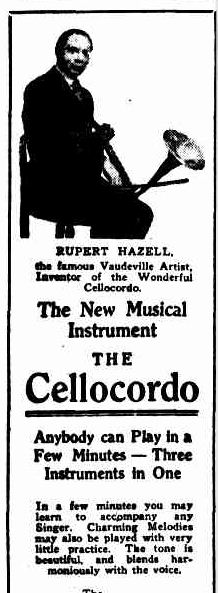
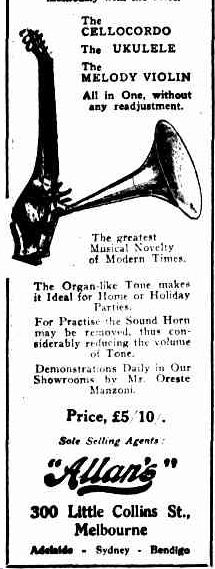
Not only was Rupert a comedian, broadcaster, and composer, but in 1925, while in Australi,a he patented his invention, the Cellocordo, an instrument like the Phonofiddle invented by A.T. Howson. Rupert also played the Phonofiddle, but also did much to promote his version.
It is around this time in Rupert’s life that questions come up. I had read many articles at Trove about the pair’s 1920s visit and a later visit in 1933-34. Frequently, newspapers reported Elsie as Rupert’s wife. If “Miss Elsie Day” was a stage name, was I to assume that her real name was Florence McKnight?
It was a search at the UK National Archives that uncovered a record of divorce served on Rupert Alexander Hazell by Florence Adele McKnight in 1929. The same year, they both supposedly returned from Australia. But why did Rupert continue to perform with Elsie into the 1930s and beyond if she was Florence?
I had to find out the true identity of “Miss Elsie Day”. I went back to the Passenger Lists and once again studied Rupert’s entries. One would expect that Miss Day would travel using her real name.
There was another “Hazell” listed on three occasions. The first was in 1929 on their return to London. Accompanying Rupert on the voyage was Eva Hazell, a vocalist. Very interesting. Also interesting was that they each listed a different residence on their return to London, Rupert at 74 Cornhill, London, and “Eva Hazell” at 28 Salmon Road, Kent.
In the later records, 1932 from South Africa and 1934 from Brisbane, Rupert was travelling with Sarah Eva Hazell. Their address was the same, 13 The Fairway, North Wembley. The 1932 record listed Sarah as “wife” and on the 1934 record as “soprano”. On each record, there was a 15-year age difference between Rupert and Eva, while there was only a two-year difference in age between Rupert and Florence.
Eva. That name rang a bell. I had found a marriage record from 1931 listing Rupert Alexander Hazell marrying a woman with the surname Pank. Further investigation revealed her full name was Eva Pank. I had initially assumed this record was for Rupert junior, as I thought Rupert senior was happily married to Florence “Elsie Day” McKnight. I also found the death record for Sarah Eva Hazell from 1988. Things were looking a lot different.
I was now working on the assumption that “Miss Elsie Day” was Sarah Eva Pank. That would mean that when Rupert and “Elsie” were in Australia for the first time, they were not married.
Then, on their arrival back in England, Florence was waiting with divorce papers. Two years later, in 1931, Rupert finally married his “Miss Elsie Day” and they returned to Australia legally as man and wife. But I could not make such claims without proof.
Back to Trove, and I read through articles from the first visit, comparing them to the second. Was there any way reporting on their relationship was different on each visit? I analysed every interview looking for clues. With no paparazzi following the couple, there were no scandalous rumours, but there were some differences.
On the earlier visit, articles mentioned Rupert Hazell appearing with Miss Elsie Day or his partner, Miss Elsie Day. On one occasion, The Register (Adelaide) reported Elsie was Rupert’s wife, and he referred to her as his “little grandmother”.
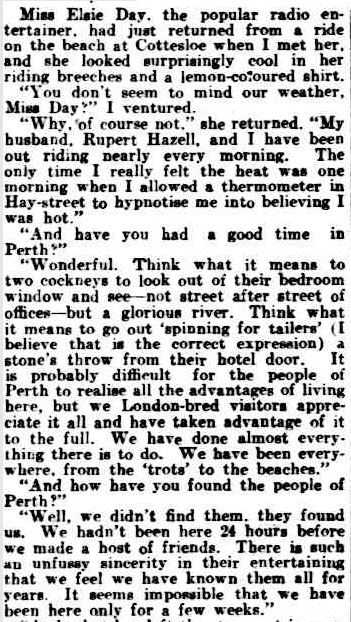
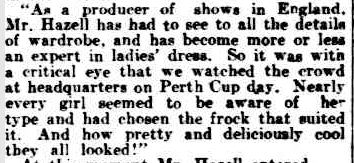
After the formal reporting on the “relationship” during the 1920s visit, the first article after they stepped off the boat at Perth on their return to Australia was totally different:
Getting copies of divorce papers was a possibility, but a quote of £63 for a digital copy was making it less of an option, although I was getting desperate. I then remembered a comment on a photo on Flickr from the ABC Archive.
The photo is of Rupert and “Elsie” to the right with 3LO Melbourne’s Fred Williams. A comment on the photo from Claire mentioned Elsie Day and Rupert were her gg aunt and uncle. Before I parted with my money for the divorce record, I would contact Claire. A prompt reply came back, giving me cause to happy dance around the room once again. Claire told me Elsie Day’s real name was Eva Pank or Sarah Eva Pank. She was Claire’s gg aunt on her maternal side.
I had noticed advertisements from 1924/5 for the Bristol Hippodrome with Rupert performing his show “Harmonylarity” accompanied by Eva Parke. I now believe that was Sarah Eva Pank, and that was when their relationship began.
I can now move on. There is so much more I could tell you about Rupert Hazell’s life. His philosophies of comedy and the audience, topics he spoke of regularly, offer a fascinating insight into early 20th-century entertainment. I also tried to strip back the grease paint to find the “real” Rupert and revealed a complex, intelligent man not afraid to give his opinion, especially about his own talents.
Determination and hard work took him from the ports of London to the stages of the world. He saw comedy move from vaudevillian performances to radio and, in his final years, television, a medium he would have enjoyed being a part of, but I have no evidence of his involvement. Rupert passed away in 1958 at Hampstead, London, aged 71.
When I first discovered Rupert, my only question was if the Harman family in Australia knew of him. I feel they probably did not know their family link, since contact between the Harmans of England and Australia may have ended once Mary Ann passed away in 1873. All the same, it is nice to think Sarah Harman of Flemington, aged in her early 80s, may have tuned her wireless to 3LO and listened to her great-nephew Rupert.
Am I happy? Yes, I am Rupert!
You can watch a performance by Rupert and Elsie from 1935 on this video of footage from the British Pathé. Rupert even plays his Cellocordo.
THANKS
I must thank Alison Rabinovici, who has researched Rupert and his Cellocordo, including for a piece at the Jon Rose Web Project site. She replied to my enquiry promptly and offered many places to look for further information. She has since followed up with more contacts, and I thank her for all her help.
I big thank you must go to Claire Hardy, the gg niece of Sarah Eva Pank. Without her, I would still be tearing my hair out, spending every waking moment reading, rereading, and analysing. Thanks to Claire, I can now move on to something else. Some would suggest housework…
If some of the pioneers from May Passing of the Pioneers could be gathered in one room, the stories would be flowing. Many of them enjoyed telling stories from the past and had great recollections of the early days. Subjects would include Queen Victoria, the Henty brothers, the Eureka Stockade, lands sales, and gold. I’m sure they would have all agreed with fellow pioneer John Waters’ philosophy to “paddle your own canoe”.
Agnes PATERSON: Died 29 May 1901 at Portland. Agnes was the daughter of a Tasmanian solicitor, Alex Paterson. She married John Norman McLEOD and they first arrived in the Portland district around 1850. John built Maretimo before purchasing Castlemaddie, a property at Tyrendarra. Between 1851 and 1856, John McLeod was the MLA for Portland. Agnes was seventy-five at the time of her death and left three sons.
John GILLIES: Died May 1914 at Moonee Ponds. John Gillies was a farming pioneer around the Ararat district. He was a member of the Farmers’ Co-operative Company and the Ararat Agriculture Society.
Emily Julia BENNETT: Died May 1914 at Stawell. Emily Bennett was a Stawell pioneer. Originally from London, she arrived in Victoria around 1860 with her parents Dr. Edwin Bennett and Mrs. Bennett. They settled around Stawell around 1865. Gold was the main focus in Stawell at the time and the town consisted mostly of tents. Dr Bennett took up a position as hospital doctor which he held for many years. Emily married Richard Z. DAVIES at the Stawell West Anglican church. Richard was the headmaster at the Stawell State School.
William B. BRADSHAW: Died 26 May 1915 at Ballarat. Born in Cambridgeshire, England, William Bradshaw arrived in Adelaide as an eleven-year-old in 1837. One of the last events he attended in London before his departure was the ceremony for the Proclamation of the accession of Queen Victoria. Once in South Australia, his father established one of the first bakeries in Adelaide. William was lured to the goldfields of Victoria in 1851. He had reached Ballarat by1854 the time of the Eureka Stockade. He was one of the first Justices of the Peace appointed in Victoria.
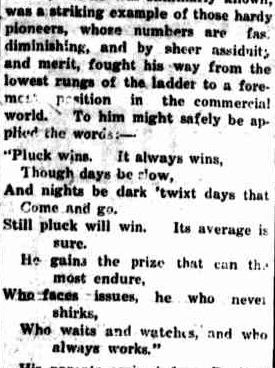
John WATERS: Died 4 May 1917 at Nareen. John Waters was born in Lurgan, Northern Ireland in 1830. He and his wife arrived at Portland aboard the General Hewitt in 1856 and headed towards the Casterton district. After some moving around he finally settled at Rock View at Nareen in 1867 where he remained until his death. John’s pioneering story is similar to so many others of his time:
Obituary. (1917, May 7). The Casterton News and the Merino and Sandford Record (Vic. : 1914 – 1918), p. 2 Edition: Bi-Weekly. Retrieved May 24, 2012, from http://nla.gov.au/nla.news-article74489225
If John was concerned about “coddling legislation” almost 100 years ago, what would he think of our society today?
John CHRISTIE: Died 15 May 1918 at Byaduk. Born at Garvald, East Lothian, Scotland in 1834 and arrived at Portland in 1851. He settled at Byaduk, naming his property Garvald Vale. With his brother, they breed fine Lincoln sheep. A further obituary can be read at Obituaries Australia
Margaret JENNINGS: Died 19 May 1927 at Heywood. Although she was only eight at the time, Margaret Jennings retained memories of her voyage to Melbourne in 1840 with her parents Cook Abraham Jennings and Hannah Birchall. She also recalled the early days of Portland, the Hentys, William Dutton, Black Thursday of 1851 and the wreck of the steamer Admella. She married Hugh Kittson and they settled at Bridgewater Lakes. In her later years, she retained her wit and loved the company of children. She was a contributor to the Red Cross during WW1. You can read more about Margaret in the post “In the News – May 26, 1927“.
William Primrose ANDERSON: Died 26 May 1927 at Portland. William Anderson was a well-known resident of Portland and was known around the town as “W.P.”. He was born in 1845 in Melbourne and arrived in Portland with his parents around 1857. His first job was working in a grocery and hardware store in Portland. By the age of twenty-eight, he had taken over the business. He set up a wool export business and had many other business interests around the town. His obituary is lengthy and is worth reading to learn more, not only about “W.P’s” life but also the early days of Portland. William Anderson demonstrated the qualities shown by many other pioneers:
William McINTYRE: Died 23 May 1936 at Hamilton. William McIntyre arrived at Portland in 1852 with his parents aboard the John Davis. He was born in Inverness, Scotland only three years earlier. By 1855, the McIntyres arrived at Muddy Creek near Hamilton via Strathdownie and South Australia. William was a gun shearer, with his record being 209 sheep in one day. He also was a good athlete, winning many prizes at sports days from Penshurst to Branxholme.
Mary MUMFORD: Died 5 May 1940 at Camperdown. Mary Mumford was born in England in 1845 and arrived in Australia with her parents in the late 1840s. She married Frederick TILL in 1863 and lived in Cobden. Frederick was killed in an accident, leaving Mary with four children. She married John PETER and they had a further five girls. It is not mentioned what happened to Mr Peter, but Mary left Cobden for Cowley’s Creek where she resided for 25 years. Later in life, she married Mr NELSON. At the time of her death, she had one son, six daughters, forty-four grandchildren, fifty-five great-grandchildren, and one great-great-grandchild. Her son William Till played a part in the rescue of the two survivors of the Loch Ard.
Mary LOUREY: Died 3 May 1941 at Glenormiston. Mary Lourey was the last surviving child of Thomas and Johanna Lourey. She was born at Kirkstall around 1858. Twenty-two years later she married Thomas KELLY and they eventually settled at Glenormiston. Thomas was behind the construction of the Glenormiston butter factory. At Mary’s funeral at the Noorat Catholic Church, the children from St Joseph’s School formed a guard of honour. The cortege was said to stretch from Noorat to Terang where Mary was buried.
Henry Cowap WILLIAMSON: Died 25 May 1948 at Portland. Henry Williamson was a pioneer of the fruit growing industry in the Gorae district. He and his brother grew apples and later built cool stores at Gorae which were a profitable ongoing concern. Henry retired into Portland and was a prominent member of the Wesley Church and the Portland P & A Society,
Robert John MALSEED: Died May1950 at Portland. Robert Malseed was the youngest son of Irish immigrants, Stewart and Margaret Malseed. Robert was born at Portland in 1860 and married Elizabeth Ann TRENEAR in 1888. Robert and Elizabeth lived all their married lives at 88 Garden Street, Portland where Robert had an orchard. One of his proudest moments was representing the Malseed family at the 100th anniversary reunion of the arrival of his parents. He was the oldest surviving member of the Portland Oddfellows Lodge.
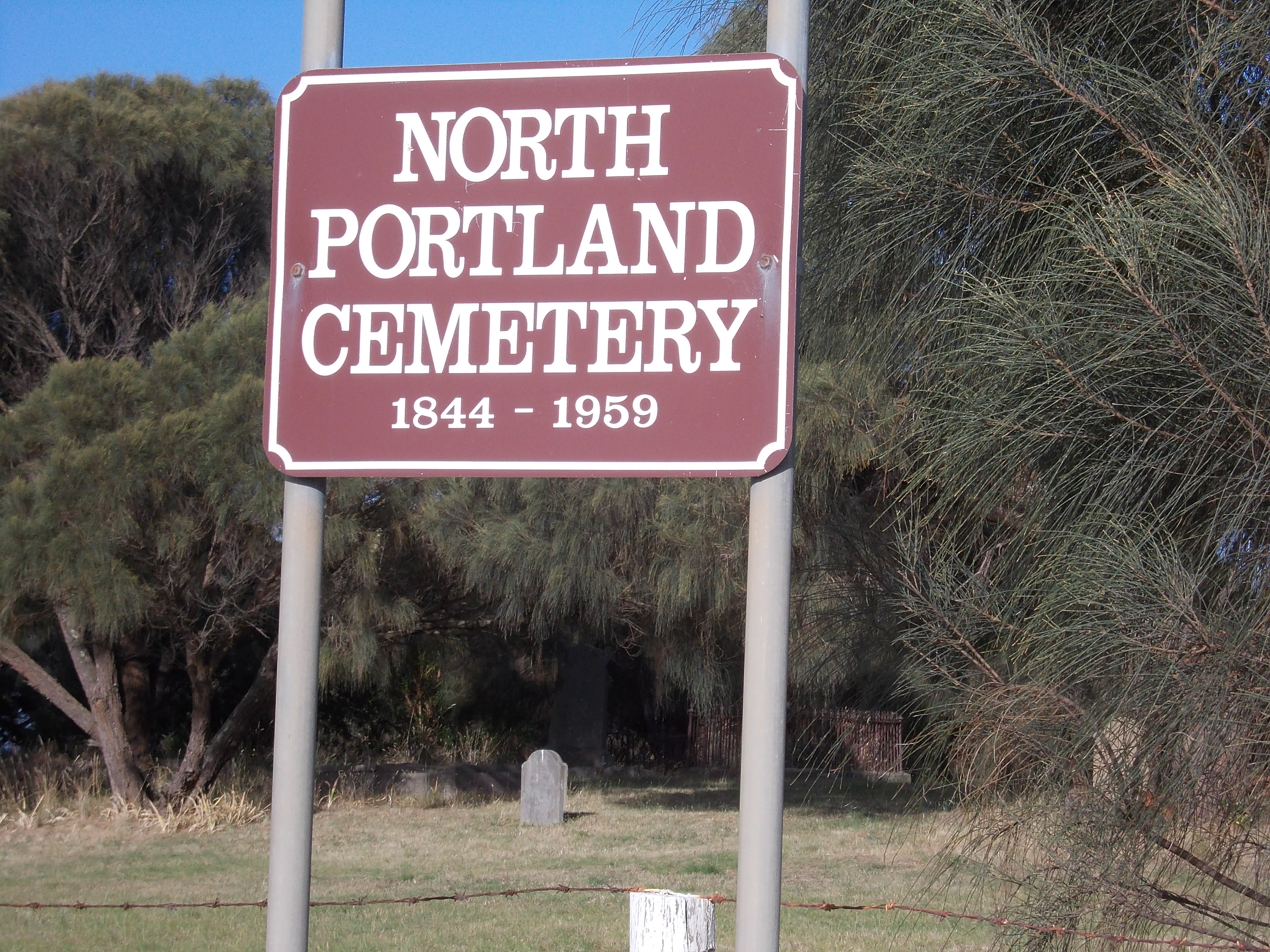
During our holiday to Portland in January, we visited the North Portland Cemetery also known as the Old Portland Cemetery. Thanks to a handy brochure I picked up at the Tourist Information Centre it was something we could do as a family.
The guide outlines some of the more notable graves in the cemetery. Each of those graves has a number marker. There are also arrows pointing to the next grave of interest. This made visiting the cemetery fun and educational for the small research assistant. Finding each of the numbered graves and reading the corresponding information in the brochure kept his interest on our circumnavigation of the cemetery.
The number one grave is the Robb family memorial. William was a local stonemason.
Robb Family Grave
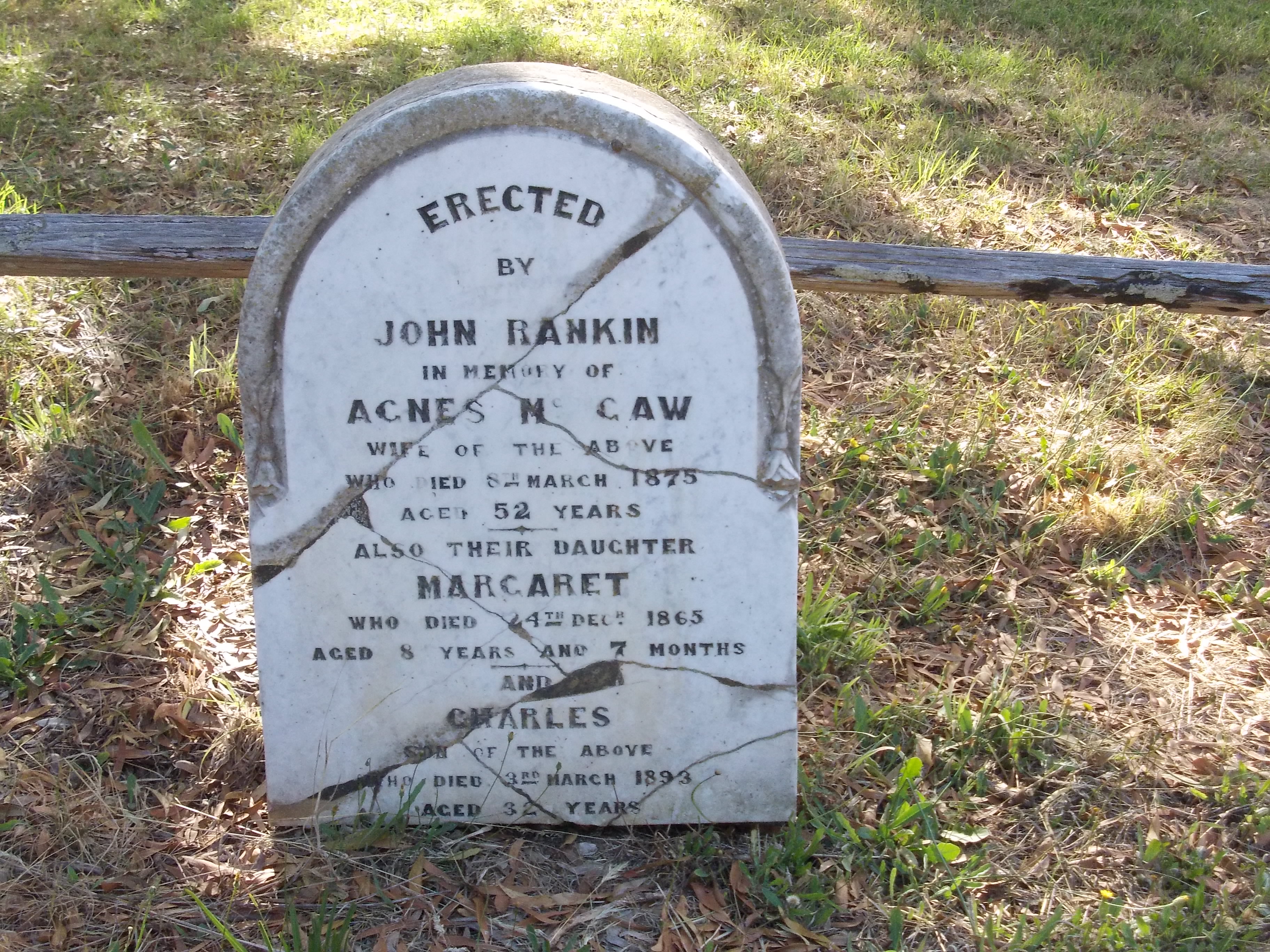
Despite fires in the past, the wooden fence around the Rankin grave still stands, the last of its kind in the cemetery. The grave belongs to Agnes, Margaret and Charles Rankin
Several members of the Haggestton family lie in the Haggestton plot. Frederick, Sara, Joseph, and John Haggestton, the children of Joseph and Mary Haggestton and Joseph and Mary themselves are all buried here. At the time of Joseph senior’s death in 1907, he owned several properties around Portland. Nineteen properties, including The Royal Hotel, were auctioned on 20 February 1908. The Haggestton headstone was vandalised, along with others, in 1986. It was restored by Parker & Sons, a Portland stonemason.
HAGGESTTON FAMILY GRAVE
The graves face out over Portland Bay where many of those buried first entered Victoria.
This unusual headstone dates back to 1841 before the cemetery opened. It belongs to six-year-old Henrietta Earls. Her mother Harriet was also buried in the plot in 1854.
Every two months I’m reminded that I must take out a subscription to Inside History magazine. As my genealogy friends tweet with delight that the postie has arrived with another fabulous issue, I must wait until it arrives at my local newsagent.
Issue 10 has been no different. As Inside History gave us a sneak peek of another wonderful cover, I once again kicked myself for not subscribing.
Worse still, I find myself with more of an anxious wait this time around. “Western District Families” is one of the Top 50 “must follow” genealogy blogs included in Jill Ball’s article”Entering the Blogosphere”.
Jill’s blog Geniaus is a favourite and one of the first genealogy blogs I read, so to be included among Jill’s own favorites is a thrill. Thank you, Jill!
I have told you about the original Harmans of Byaduk and their time in Cambridgeshire, their journey to Australia, and their life beyond. What I haven’t told you about is the family members that were left in England.
Yes, Joseph and Sarah Harman had children that did not make the voyage to Australia, thus never getting the opportunity to live the long and prosperous lives of their siblings.
For most of the children, it was death that robbed them of the life-changing experience. For Mary Ann, the eldest living daughter, it seems marriage and children sealed her fate.
The children of Joseph and Sarah that did not travel to Australia were:
James: Born 1827, Cambridgeshire, Died 1827, Cambridgeshire
Mary Ann: Born 1829, Melbourn, Cambridgeshire; Died 1873, Poplar, London.
Alfred: Born 1833, Melbourn, Cambridgeshire; Died 1851, Melbourn, Cambridgeshire
Arthur: Born 1842, Melbourn, Cambridgeshire; Died ?
Ann: Born 1847, Melbourn, Cambridgeshire; Died ?
Betsy/Elizabeth: Born 1849, Melbourn, Cambridgeshire; Died ?
James was first born of Joseph and Sarah but he died as a baby. Alfred was the fourth born child and he appears on the 1841 England Census. His death was registered in January 1851 thus missing the 1851 England Census.
It was that census in 1851 that Arthur, Ann and Betsy appeared, all born after the 1841 England Census. The question is, what happened to them between 1851 and 1854 when Joseph and Sarah and three children sailed for Sydney? I have not found death or marriage records for these three children.
Second born child and eldest daughter, Mary Ann was married in 1847. Her husband was James Loats, who was living with his family in the same street as the Harmans, Drury Lane, Melbourn. After their marriage, they continued to live in Drury Lane in their own house.
At the time, none of the family would have even heard of Australia let alone considered making it their home. However, on three occasions from 1852, Mary-Ann said goodbye to family members beginning their journeys to Australia. It began with James and his new wife Susan sailing on the Duke ofRichmond in 1852. Then the three boys, George, Jonathan, and Reuben.
In 1854, the last goodbyes came when her parents sailed. Around this time Mary Ann was living in London. Maybe she was at the docks.
Mary Ann and James had 10 children that I can match on the various census and vital records. The first three children were born in Melbourn, with the remaining seven born in London. James was working as a labourer at a coke oven. Mary Ann died in 1871 at just 43 leaving four children under 10. Aside from her brother Reuben, all the siblings that immigrated to Australia lived to around double that age.
Recognition of the Harman family is clear with the names of the Loats children. Julia again proves a popular Harman name, possibly the earliest record of that name in the family.
Betsy/Elizabeth: Born 1849, Melbourn, Cambridgeshire
Julia: Born 1851, Melbourn, Cambridgeshire; Died 1856
Harriet Sarah: Born 1852, Melbourn, Cambridgeshire; Marriage: Charles George Hazell, 1874 West Ham, London; Died:
Mary Ann Harman: Born 1854, Camberwell, London
Wilfred: Born 1857, Camberwell, London; Died 1857 Camberwell, London
Julia Mary Ann: Born 1858, Rotherhite, Surrey; Died 1900 Holburn, London
Laura: Born 1861, Bromley Middlesex
Grace: Born 1864, Bromley Middlesex
Joseph Harman: Born 1867, Poplar, London
Jesse: Born 1868, Bromley, Middlesex
I had always hoped I might find an Australian link through the Loats line, especially as I know of the name from the Hamilton area. I have found two links.
Firstly, aboard the Dukeof Richmond with Susan and James Harman was Thomas Loats, the brother of James. Thomas settled in the Western District. It makes me wonder how close James and Mary Ann may have come themselves to settle in Australia. What stopped them?
Secondly, thanks to the granddaughter of Joseph and Sarah Harman, Harriet Sarah Loats, I have found a link taking a Harman descendant where none have gone before. However, this post has gone on long enough and I will need to dedicate a whole post to my exciting find. Stay Tuned! (That might be a clue).
April Passing of the Pioneers reminds me how much can be learnt about Western Victorian history from reading pioneer obituaries. This month sees some prominent men of 19th century Western Victoria, James Dawson, James Thomson, and John Kirby.
I am also learning more about the wonderful homesteads dotted throughout the Western District. The Monivae, Longerenong, and Mt. Koroite Homesteads are all mentioned this month. If you click on the homestead name in the obituary, the link will take you through to the Victorian Heritage Database and relevant homestead’s listing.
James DAWSON: Died 19 April 1900 at Camperdown. James Dawson was born at Linlithgow, Scotland in 1806. His mother, Johannah Park, was a niece of explorer Mungo Park. James left Scotland in 1840, bound for Victoria. He initially purchased a property on the Upper Yarra at Melbourne, but later bought a property at Port Fairy. He erected a house he had brought in pieces from Scotland. The property was known as Kangatong Estate. While there, he commissioned artist Eugene von Guerard to paint nearby Tower Hill.
He sold the property and moved to Keilor then Camperdown. After two years away in Scotland, James returned and was appointed Protector of Aboriginals, a role that saw his greatest contribution to Victorian history. He was also an honourary superintendent of the Society for the Prevention of Cruelty to Animals and amateur taxidermist. A large collection of his taxidermy was presented to the Museum connected to the Melbourne Mechanics Institute.
William BAILEY: Died 25 April 1906 at Ballarat. Born in about 1828, William arrived in Victoria in 1848. He went to Ballarat during the gold rush and remained there until his death. he Ballarat papers were speculating at the time of his death the value of his estate, thought to be £400,000 thanks to mining and squatting. He had a number of children who had been successful including Stephen who was a station owner at Orange N.S.W. The boys were also good cricketers.
Margaret Bennett MARTIN: Died 22 April 1909 at Portland. The wife of Mr Francis Findon Levett, Margaret Martin was eighty-five years old at the time of her death. She had been in Victoria since her early teens. She had many stories about the early days of the Portland district.
James ALGIE: Died 17 April 1910 at Stawell. Jame Algie was a veteran of the Crimean War. He was born in Glasgow around 1832 and joined the 71st Highland Light Infantry from Glasgow in 1849 and served in Greece and India. He lived in Stawell for forty years.
Thomas CLOHESY: Died 24 April 1910 at Hamilton. Thomas Clohesy had been in Victoria since 1871. He made the journey from Ireland with his father and brother, but sadly his father passed away on the voyage. He at one time worked at the estates of the Chirnside brothers. In 1894, he married Mary Jeanes. Thomas and Mary were buried at the Hamilton (Old) Cemetery.
GRAVE OF THOMAS AND MARY CLOHESY, HAMILTON (OLD) CEMETERY.
James THOMSON: Died 25 April 1910 at Hamilton. James Thomson was born in Balnachole, Scotland in 1823. He and his wife travelled to Australia in 1852. With him, he brought sheep farming experience which he tried, first at Edenhope in a partnership and later at Hamilton at the well known Monivae estate. James purchased Monivae in 1870 from the estate of Police Magistrate Acheson Ffrench. The property was 18,000 acres and James ran Angus cattle and Lincoln sheep. The Victorian Heritage Database lists he also bred rare Scottish ponies, collie dogs and goats.
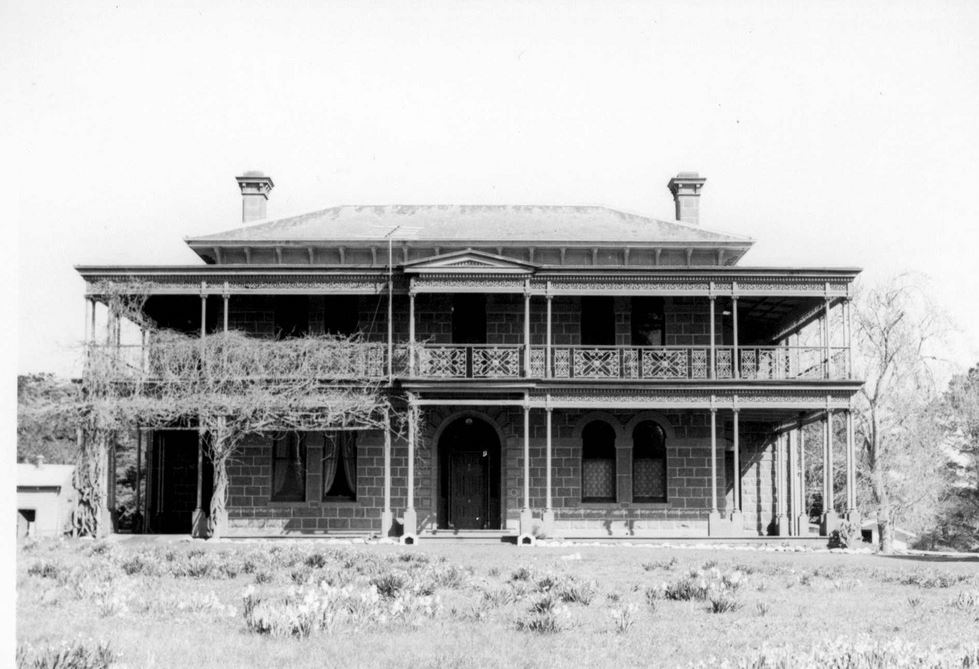
MONIVAE 1966. Image courtesy of the J.T. Collins Collection, La Trobe Picture Collection, State Library of Victoria. Image no. H97.250/44 http://handle.slv.vic.gov.au/10381/230077
I have an interest in the history of the Monivae property and it’s homestead as I attended Monivae College in Hamilton which, for a short time in the 1950s, ran the school from the homestead before moving to the current site. The school retained the Monivae name. At school, we learnt a lot about Acheson Ffrench, the original owner, but I knew nothing of James Thomson’s links to the homestead. Ffrench named Monivae after Monivaea Castle, his father’s castle in Galway, Ireland.
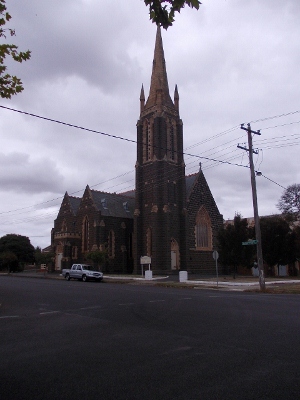
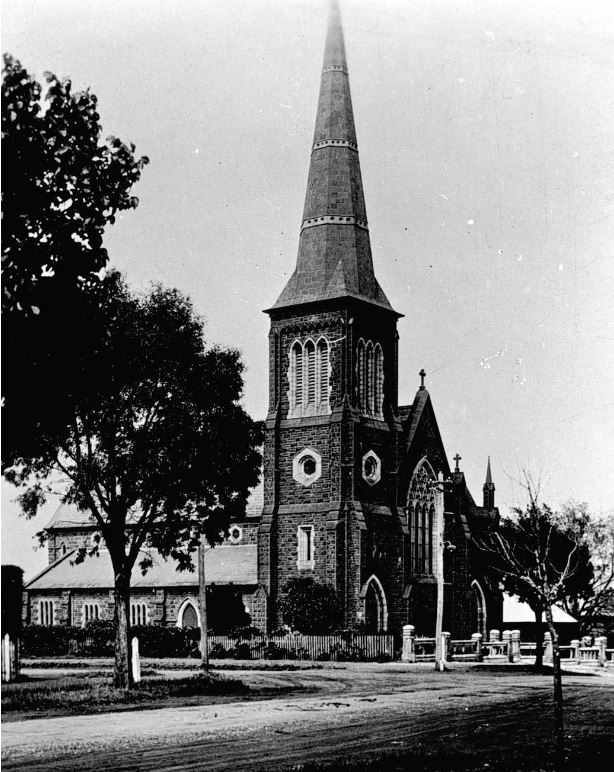
I discovered, thanks to the Victorian Heritage Database, that James Thomson built the existing Monivae homestead, known as “Old Monivae”, rather than Ffrench. Ffrench had lived in another home on the property and it was later left empty by Thomson. The bluestone for the new homestead was taken from a quarry on the property. James also donated bluestone for St. Andrew’s Presbyterian Church, which stands with the Hamilton Anglican Church on Hamilton’s “Church Hill”. Their spires are landmarks on the Hamilton skyline. Nana and several other Haddens were married at the Presbyterian Church.
St. Andrew’s Presbyterian Church, Hamilton
James Thomson was buried at the Hamilton (Old) Cemetery.
James INGLIS: Died 12 April 1914 at Ballarat. James Inglis ran the Ballarat coachbuilding business of J. & J. Inglis. with his brother John. His father started the business in 1860 after he took his family from Melbourne to Ballarat. James was just three at that time. The original business was at Market Square but later moved to nearby Creswick Road.
Robert DALGLEISH: Died 12 April 1914 at Learmonth. Robert Dalgliesh arrived in Ballarat around 1850 from his native Roxboroughshire, Scotland. He tried his luck on the diggings, brought property with his brothers, then returned home to Scotland in 1856. In 1860, he was back and bought a property at Learmonth, Salwick Hall“, from his brother. It was there he died in 1914.
William UREN: Died 19 April 1914 at Berringa. Before travelling to South Australia with his wife during the 1860s, Cornish-born William spent time in Chile, South America. He and his father worked in silver mines. While in South Australia he worked in the copper mines before moving to Ballarat. He was a shift boss at the Midas and Lone Hand mines.
Agnes LUNDY: Died 16 April 1916 at Horsham. Agnes came to Australia from Scotland during the 1860s and worked for Sir Samuel Wilson at Longerenong near Horsham. That is where she met her future husband, William McClintock. William was a cousin of Sir Samuel and worked as an overseer at Longerenong. They remained at Longerenong for some time, before William bought land and bred fine woolled sheep and thoroughbred horses.
Sybil GAIN: Died 28 April 1921 at Horsham. Sybil Gain was ninety years old at the time of her death and was one of the Horsham district’s oldest pioneers. She arrived in Victoria from Scotland during the 1850s. She married three times. Her husbands were John Morrison who she married at nineteen, William Knipe and John Gillies. Gillies was a pioneer of the flour milling industry at Horsham while Sybil was a foundation member of the Horsham Presbyterian Church.
John RUNDELL: Died 19 April 1925 at Condah. Born in Cornwall around 1840, John Rundell was a well-known member of the Condah community. He arrived as a child aboard Birmingham with his parents and spent time with his father at the Ararat goldfields. He married Matilda Hardy upon his return. Matilda later died and John married Agnes Willling. John was a road contractor and spent many years building roads between Portland and Hamilton for the Shire.
Catherine HANLEY: Died 12 April 1929 at Hamilton. Catherine Hanley was an early pioneer of the Portland district, having arrived in Adelaide around 1856 from Donegal, Ireland. It was in Adelaide that she married her husband, James Ball in 1858. They then journeyed to Portland where James farmed. After the death of James Ball, Catherine moved to Hamilton.
Hannah HATHERELL: Died 13 April 1934 at Lyons. Hannah Barr would have had some great pioneering stories to tell. She and her husband ran the first and apparently the only hotel in the Lyons/Greenwald area.
Eliza FEATHERBY: Died April 1934 at Hamilton. Eliza was born in England and travelled to Portland with her parents aboard the Flora McDonald. While in Portland she knew Stephen, Edward and John Henty and had many stories to tell about them. She moved with her parents to Coleraine and after her marriage to John Molloy in 1867, she moved to Hamilton. She was a devout Roman Catholic and crocheted an altar cloth for the St. Marys Church, Hamilton.
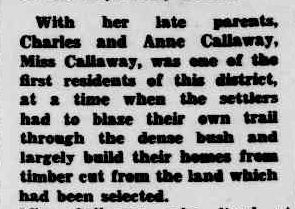
Eliza CALLAWAY: Died 3 April 1942 at Maryborough. Eliza was the daughter of Charles and Anne Callaway and was born in Amherst, Victoria in the mid-1860s. During the 1870s, the Callaways moved to the Heytesbury Forest near Timboon where Charles selected 240 acres. He cleared the land and grew hops until red spiders began destroying the crops.
John Finn KIRBY: Died 7 April 1942 at Portland. John Kirby was quite a man. Born at Springbank Casterton in 1858, he completed his schooling at Ballarat College. He then worked for seven years as a stock and station agent in Ballarat, before returning closer to home in 1882 to work as a stock and station agent at Coleraine. He eventually bought the business.
Among his many positions around the district, he was both a Councillor and three-time president of the Wannon shire. He was a chairman of directors of the Western District Butter Factory Ltd. and a Justice of the Peace. John was a talented sportsman and excelled as a footballer, including a stint in the metropolitan league. Probably his greatest sporting achievement was as a racehorse owner. His horse TheParisian won the 1911 Melbourne Cup. He also had success with a steeplechaser, Napier which won the Great Eastern Steeple at Oakbank, South Australia, and the Grand Annual Steeplechase at Warrnambool.
John Kirby married Elizabeth Crowe in 1885. They resided in the Mt. Koroite homestead overlooking the Coleraine racecourse. The Victorian Heritage Database mentions extensive renovations to the homestead after Parisian’s success in the Cup.
John was buried at the Coleraine Cemetery (below).
KIRBY FAMILY PLOT, COLERAINE CEMETERY
Robert Arthur LIGHTBODY: Died April 1949 at Drik Drik. Robert Lightbody was the third son of the wonderful Rebecca Kitson remembered in the January Passing of the Pioneers. Robert had fine clerical skills and was a Justice of the Peace, secretary of the Drik Drik Butter factory, Drik Drik P & A Society, Drik Drik school, Drik Drik Repatriation committee and the Drik Drik cricket club. As if wasn’t busy enough, he was also a local preacher of the Methodist church for sixty-five years. His wife, Ellen Jones, must never have seen him. All that activity must have contributed to him living to the ripe old age of ninety-three.
A little while ago I came across a great video on YouTube that I have been saving for a suitable time to share. This week I found another with a similar theme. As this is ANZAC Day, I thought it was the perfect time to share the videos. Each is about small Western Victorian towns remembering those who served in World War 1. One is the story of the restoration and revitalisation of the old and the other, the unveiling of the new.
Beau Nieuwveld’s video was impressive, not only because of the story it told but it was great to see a teenage boy with an interest in his town’s history. Not only that, his video was the overall winner of the 2009 10MMM Youth Film Festival held in Hamilton.
Beau’s town is Dartmoor in the south-west of Victoria. Faced with the dilemma of many other towns, the trees in the Avenue of Honour were deteriorating. How could the integrity of the Avenue be maintained while ensuring the safety of the residents?
The result is fantastic. Family members of the soldiers with memorial trees were happy and the town now has a great tourist attraction! For more information about the Dartmoor Avenue of Honour, check out the Glenelg & Wannon Settlers website http://www.swvic.org/dartmoor/avenue.htm
On October 31, 2009, the people of Rupanyup in the Wimmera, celebrated the unveiling of a new memorial to remember local men who served with the 4th Light Horse at Beersheba on October 31, 1917. One of those, Colonel James Lawson is given special recognition on the memorial.
I love this video because of the community spirit it depicts. Rupanyup is a town of under 800 people and I think they were all there on the day. I am assuming, but can’t be sure, that those depicting the Light Horse soldiers were members of the Creswick Light Horse Troop, a fantastic group of people keeping the memory of the Light Horse alive.
To see the horses at the ceremony is moving as one remembers the heroics of not only the soldiers but also the horses. The bond between man and horse was deep.
This is the second year I have participated in the ANZAC Day Blog Challenge. It is a privilege to share the stories of my family members who went to war. The stories of the men and women who served their country in each of the wars should never be forgotten.
Reading the World War 1 service records of my 1st cousins 3x removed, brothers, John, James and Albert McClintock one thing was obvious. The great adventure of war soon became a nightmare for the McClintock family of Grassdale near Digby.
Head of the family, John McClintock was born in Ireland in 1842. He arrived in Victoria in 1865 aboard the Vanguard. Somehow he ended up in the Digby area and in 1878 he married Sarah Ann Diwell, my ggg aunt and daughter of William Diwell and Margaret Turner. The following year, daughter Margaret Ann was born and in 1880, son David was born. Life seemed good for the McClintock family.
In 1882, the first tragedy befell them. Sarah passed away at just thirty-one. John was left with two children aged just three and four. Help was close at hand. In 1883, John married Sarah’s younger sister, Margaret Ann Diwell. At twenty-six and fifteen years John’s junior, Margaret went from aunt to mother to Margaret and David. In 1885, the first of eleven children were born to John and Margaret McClintock. A son, William Diwell McClintock died as an infant in 1887 but by 1902, when the last child Flora was born, Margaret and John had a family of six girls and six boys.
In 1913, a seemingly harmless activity of chasing a fox ended in another tragedy for the McClintocks. Eighteen-year-old Robert died from heart strain and tetanus as a result of his fox chasing.
Next was the outbreak of war in 1914 which paved the way for the greatest tragedy faced by the family. Three of the five McClintock boys, John, James and Albert, enlisted. Of the remaining two boys, David was too old and Thomas was too young.
JAMES RICHARD McCLINTOCK
James was the first of the McClintock boys to enlist. In Melbourne on 7 October 1915, the twenty-four-year-old signed his attestation papers and effectively signed his life away.
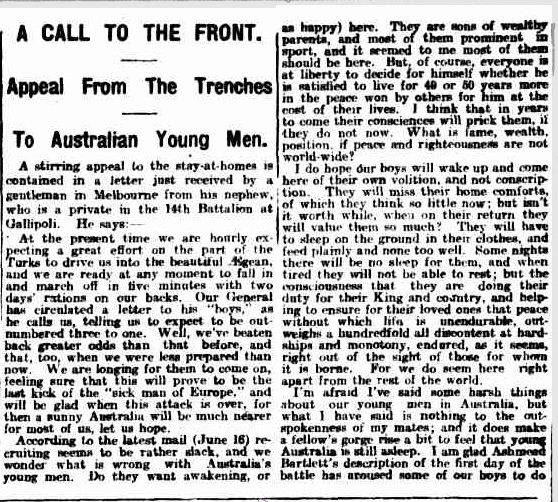
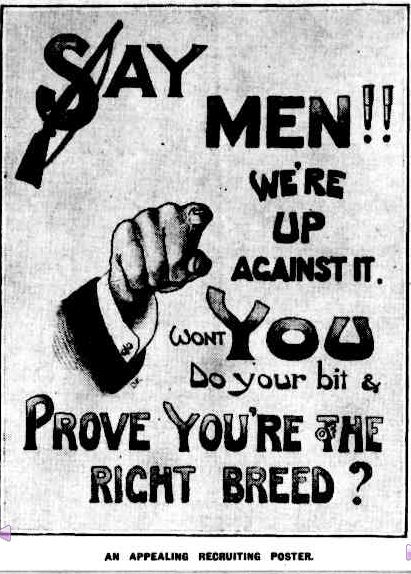
At the time, those of eligible age were bombarded with propaganda designed to drive recruitment. The horrors of war had already been felt at home with the Gallipoli landing earlier in the year. The recruitment campaign went to a new level. War was no longer the big adventure it was made out to be. Rather men were urged to fight in honour of their fallen countrymen who had died for them. Recruitment posters were everywhere and articles such as this from The Argus of 16 September 1915, must have gone a long way to persuading James to enlist the following month.
A CALL TO THE FRONT. (1915, September 16). The Argus (Melbourne, Vic. : 1848 – 1956), p. 5. Retrieved April 20, 2012, from http://nla.gov.au/nla.news-article1560597
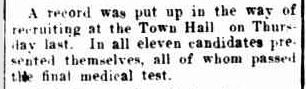
On 27 January 1916, James was given a send-off by the Digby community.
A Digby Recruit. (1916, January 27). The Casterton News and the Merino and Sandford Record (Vic. : 1914 – 1918), p. 3 Edition: Bi-Weekly. Retrieved April 19, 2012, from http://nla.gov.au/nla.news-article74484539
James sailed on 7 March 1916 aboard the HMAT Wiltshire with the 24th Battalion 10th Reinforcement. He arrived in England on 26 July 1916, and later France at Sausage Valley south of Pozieres on 5 August 1916. The 24th Battalion had been in France since March after arriving from Egypt. Previous to that the battalion had been at the Gallipoli landing in 1915.
On the day of his arrival, the 24th had seen action with casualties. They moved on from their position, making their way around the Somme before reaching Mouquet Farm on 23 August. The battalion settled in, digging trenches while they could. The noise of shelling was all around them.
THE FIGHT AT MOQUET FARM. (1916, August 31). Townsville Daily Bulletin (Qld. : 1885 – 1954), p. 4. Retrieved April 21, 2012, from http://nla.gov.au/nla.news-article58914119
The following day, the battle intensified. The 24th Battalion received an estimated fifty casualties. James McClintock was one of those
Details surrounding his death were sketchy, so much so, his father employed the services of Hamilton solicitors, Westacott and Lord. On his behalf, they requested details of the death from the defence department to finalise necessary paperwork. As of November 1916, the final report on James’ death had not been received. It was clear his remains had not been found. He now lies below the former battlefields of the Somme with no known grave.
James is remembered at the Villers-Brettoneaux Military Cemetery. The cemetery has the remains of soldiers brought from various burial grounds and battlefields when it was created after Armistice. It also has memorials for those missing and with no known grave. James is one of 10,885 listed with such a fate.
Anxiety at home must have increased after news of the death of James. It was too late to talk John and Albert out of going to war. They had already arrived in England preparing to also travel to the battlefields of the Somme. At least John and Margaret would have been comforted that twenty-six-year-old John would be there to look after his younger brother.
ALBERT EDWARD McCLINTOCK & JOHN McCLINTOCK
John and Albert McClintock shared their World War 1 journey. They would have been spurred on by the enlistment of James and maybe envy that he was setting sail on 7 March 1916. The recruitment drive was in full swing and what man would not have felt that he was less of a man if he did not enlist?
Albert enlisted six days before his brother John. At nineteen, he filled in his enlistment papers at Hamilton on 25 February 1916.
STREET APPEAL AT HAMILTON. (1916, February 26). The Ballarat Courier (Vic. : 1914 – 1918), p. 4 Edition: DAILY. Retrieved April 20, 2012, from http://nla.gov.au/nla.news-article74502118
John was married and living at Wickliffe with his wife Selina Miller Ford. They had married a year earlier. At the time of John’s enlistment, it is unlikely that the couple knew they were expecting their first child, due in December. Maybe John knew by 4 July, when he and Albert boarded the HMAT Berrima and sailed for war with the 29th Battalion 7th Reinforcements.
John and Albert disembarked in England on 23 August 1916. During December, back home, John’s wife Selina gave birth to their son, John James, his second name a tribute to his fallen uncle.
After time in England, Albert and John arrived in Etaples, France on 4 February 1917. On 9 February, they marched out into the field. The 29th Battalion unit diary notes their location on February 9 as Trones Wood near Guillemont and only ten kilometres from Mouquet Farm.
The battalion was not involved in any major battles at the time. It was at the Battle of Fromelles in 1916 and later in 1917 were a part of the Battle of Polygon Wood, but John and Albert had arrived between campaigns. During February 1917, members of the battalion were laying cable in the area around Trones Wood.
What exactly happened, three days later on the 12th, is not clear, however, the outcome saw both McClintock boys fighting for their lives with gunshot wounds to their faces. John’s service record notes the injury was accidental. He also had shoulder injuries and a fractured left arm. Albert lost his right eye and had an injured left arm and a fractured right leg. They were relocated over the next twenty-four hours to the 1st New Zealand Stationary Hospital at Amiens.
On 17 February, John and Albert’s war-time “adventure” together would end. Albert was transferred from Amiens to the 13th General Hospital at Boulogne, leaving John fighting for his life at Amiens.
On 1 March 1917, John McClintock passed away from his wounds. He was buried at the St Pierre Cemetery at Amiens. Both boys said goodbye to France on the same day, as it was that day that Albert sailed for England. After only twenty days in the country, and no active fighting, one had lost his life and the other had suffered life changing wounds.
On 28 February 1918, over twelve months after the incident, Albert was discharged from Harefield House Hospital, north of London, the No.1 Australian Auxiliary Hospital. He remained in England until May when he returned to Australia.
Digby. (1918, July 25). The Casterton News and the Merino and Sandford Record (Vic. : 1914 – 1918), p. 3 Edition: Bi-Weekly.. Retrieved April 19, 2012, from http://nla.gov.au/nla.news-article74221588
So Albert was home and the war had ended. Life was expected to go on. On the outside that is what it did. There would have been some brave faces at the welcome at Digby.
Albert married Doris Hancock around 1920 and they raised a family of seven. He died in Digby in 1970 aged seventy-four.
John’s wife Selina never remarried and remained in Wickliffe most of her life, finally passing away in Adelaide in 1960. John jr enlisted in WW2 but was discharged early. For Selina, there was a constant reminder of John’s sacrifice on the Wickliffe War Memorial.
Parents John and Margaret McClintock did not live long past the war. The loss of one son would have been enough for any parents to bear, but two would be heart-wrenching. Another tragedy bestowed them with daughter Flora passing away in 1921 aged just nineteen. John passed away in 1923 aged eighty and Margaret in 1932 aged seventy-four.
On the inside, those people could never have been the same as they were before the war. In Albert’s case, the loss of an eye and memories of his short time as a soldier would have lived with him forever. For the others, the deep loss each suffered must have been immense.
This story interested me in a number of ways. In particular the timing and the locations of the McClintock brothers while in France. They were each there for such a short time and in similar towns and villages.
Maybe, in those last days before the departure of James, the brothers talked about meeting up somewhere, sometime during their war adventure. They were very close. James was killed only six months before John and Albert arrived in the same area of France he had fallen. They marched the same roads. Maybe at some time they did in some way pass each other by. As John and Albert marched to Trones Wood they could well have passed the final resting place of their brother James.
Today, John and James lay around forty kilometres away from each other in France. Albert is buried at Digby, thousands of kilometres away from his brothers, but I am sure he left a part of his heart in France the day in left in 1917.


























 Western District Families
You must be logged in to post a comment.